"There is so much writing in English on Japanese cinema that can't be accepted at face value — not because the writers are careless, but because the differences in culture and language are just too intricate. When I see August Ragone's name on a piece of writing, it gives me permission to place my faith in it completely. Among Japanese fantasy film historians, he's the best working in English." —Tim Lucas, Video Watchdog

Showing posts with label Kenji Sahara. Show all posts

Sunday, May 12, 2013

UPDATE ON "ULTRA Q: THE COMPLETE SERIES"!
Specs for Shout! Factory's Upcoming Release


Iconic opening title animation will remain in beautiful B&W!

With the release of the news of Shout! Factory's impending release of ULTRA Q (see previous blog entry), there has been wild speculation on internet concerning the contents of this forthcoming set — since the series was remastered for HD 1080p and colorized for the domestic Japanese Blu-ray release by US-based Legend Films (who handled the colorization work on Ray Harryhausen's B&W classics) — since Shout! Factory's page for listed this title as being "color."


Ziggy Namegon and the Mollusks from Mars are slimier in B&W!

Now, the the truth can be told; according to Shout! Factory's VP of Acquisitions and Production, who spearheaded licensing the rights to ULTRA Q and ULTRA SEVEN, "I've seen it on (the check) discs; (our release will be) in B&W." So, there you have it; this release of ULTRA Q will be in it's original chiaroscuro color format, which made it so atmospheric — therefore, we can assume that the aforementioned colorized version will not be included in this release.


Yuriko and Jun, can't believe their ears — it's in Japanese!

Also, since there were no other details on neither the Shout! or Amazon listings, rumors began swirling that perhaps the "lost" English language tracks produced back by Film House Inc. in Toronto, back in 1966, might also be included — since they were unearthed as a result of the research on my book a few years ago. Cliff's reply was short and to the point: "(This release) is in Japanese with English subs."


Garamon is a-gog that he's finally going to be discovered in the US!

Containing all 28 B&W episodes on six discs (with a total running time of 690 minutes), the street date for ULTRA Q: THE COMPLETE SERIES is August 13, 2013 with an MSRP of $59.97. Format: NTSC. Region Encoding: Region 1. Includes extensive on-screen liner notes by Yours Truly on the development and production of the series. You can pre-order from Shout! Factory or Amazon, today!

Friday, May 10, 2013

SHOUT! FACTORY UNLEASHES "ULTRA Q"!
Seminal Sci-Fi Series on US DVD August 13th

伝説の特撮番組『ウルトラQ』は米国DVDで登場!


Shout! Factory's package design for the forthcoming DVD release.

THE TRUTH CAN FINALLY BE TOLD... ULTRA Q is coming to DVD in the US from on August 13th! Eiji Tsuburaya's seminal 1966 science fantasy series, which spurred the creation of ULTRAMAN, is finally receiving its long-overdue release in North America, thanks to Cliff MacMillan of Shout! Factory, who has pushed through releases of the original GAMERA film series, neglected movies such as MESSAGE FROM SPACE, and tokusatsu teleseries, including ULTRA SEVEN and JOHNNY SOKKO. Details as to the contents of this release have yet to be officially announced, but I was contracted to provide content for their momentous home video releases of ULTRA Q and ULTRA SEVEN back in 2011.

So, for those unfamiliar with ULTRA Q, here's what I wrote for the DVD package copy:

“For the next 30 minutes, your eyes will leave your body and arrive in this strange moment in time…” In the world of ULTRA Q, the very fabric of nature is warped into a state of unbalance, and all manner of strange phenomenon and unearthly creatures threaten the very future of mankind! On the scene are a world-renowned scientist and his young friends — a female photojournalist, an aviator, and his co-pilot — who investigate these supernatural menaces. When sheer military might is futile, the intrepid team comes to the rescue, armed solely with their ingenuity and scientific prowess, to quell these malevolent forces and restore the balance of nature.

The precursor to ULTRAMAN, ULTRA Q is a seminal science-fantasy television series in the monstrous mold of THE OUTER LIMITS and THE X FILES. As deeply ingrained in Japan’s pop culture as THE TWILIGHT ZONE is in America’s, ULTRA Q is available for the first time ever in its entirety on DVD! Eiji Tsuburaya, the visual effects wizard behind GODZILLA, RODAN, and MOTHRA, creates a spectacular cavalcade of bizarre beasts and mass mayhem in each and every episode of this wildly popular series. Never before broadcast in North America, ULTRA Q stars Kenji Sahara (RODAN), Hiroko Sakurai (ULTRAMAN) and Yasuhiko Saijo (SON OF GODZILLA).

As with previous Japanese releases from Shout!, I wrote extensive liner notes on the making of the series, which will *not* be in a booklet this time, but rather on one of the actual discs, itself (which you scroll through to read). This essay contains numerous facts about the development, production, and even the lost English Dubbing, never before published in English! But, it's the fans who make these things happen — so please support these releases from Shout! — because, if you don't support them with your dollars, those "Bean Counters" in the front office will be led to believe there's no market in the US for these films and television series! So, order "ULTRA Q: The Complete Series" today!

Stay tuned for more information as it is cleared for release!

• Pre-order ULTRA Q from Shout! Factory 
• Pre-order ULTRA Q from Amazon

Friday, May 14, 2010

Saturday, June 14, 2008

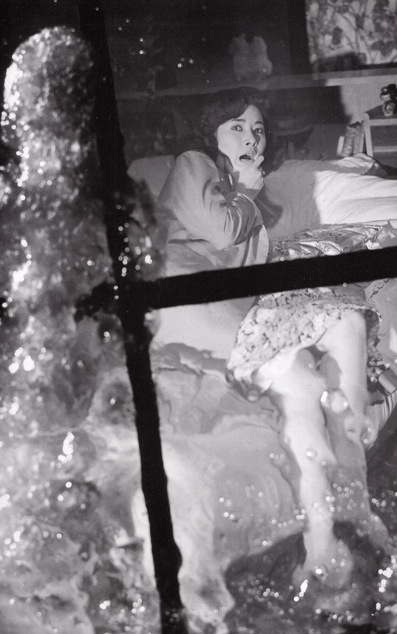
「美女と液体人間」THE H-MAN (1958)


Shirakawa's Beauty is threatened by Tsuburaya's Beast.

THE H-MAN

Bijo to Ekitai Ningen, Toho, 1958, 87 minutes
Director ISHIRO HONDA • Visual Effects Director EIJI TSUBURAYA


Often woefully mistaken for a rip-off of Irving S. Yeaworth Jr.’s THE BLOB (1958), "The Beauty and the Liquefied Man" (the film’s Japanese title) was in production long before the infamous creature feature ever hit American screens. According to official records, a former Shochiku Studios actor who was hired by Toho, under his new stage name, Hideo Unagami, submitted the story treatment that became THE H-MAN (the film’s U.S. title). His story caught the eye of producer Tomoyuki Tanaka, and was pushed through for development under the supervision of genre specialists, Ishiro Honda and Eiji Tsuburaya — thus launching Toho's "Mutant Series," incorporating Honda's THE HUMAN VAPOR (1960) and MATANGO (1963).

As with the original GODZILLA (1954), the premise of THE H-MAN was based on the real-life "Lucky Dragon" incident, where a Japanese fishing trawler wandered into the waters of the H-Bomb test site at Bikini Atoll. The crew and their catch became radioactive, and death came to several of the crewmembers as a result of poisoning from radioactive fallout. In November 1957, Tanaka, Honda and Tsuburaya finalized the story with writer Takeshi Kimura, who penned the screenplays for RODAN (1956) and THE MYSTERIANS (1957). The pessimistic Kimura was put in charge of fleshing out Unagami’s treatment, and created a world where the law is only a thin veil that differentiates the police from organized crime.

This mixture of detective story and science fiction was not new to the Japanese; "Tantei Shosetsu Henkaku" (or Irregular Detective Fiction) took root in the 1920s with the rise in popularity of such pulp magazines such as Shinseinen (New Youth) and Kagaku Gaho (Science Pictorial), where this sub-genre originated. The first movies in this vein were Daiei Studio's THE RAINBOW MAN and ENTER THE INVISIBLE MAN (both 1949), the latter with inspired effects work created by Tsuburaya. While Toei made Rampo Edogawa’s juvenile stories, Boys Detective Gang, into a series of films between 1954-1958, THE H-MAN was far more adult; with its mixture of seedy nightclubs, lurid characters and drug smuggling — akin to similar "Anokokugai" (Underworld) pictures pouring out of post-war Japanese studios, such as Seijun Suzuki's UNDERWORLD BEAUTY (1958).

Honda paired Kenji Sahara and Yumi Shirakawa for the third, and last, time in THE H-MAN. Playing the young theoretical scientist, Sahara would continue to appear in many films for Honda, as well as star in Tsuburaya's classic television series ULTRA Q (1966). Shirakawa plays a Cabaret Chanteuse, and shortly thereafter was cast in such films as Yasujiro Ozu's EARLY AUTUMN (1961). She only made a handful of fantasy films after THE H-MAN, Jun Fukuda’s THE SECRET OF THE TELEGIAN (1960), Shuei Matsubayashi’s THE LAST WAR (1961) and Honda’s GORATH (1962), and then married Nikkatsu Studios star Hideaki Nitani (TOKYO DRIFTER). Cutting an imposing figure as the vile "Uchida," Makoto Sato was launched into a long career as heavies and heroes alike, despite his brutish features, and recently appeared in Takayoshi Watanabe’s DEAR HINAGON (2005).

Although there are no colossal beasts in THE H-MAN, Tsuburaya managed to conjure up some very special effects for this picture; especially eerie is the hydrogen ooze that dissolves the human victims — and when the shapeless mutants manifest into humanoid forms (most notably, during the flashback set aboard the "haunted" fishing trawler). Another remarkable visual effect is the death of Detective Sakata (Yoshifumi Tajima), when the liquefied creatures dissolve him in the cabaret. While these effects were considered somewhat shocking in 1958, even more shocking were the scantily-clad cabaret dancers, who were a little racier than allowed in mainstream American cinemas at the time. (While Columbia Pictures' trims for the U.S. release resulted in more than five minutes of footage hitting the cutting room floor, most was comprised of police exposition, the aforementioned saucy bits, and some of the shots in the sewers featuring Shirakawa in nothing more than a slip.)

To achieve the effect of the dissolving human beings, Tsuburaya had life-sized latex dummies of the actors made, and dressed them up as their flesh-and-blood counterparts. Shooting with high speed cameras, Tsuburaya’s crew literally let the air out of these dummies, and when combined with optical effects in post-production, they appear to be dissolved by the gelatinous monsters. Then, there’s the creeping ooze itself (cooked up from a special silicon compound), which was manipulated on special sets constructed to roll 60%, thus allowing the deadly miasma to threaten the cast. Tsuburaya also created some atmospheric miniature photography of the ghost ship for the title sequence and the creepy flashback, as well as the spooky lattice of sewers under Tokyo — transformed into a raging inferno, as they are engulfed in the conflagration created to incinerate the H-Men in the fiery climax.

Executive Producer TOMOYUKI TANAKA Screenplay TAKESHI KIMURA Original Story HIDEO UNAGAMI Production Design TAKEO KITA Cinematography HAJIME KOIZUMI Lighting TSURUZO NISHIKAWA Film Editor KAZUJI TAIRA Sound Recording CHOSHICHIRO MIKAMI and MASANOBU MIYAZAKI Music MASARU SATO Visual Effects Production Design AKIRA WATANABE Visual Effects Photography HIDESABURO ARAKI and SADAMASA ARIKAWA

Starring KENJI SAHARA (Dr. Masada) AKIHIKO HIRATA (Detective Tominaga) YUMI SHIRAKAWA (Chikako Arai) EITARO OZAWA (Chief Detective Miyashita) MAKOTO SATO (Uchida) YOSHIO TSUCHIYA (Detective Taguchi) YOSHIFUMI TAJIMA (Detective Sakata) TETSU NAKAMURA (Chen) NIDAO KIRINO (Shimazaki) AYUMI SONODA (Emi) NAOMI SHIRAISHI (Mineko) MACHIKO KITAGAWA (Hanae) TADAO NAKAMARU (Detective Seki) HISAYA ITO (Masaki) and KOREYA SENDA (Professor Maki)

Saturday, May 24, 2008

「空の大怪獣 ラドン」RODAN (1956)


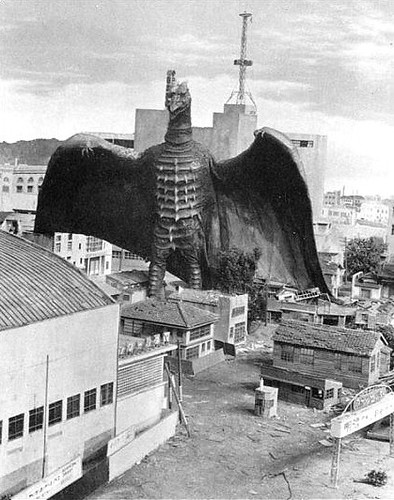
The titular monster amidst the detailed miniature set of Fukuoka.

RODAN, THE FLYING MONSTER
Sora-no Daikaiju Radon, Toho, 1956, 82 minutes
Director ISHIRO HONDA • Visual Effects Director EIJI TSUBURAYA

With the success of the first two Godzilla films under his belt, Producer Tomoyuki Tanaka looked to create a new style of monster movie to be shot in color, and solicited a treatment from mystery writer, Ken Kuronuma, who was the one of the translators for the Japanese edition of Amazing Stories magazine. Kuronuma based the core of his treatment on the unexplained, real-life "Mantell Case" of 1948, in which veteran WW2 pilot, Captain Thomas F. Mantell of the Kentucky Air National Guard, died when his aircraft crashed during the pursuit of an Unidentified Flying Object. Such a scene figures prominently in the completed film, and is cited as one of the most memorable in RODAN — one of Toho's finest genre films.

Set on Japan’s southern island of Kyushu (but mostly shot on location in western Japan), RODAN was Toho's first color kaiju eiga featuring a screenplay, written by Takeshi Kimura and Takeo Murata, which centers on two lovers whom are mirrored with the Rodan. While not appearing in Kuronuma's treatment, the murderous super-sized dragonfly larvae, or Meganuron, were inspired by gargantuan ants in Gordon Douglas' THEM! (1954), and became another memorable element of the film. Honda's direction is solid and dramatic, and much less documentarian than GODZILLA (1954), with truly creepy scenes in the dark and claustrophobic coal mine sets, and beautiful panoramic photography of the breathtaking countryside vistas. Heading up the 2nd Unit was Jun Fukuda (1923-2000), who was promoted to director in 1960 with THE SECRET OF THE TELEGIAN, and later became well-known for his stylish gangster movies and outrageous fantasy films.

Toho trumpeted that RODAN starred the "Hopes for 1957," newcomers Kenji Sahara (b.1932) and Yumi Shirakawa (b.1936), who would be paired in several pictures together after RODAN, including THE MYSTERIANS (1957). After placing second in a Toho talent contest in 1953, Sahara was a bit player until RODAN, and summarily became one of the busiest actors at the studio, appearing in over twenty science fiction films. Still active, Sahara recently appeared in the Tsuburaya Productions television series ULTRAMAN NEXUS (2004). Joining Toho in 1956, the beautiful Shirakawa appeared in several of Honda's pictures, and is still acting today. A favorite of Hiroshi Inagaki and Akira Kurosawa, the late Akihiko Hirata (1927-1984) played "Dr. Kashiwagi" and many memorable roles in Toho fantasy films, starting with "Dr. Serizawa" in GODZILLA. Even today, Hirata continues to be one of the most recognizable faces in the history of the genre.

Tsuburaya's elaborate and spectacular visual effects took up 60% of the film's entire production budget, and it's all up there on screen — from beautiful matte paintings to highly detailed miniature sets — and is still quite effective a half-century later. One of his outstanding sequences is the destruction of the Saikai Bridge, a scene that could only be shot once. A matter of precise timing, his wire operators had to pull the Rodan prop over the 1/20 scale bridge, while other crew members pulled another series of wires to collapse the bridge. Shot with several cameras in tandem (a Tsuburaya technique shared by Kurosawa), it all went off perfectly in one take. The finely detailed miniature of the Iwata-ya department store in Fukuoka City (changed to Sasebo City in the U.S. version) was built with real reinforced steel beams, in order to support the weight of monster actor Haruo Nakajima and the 150-pound Rodan costume. Scenes featuring animation of the flying Rodan being pursued by the fighter plane, or streaking through the skies, are still staggeringly realistic.

Because of the international success of GODZILLA in 1956, the U.S. rights for RODAN were immediately acquired by the King Brothers (Maurice, Frank and Herman), who are today best remembered for RODAN (as well as Eugene Lourie's kaiju eiga-styled GORGO, 1961). Starting with a complete work print, several shots excised in the Japanese version were utilized, while the H-Bomb tests seen at the top of the film came from newsreel footage. The English dialogue was written and directed by David Duncan (1913-1999), best known for THE TIME MACHINE (1960). Voice talent included the venerable Keye Luke (KUNG FU) as "Shigeru" and Paul Frees (THE THING FROM ANOTHER WORLD) as "Nishimura," while a young George Takei, who took RODAN as a summer job — his first acting gig — provided the voice for "Professor Kashiwagi" ("…and at least ten other characters — I lost count!" he recalled). Upon its release in the U.S. in July 1957, RODAN became the highest-grossing science fiction film of that year.

Despite the extensive re-editing of the film (approximately ten minutes shorter than the Japanese, and the removal of some of Ifukube's score), the U.S. version benefits from Duncan's surprisingly poetic narration, especially as the Rodans are consumed in the fiery climax: "Like moths in those rivers of fire, they seemed almost to welcome the agonies of death. The last of their kind, masters of the air and earth, the strongest, swiftest creatures that ever breathed… now, they sank against the earth like weary children. Each had refused to live without the other. And so, they were dying together… I realize now, that by the narrowest of margins, man had proved himself the stronger. But, will it always be so? May not other and more terrible monsters, even now, be stirring in the darkness? And when, at last, they spring upon us, can we be certain to beat them back a second time? That answer lies in the future. Our fears, for now, have gone up in flame and smoke."

Executive Producer TOMOYUKI TANAKA Original Story KEN KURONUMA Screenplay TAKESHI KIMURA and TAKEO MURATA Production Design TATSUO KITA Cinematography ISAMU ASHIDA Film Editor KOICHI IWASHITA Music AKIRA IFUKUBE Visual Effects Production Design AKIRA WATANABE Visual Effects Photography SADAMASA ARIKAWA [US Version] Producers THE KING BROTHERS Film Editor ROBERT EISEN English Dialogue and Director DAVID DUNCAN

Starring KENJI SAHARA (Shigeru Kamura) YUMI SHIRAKAWA (Kiyo) AKIHIKO HIRATA (Professor Kyuichiro Kashiwagi) AKIO KOBORI (Police Chief Nishimura) YOSHIFUMI TAJIMA (Iseki, Seibu News) MINOSUKE YAMADA (Constable Ozaki) RINSAKU OGATA (Goro) and HIDEO MIHARA (Japan Air Self-Defense Forces Commander)

Thursday, May 8, 2008

フランケンシュタインの怪獣 サンダ対ガイラ
THE WAR OF THE GARGANTUAS (1966)

EijiGarg
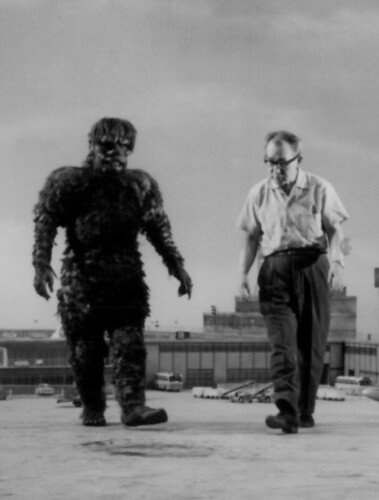
Tsuburaya directs Haruo Nakajima as Gaira, 1966.

THE WAR OF THE GARGANTUAS
Furankenshutain-no Kaiju Sanda tai Gaira (Toho, 1966), 88 minutes
Director ISHIRO HONDA • Director of Visual Effects EIJI TSUBURAYA

One of the most beloved of Toho's non-Godzilla kaiju eiga, THE WAR OF THE GARGANTUAS (Japanese title "Frankenstein's Monsters: Sanda vs. Gaira") was produced as a direct sequel to FRANKENSTEIN CONQUERS THE WORLD (1965), but this connection was obscured in the US version by co-producer Henry G. Saperstein. His reasoning was that the characters did not look enough like the Giant Frankenstein from the previous film — the four-year gap between the release of FRANKENSTEIN CONQUERS THE WORLD and THE WAR OF THE GARGANTUAS in the States, may be a better (and more logical) explanation.

The first draft of Mabuchi's screenplay featured the same trio of characters from the previous film, "James Bowen" (Nick Adams) "Sueko Togami" (Kumi Mizuno) and "Yuzo Kawaji" (Tadao Takashima), but for unknown reasons, Nick Adams was not available, and so the characters' names were changed and the parts recast, with Kumi Mizuno (MATANGO) being the holdover (as "Akemi Togawa"). Kenji Sahara, the star of RODAN (1956) and THE MYSTERIANS (1957) replaced Takashima (as "Yuzo Mamiya") and Adams was supplanted by Russ Tamblyn (THE HAUNTING) as "Paul Stewart." The rest of the cast is rounded out with the usual stable of character actors, including Jun Tazaki (ATRAGON), Yoshifumi Tajima (MOTHRA VS. GODZILLA), and Ren Yamamoto (GODZILLA).

Prominently featured in the film are the Self-Defense Forces' mobile Maser Cannons, one of the more evocative and iconic creations in the genre — a tradition that started with the Katusha Rocket Tanks in GODZILLA RAIDS AGAIN (1955), the Markalites in THE MYSTERIANS, and the Atomic Heat Ray Cannons in BATTLE IN OUTER SPACE (1959) and MOTHRA (1961). The principal behind the weapon was a concentrated microwave beam, used to disrupt the cellular structure of its targets. Designed by Mutsumi Toyoshima (the unsung genius behind some of Toho's famous "mecha"), the Maser Cannons were built upon the A-Cycle Light Ray Cannons previously featured in MONSTER ZERO (1965). The Maser Cannons were also featured in GODZILLA VS. GIGAN (1972), GODZILLA VS. MEGALON (1973), and while offshoots and variants appeared in the Godzilla films of the 1990s, the originals were revived for GODZILLA AGAINST MECHAGODZILLA (2002) and GODZILLA: TOKYO SOS (2003).

Another element that has made the film memorable was the Gargantuas themselves and the striking use of the monster suit actors' own eyes, emphasizing the physical performances of Haruo Nakajima (as Gaira, the Green Gargantua) and Hiroshi Sekita (as Sanda, the Brown Gargantua), and allowing for a realistic and unsettling effect. This element of realism is one of the contributing factors in the film's rabid cult following on both sides of the Pacific, coupled with Tsuburaya's highly detailed studio and outdoor miniature sets (roughly 1/10 scale) which achieve a greater illusion of reality — and the furious fight to the death between the monsters — making this one of Tsuburaya's best monster films. Unfortunately, Honda's original concepts concerning the Gargantuas' growth from another's cells (adding a threat of more such creatures), and the original ending, having the undersea volcano engulfing and destroying Tokyo in flaming magma (an ironic twist that Honda wanted to punctuate the ending with), were cut from the final script. Honda later stated that shooting these destruction scenes would have run the film well over budget.

There were a number of editorial changes made between the Japanese and American versions of the film that are worthy of spotlighting: Tamblyn was given more scenes for the US version, including those only featuring Japanese cast members in the original, emphasizing his central importance in the narrative (Tamblyn was also asked to loop his dialogue to remove any references to "Frankenstein"). S. Richard Krown replaced Ifukube's repetitious military march with more suspenseful stock library music cues (including cues cribbed from MONSTER ZERO), which actually help the scenes in question. And there are additional visual effects scenes, unused in the Japanese version, which were employed to great effect, and help to make the US version four minutes longer than the Japanese. Honda told the late Guy Tucker (in his 1996 book, "Age of the Gods"), "Actually, I find [the film] a little boring. I'm glad it's popular, but [I feel that it] doesn't really have much heart."

Executive Producer TOMOYUKI TANAKA and KENICHIRO TSUNODA Screenplay KAORU MABUCHI and ISHIRO HONDA Production Design TAKEO KITA Cinematography HAJIME KOIZUMI Film Editor RYOHEI FUJII Music AKIRA IFUKUBE Visual Effects Production Design YASUYUKI INOUE Monster Design TOHRU NARITA Visual Effects Photography SADAMASA ARIKAWA and SOKEI TOMIOKA [US Version]: Producers HENRY G. SAPERSTEIN and REUBEN BERCOVITCH Original Story RUBEN BERCOVITCH Dialogue Supervisor RILEY JACKSON Film Editor FREDERIC KNUDTSON Production Supervisor S. RICHARD KROWN

Starring RUSS TAMBLYN (Dr. Paul Stewart) KENJI SAHARA (Dr. Yuzo Mamiya) KUMI MIZUNO (Dr. Akemi Togawa) JUN TAZAKI (Colonel Hashimoto) NOBUO NAKAMURA (Professor Kita) YOSHIFUMI TAJIMA (Hirai, Maritime Safety Agency)) NIDAO KIRINO (Lieutenant Kazama) REN YAMAMOTO (Saburo Kameda) and KIP HAMILTON (Nightclub Singer)