さらば、新宿昭和館よ!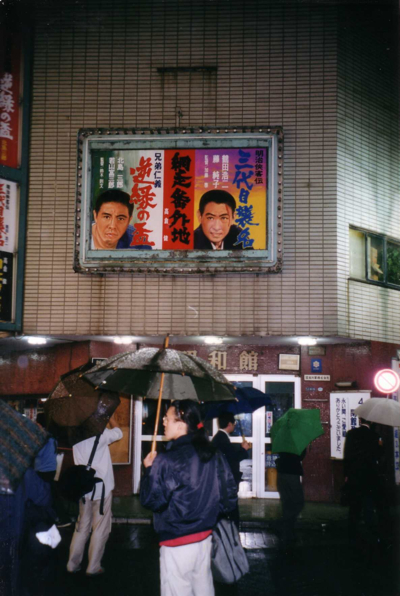 The final marquee on April 30, 2002.
You could call it progress or you could call it an atrocity, but time and money march on, and as a result, we have now lost a treasure for Tokyo movie fans. Early in 2002, an announcement was made that the historic, infamous and largely ignored Shinjuku Showakan theater was to be closed after fifty-one years of unbroken screenings.
The reason for the closure? The theater could no longer support its operating costs, so the controlling members of the family-run business decided to go into a more lucrative venture with the property. Pachinko Parlor, anyone? Seven Eleven? Time marches on, destroying valuable institutions like the Shinjuku Showakan in the process.
One of the last of the old-time postwar cinemas in metropolitan Tokyo, the Showakan originally opened in 1932 and featured screenings of foreign films from Europe and America (when Japan later allied itself with Germany, all foreign films were banned). During the closing days of World War 2, the theater was flattened, along with the entire city, in the incendiary waves of fire bombing raids by United States Army Air Force B-29s.
Miraculously, the Showakan was rebuilt during the American Occupation and reopened for business in 1951 (about twelve months before the seven-year occupation ended), and began exclusively screening Japanese-produced motion pictures; mostly period chambara (swordplay) and ninkyo eiga, films made about heroic and honorable Yakuza at the turn of the century.
The new Showakan featured two screens; the main screen in the street-level theater, which had a capacity of 451 (including balcony seats), and the Chika Gekijo or "Underground Theater" (literally, not figuratively) was built under the main theater and was accessible through a separate entrance on the side of the main building.
After the Occupation, the Showakan began screening more daring and racy films — later to evolve into the pink eiga (soft-core porno films) — in their Underground Theater. The smut continued for decades to come, becoming a tradition that hung to the end as well (no pun intended). For at least twenty years, three new triple-bills of these 60 to 70 minute films were screened weekly.
This was also true for the Showakan proper — three new film programs, each and every week. During the late 1960s and 1970s, when the Showakan started specializing in yakuza eiga, it was the yakuza themselves who kept the theater going by patronizing the screenings in droves. As a side-effect, things would get hairy when they demanded free entry or brawls would break out in the auditorium! So authentic was the yakuza atmosphere of the theater that Toei Studios shot scenes for their films inside the Showakan.
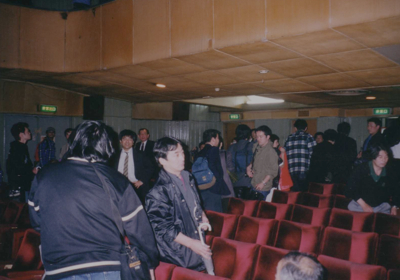 The lights come up after the climatic screening.
 A wealth of Japanese cinema history on and off screen — a place that should have been made into a shrine, if not declared a national landmark — was about to come to an end. The closure of the Shinjuku Showakan was coming, ironically, 13 years after the death of its namesake, Hirohito: The Showa Emperor, who reigned from 1925 to 1989.
Upon hearing the news of the closure, I made sure to attended the last two weeks of screenings at the Shinjuku Showakan theater on my most recent trip to Tokyo. After all, it was my obligation. I had been attending screenings at the theater since the mid-1980s, when I first lived in Japan. At first I was not sure if I'd like Yakuza movies, the now-defunct Kokusai Theater in San Francisco's Japantown never screened them — sticking to mostly to
chambara and
jidaigeki (fedual period) films.
But, I was seduced into the Showakan by the inclusion of the Sonny Chiba vehicle GANGSTER COP (Yakuza Deka, directed by Yukio Noda) on the bill. I was ill-prepared for Sadao Nakajima's THE IDIOT, THE UNTAMED AND THE THUG (Bakamasa Horamasa Toppamasa, 1976) — starring Bunta Sugawara — which blew me away. I wasn't the same person who entered the Showakan — that damned theater changed me.
Fast forward to the April 23, 2002: When I arrived in Tokyo, I was both excited to be a witness to the end, yet almost too sad to actually go through with it. It was like visiting a terminal relative on their deathbed and arriving in time only to see them as they draw their last breath.
Well, I bucked up and went by the theater the second day I was in town just to look at it. To just stare at Showakan to ready myself and see what films were playing on the second-to-last triple-feature before the end. Shinichi "Sonny" Chiba, Junko Fuji and Bunta Sugawara — a great lineup of stars graced the marquee and posters — their stern faces stared back at me, daring me to enter. Tatsuichi Takamori's YAKUZA WOLF: I BRING YOU DEATH (Okami Yakuza Koroshi-wa Ore-ga Yaru, 1972) — interestingly, a more FEMALE CONVICT SCORPION film than Chiba's usual actioners — Kosaku Yamashita's RED PEONY: FEMALE GAMBLER (Hibotan Bakuto, 1968) — the first in a long-running series — and Kinji Fukasaku's first entry in the seminal (can we use that word too much?) BATTLES WITHOUT HONOR AND HUMANITY (Jingi-naki Tatakai, 1972) series. Taking a deep breath, I made up my mind to attend the following night — the screening before the next (and last) change.
The next evening, I stood outside the Showakan for a long time just watching, just drinking in what was soon to be gone. The
gomoku ramen settling in my stomach made me feel relaxed. One, two, three cigarettes. The last screening was about to begin. I snuffed out my Lucky Strike and walked over to purchase a ticket. After handing my ticket for resident illustrator Happy Ujihashi to tear, I entered the auditorium like it was Midnight Mass at the Vatican.
Soon, the films began to unspool as if the Showakan's impending doom was not coming. As for attendance, it was three-quarters full (I didn't check the balcony), and featured the usual suspects: salarymen,
oyaji (old guys), some winos and a smattering of young hipsters. Strange. Young people in Japan hate old Japanese films, don't they? Meanwhile, the old coot who sat nosily behind me during Chiba's big finale, soon began snoring — but, it wouldn't be the Showakan without it. It somehow felt... right.
 The balcony filters out at curtain call.
At curtain call, I stood in the lobby for a couple of minutes just drinking it all in, savoring each sight and sound. The walls, the floors and the tiles of the Showakan. Outside of the theater, I gulped down a Pocari Sweat, and then lit up a Lucky Strike. One cigarette, followed by another — just soaking up the atmosphere and the glare of the bulbs of the condemned Showakan. Finally, I walked away, but kept looking back.
Taking the Yamanote Line back to my
ryokan (Japanese Inn) I was somehow elated... But, soon I started to realize that tomorrow would herald the beginning of the end. Melancholy began growing inside me. I somehow had to prepare myself for the inevitable, so I avoided going to see any other films before the Showakan's closure, and satisfied myself by rummaging through Tokyo's movie memorabilia shops — dwelling deep in the nostalgia for Japan's postwar Golden Age of Motion Pictures. You can smell the musty movie posters, can't you?
The night of nights finally came. The Showakan closed Tuesday, April 30 — the final triple-bill was Teruo Ishii's ABASHIRI PRISON (Abarashi Banchigaichi, 1965), the first entry in the 18-film series starring Ken Takakura and Tetsuro Tamba, One of Norifumi Suzuki's early efforts, BROTHERHOOD CODE: OPPOSITE SIDE OF THE SAKAZUKI CUP (Kyodai Jingi Gyakuen-no Sakazuki, 1968; 7th entry in the 9-film series) starring Saburo Kitajima, Tomisaburo Wakayama and Bunta Sugawara — and Tai Kato's monumental BLOOD OF HONOR (Meiji Kyokyakuden Sandaime Shume, 1965) with Koji Tsuruta and Junko Fuji. All were beautiful prints, for their age, and the audience was enthusiastic — there were more hipsters of all ages, who seemed out-of-place among the salarymen and oyaji.
Hey, there was even another whitey there as well: The Unknown Clown. Well, at any rate, that's what I always called him — a wacky gaijin expat who can be seen riding his bike through Shinjuku in full clown regalia (apparently, he's been doing this at least since the 1980s, when I first spotted him)! He came to the last show dressed for the occasion replete with a feathered mane fanning out from a plastic Tiger Mask matsuri mask! Oh, he brought beers, too, and sat right in front of me. "Hey, pass the Asahi Dry, please! One sip for me and one for my Homey — the Showakan."
Eventually, Shusuke Kikuchi's ending cue for BLOOD OF HONOR came to a reverberating crescendo and Showakan's curtain came down — and the house lights went up — for a final time. The capacity crowd rose to its feet in a standing ovation. It was then, through the applauding capacity crowd, that I spotted another gaijin in attendance, John Robinson (aka DJ Gnosis), who couldn't believe that the Showakan was now slipping into history.
As we stood whispering in the darkened auditorium, brilliant camera flashes combined with stunned silence and streaming tears for several minutes. Conversation began as the staff ushered everyone into the lobby, where we were sent off with sincere volleys of honto domo arigato (thank you very much) and gymnastic-like repetitions of deep bows as we left the Showakan for the last time.
About forty or more attendees, stood outside in the funeral-like drizzle, as if we were waiting for a Buddhist Priest to arrive and give the Showakan it's last rites. After a few minutes, the staff came out and thanked everyone for our support and performed another deep bow. Camera flashes. More tears. The doors were then shut for the last time. Hold on, August, hold on...
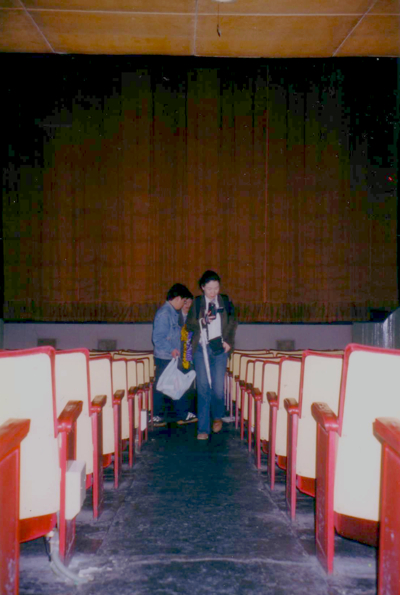 The last moviegoers leave the Showakan in silence.
Gradually, the flashes died down, and the crowd slowly and quietly departed one-by-one, or in small groups. At the very end, several people stood around talking about Old Skool Japanese films or the Showakan. Soon, I was the only person standing and staring at the end of an era — another chapter of Japanese cinema history now closed. Forever. I am grateful that I was there, and thankful for all the years of entertainment the Showakan has provided die-hard Japanese Cinemaniacs like myself — we were truly lucky.
Now, it was all over.
There are still two theaters left in Tokyo that specialize in screening Old Skool Japanese films. But, it is ironic that the Showakan closes as the younger Japanese movie fans are just starting to check out their own cinema history. "Since the Showakan closing was announced, attendance had gone up. Lots of the hip and trendy started coming... Too little, too late," observed John Robinson.
There may be some hope for the future — during my visit, there were ongoing tributes to Masamura Yasuzo, Japanese silent films, and other Old Skool Japanese pictures going on during Golden Week. A theater in the Nakano Ward was doing a series tribute to Toei's ninkyo yakuza films, while the Toho Asakusa Theater was screening an All-Night tribute to the films of Ishiro Honda: DOGORA THE SPACE MONSTER (1964), FRANKENSTEIN VS. BARAGON (1965), THE WAR OF THE GARGANTUAS (1966), GORATH (1963) and KING KONG ESCAPES (1967). These were pretty cool events and helped to ease the pain in the wake of the Showakan.
Perhaps these hipsters who starting turning out for the Showakan's Swan Songs, are also patronizing the others theaters still holding on. Hopefully, they will bear the torch for the coming generations of film fans, so that these wonderful gems of Japan's Golden Age of Cinema will not go silently into the night.
But still, the Showakan is gone. I am grateful that I was there to help honor and send her off into history. Long live the Shinjuku Showakan!
 The doors of the Shinjuku Showakan being locked forever.Orignally written and published on my former website, Henshin! Online, in August of 2002. All photos by the author.