『フランケンシュタイン対大ダコ』の物語
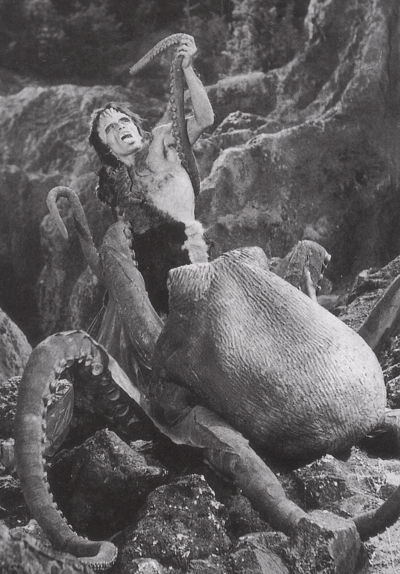 Mystery! Colossal Frankenstein vs. Giant Devilfish! ©Toho Co., Ltd.
One of most oft-asked questions by fans of Japanese Fantasy Films fans on both sides of the Pacific is "What happened to that monster octopus that the giant Frankenstein was supposed to fight in FRANKENSTEIN CONQUERS THE WORLD?" For American fans, this question was originally raised due to and article (with accompanying photos) that appeared in "Famous Monsters of Filmland" #35 (later reprinted in #114 in 1975) as a sneak preview for the film's 1966 Stateside release by American International Pictures.
Readers of "Famous Monsters" discovered that the film was allegedly envisioned as "Frankenstein vs. the Giant Devilfish," according to Forry Ackerman's uncredited piece. Two stills accompanying the article featured this confrontation, but when we went to go see the film in theaters, no Giant Devilfish unspooled before our eyes. In fact, there were no fish of any kind in the picture at all (unless you count what was offered for lunch in the Toho's commissary).
So, while leaving the Grand Theater's triple feature in 1973 of ISLAND OF TERROR (1966), THE PROJECTED MAN (1967), and FRANKENSTEIN CONQUERS THE WORLD, I took a look at the display case again, and sure enough - as in "Famous Monsters" - there was a still of Frankenstein engaged in a water-struggle with a mammoth octopod! Did I miss something when I had to heed Nature's Call? Was I distracted by the other kids bouncing off the walls? Boy, was I a confused little monster kid, and was probably as confounded as Uncle Forry himself was.
Now the truth can be told! The "Devilfish" did indeed exist and it actually mixed it up with the hulking Frankenstein Giant. But first, let's take a step back to the evolution of the picture itself, known in Japan as FRANKENSTEIN VS. BARAGON (1965).
The Toho Motion Picture Company having met critical success with the hybrid "Irregular Fiction" (read:
Science Crime Drama)/"Mutant Film," Ishiro Honda's THE HUMAN VAPOR (1960) - planned a sequel in which the Vapor Man brings the body of his beloved Fujichiyo to a practicing descendant of the original Dr. Frankenstein. The project was entitled, "Frankenstein vs. The Human Vapor", penned by Takeshi Kimura (MATANGO), never got past the screenplay stage. But, Frankenstein did not wait long, when producer John Beck presented Toho with Willis O'Brien's "King Kong vs. Frankenstein", although it was not meant to be. The concept was quickly eyed by Toho as a return vehicle for their own titan of terror, and responded with KING KONG VS. GODZILLA (but that's another story).
With the success of KING KONG VS. GODZILLA (1962), Toho opined that another western monster to pit against theirs should be their next film, but the tremendous cost of licensing King Kong from RKO (more than the cost to produce the picture itself), and had them looking for less expensive options. Eventually, they came back to "Frankenstein", since Mary Shelly's book was in the public domain. But, how would Toho come to pit the towering Godzilla against Frankenstein's human-sized Prometheus?
"Frankenstein vs. Godzilla," scripted by Shinichi Sekizawa (MOTHRA) contained elements that would be employed in FRANKENSTEIN VS. BARAGON, but ended with Godzilla being washed out to sea in a huge flood, while Frankenstein is consumed by the collapsing earth around him. With Sekizawa off to penning KING KONG VS. GODZILLA, the Frankenstein project ended up in the hands of Kimura. The president of United Productions of America, Henry G. Saperstein, after purchasing MOTHRA VS. GODZILLA (1964) and successfully licensing it to American International Pictures as GODZILLA VS. THE THING, became interested in the Giant Frankenstein scenario. Saperstein tapped Reuben Bercovitch (HELL IN THE PACIFIC) and Jerry Sohl (THE TWILIGHT ZONE) to flesh out a synopsis that could be turned into a screenplay.
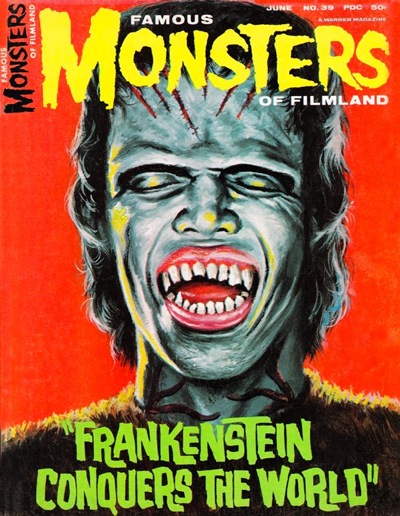 The cover story that confused the world! (Art by Vic Prezio)
The final screenplay for FRANKENSTEIN VS. BARAGON concerned Nazi Germany handing over a trunk containing the immortal heart of the Frankenstein Monster to the Japanese in the last days of the war. Berlin was about to fall, and the Nazis didn't want such a precious scientific treasure to fall into Allied hands - perhaps wounded and dying soldiers could be cured by the secret of the Monster's Immortal Heart. But, sometime after the trunk arrived in Hiroshima, the city would meet the end of the war: The Atomic Bomb. The Immortal Heart, irradiated with all the horrific energy released by the destruction, began to mutate and grow a new body among the ruins of the vaporized city.
Soon, FRANKENSTEIN VS. BARAGON went into preproduction with Saperstein supplying a name American star to the proceedings. Toho wanted David Jansen, due to his high-profile status in Japan from his hit teleseries THE FUGITIVE (and were also courting COMBAT star Vic Morrow). Unfortunately, Jansen backed out at the 11th Hour, and next in line was Oscar-nominee Nick Adams, who had a hit series on the air in Japan, THE REBEL (1959-61). Adams also seemed more youthful and cheerful than Jansen on screen and he was given the role of Dr. Bowen. The script would somewhat follow Sekizawa's in basic structure, but drawing from ideas by Bercovitch and Sohl, and replacing Godzilla with a new antagonist: the subterranean monster, Baragon. But what about the Giant Devilfish?
According to an interview with director Ishiro Honda in "Toho Monster Graffiti" (Kindai Eigasha, 1991), FRANKENSTEIN VS. BARAGON "...was a co-production between Japan and America; if I remember correctly, it was with Benedict Productions [UPA's overseas production moniker]. You see, the money [budget] came from over there [laughter] ...so, there was an order from Benedict requesting us to add this octopus [to the last scene], and we complied - although we wondered about the logic that was involved, having this octopus popping out from the mountains [laughter]."
Kimura's screenplay: After defeating Baragon, with the raging fire swirling around him, Frankenstein begins to feel the ground beneath him heaving, as if it were alive. Suddenly Drs. Bowen, Togami and Kawaji notice than the giant is sinking into the ground, the massive battle having weakened the very earth itself. Slowly, Frankenstein disappears from sight; Dr. Bowen and party look on with subdued shock.
"Frankenstein is finally dead," sighs Togami.
Kawaji interjects, "He can't die. His heart will live forever."
Dr. Bowen adds, "He may be better off now; he couldn't live in this world."
The "Devilfish" was added to the script for the US version only (Honda would never allow such an outrageous occurrence in his cut):
After defeating Baragon, and with the raging fire swirling around him, Frankenstein hauls the carcass to the end of a high precipice, and tosses the corpse into a ravine, where it is buried in an avalanche. Suddenly, from out of nowhere, a giant octopus from the craggy rocks, to which Dr. Bowen exclaims "A Devilfish!"
The mammoth octopus attacks the Frankenstein giant. Finally, worn from his exhausting battle with Baragon, the giant is pulled into a lake by the creature, and still fighting, sinks beneath the waters, apparently to his death. Dr. Bowen and party look on in subdued shock.
"Frankenstein is finally dead," sighs Togami.
Kawaji interjects, "He can't die. His heart will live forever."
Dr. Bowen adds, "He may be better off now; he couldn't live in this world."
Honda prepared the sequence for the Japanese version, having veteran voice actor Goro Naya dub Adams' line "A Devilfish!" with "Daidako-da!" (It's a giant octopus!), and scoring it with Akira Ifukube's cue for the colossal cephalopod in KING KONG VS. GODZILLA (1962). Ultimately and ironically, the footage did not end up in either the Japanese or US versions of the film - following Kimura's script to the letter. The only difference in the two versions are several sequences that were specifically shot for the US version that would make Frankenstein appear more aggressive than the Japanese version, which portrayed him as a complete victim of a world he did not make and becoming aggressive only to save people threatened by the hungry wrath of Baragon.
Then, so why did Saperstein want to add this damned octo-thing into an already action-crammed finale in the first place? According to Director Honda: "Well, abroad the octopus was apparently supposed to be something demonic [a devilfish]; besides, [Benedict Productions] said that the special effects shot by [Eiji] Tsuburaya - the aforementioned Giant Octopus scenes in KING KONG VS. GODZILLA - were so spectacular, that no matter what, please shoot a scene like that for our film." To paraphase United World News reporter Steven Martin, "Perhaps Saperstein had too much sake."
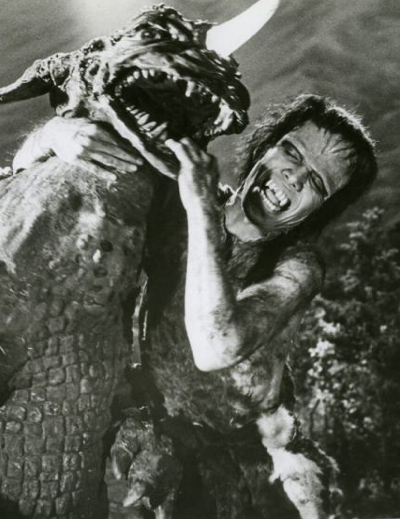 Both versions end with the defeat of Baragon. ©Toho Co., Ltd.
For many years both Japanese and American fans were under the impression that the other's version contained the "missing devilfish," and both were wrong. It was not until 1983 when this author was given a VHS copy of the sequence by renown kaiju artist, Yuji Kaida, who was attending the San Diego Comic-Con. Two years later, Toho Video restored the footage and incorporated it into the film for their VHS and Laserdisc releases. But now, the original ending was gone! Couldn't they have just added it to the end of the tape/disc as a supplemental? Well, eventually in 1993, Toho Video did just that on a disc which also contains Benedict's "aggressive" Frankenstein scenes (unfortunately in Pan & Scan), also as a supplemental. This footage is also available on the subsequent Toho Video and Media Blasters DVD releases.
Honda lamented, "We went all the way to America for discussions with the people at Benedict [UPA], and then back again at Toho. Eventually, we ended up doing that Giant Octopus for them twice." Yes, the Giant Devilfish finally made its appearance to the world during the opening scenes of THE WAR OF THE GARGANTUAS (the very same marionette was also featured in an episode of Tsuburaya Productions' ULTRA Q, also in 1966). Guess what? Since the octo-limbed beast is seen being wrestled by Gaira - the Green Gargantua - who was an offshoot of the remains of the Frankenstein Giant... - see it coming? - it finally took place: "Frankenstein vs. the Giant Devilfish"!
And you though you were going to get away easy, didn't you?
(Updated and revised from a 1996 piece first featured in 2004 on my former website, Henshin! Online.)