"There is so much writing in English on Japanese cinema that can't be accepted at face value — not because the writers are careless, but because the differences in culture and language are just too intricate. When I see August Ragone's name on a piece of writing, it gives me permission to place my faith in it completely. Among Japanese fantasy film historians, he's the best working in English." —Tim Lucas, Video Watchdog

Showing posts with label Tohru Hirayama. Show all posts

Friday, January 16, 2015

FRIEND OR FOE? ENTER "KAMEN RIDER NO. 3"!
Discarded Rider of the '70s Revived for Today

幻の仮面ライダー3号が登場 !


New teaser art for the upcoming film introducing Rider No. 3!

Fans all know Kamen Rider V3 is the third cybernetic hero, created by Riders No. 1 & No. 2 in his own series in 1973, but the initial concept was very much different. Originally, KAMEN RIDER (1971-1973) would continue, with the 100th episode introducing a new Rider: No. 3! The character was to be an android conceived by the Double Riders to help combat the latest enemy organization, Ghost Shocker! Rider No. 3 only appearred in pages of the October 1972 issue of Tanoshii Yochien (Shogakukan Publishing) in the manga story, "No. 3 Rider vs. Black Shogun" (illustrated by Norihiko Ishikawa), where the character was created by Black Shogun to defeat the Double Riders.


Former pro-wrestler Nobuhiko Takada plays the new Black Shogun.

Ultimately, this character was scrapped and KAMEN RIDER V3 was created instead. Now, the discarded hero comes to life in Toei's upcoming feature directed by Takayuki Shibasaki, SUPERHERO WAR GRAND PRIX: KAMEN RIDER NO. 3 (Supahiro Taisen GP: Kamen Rider San-go), opening on March 21, 2015! Noting the broken manacle chains on his wrists, it seems that No. 3 may have the same origin as the '70s manga. While the Kamen Riders have traditionally mounted motorcycles, Rider No. 3 has been granted a car, to tie in with the currently-running series KAMEN RIDER DRIVE (2014) and the "Grand Prix" theme of the film.


Kamen Rider No. 3 production design. Note manacles and chains.

Meanwhile, the design and execution of the costume recalls the re-imagined titular characters featured in the theatrical films KAMEN RIDER: THE FIRST (2005) and KAMEN RIDER: THE NEXT (2007). Any direct tie-in or crossover with the previous pair of stories is unknown at present, but Toei has already produced a number of movies and series in which the "alternate realities" of the Kamen Rider Universes bleed through. Now, Kamen Rider No. 3 comes to life and becomes canon. And in spite of the wildly uneven nature of Toei's seasonal superhero movies, there's no guarantee it will be any better (or worse). Hopefully, if nothing else, the film will be entertaining.

Click to jump to the official website to see the first teaser trailer!


Sunday, February 17, 2013

2013 IS 1973: "KAMEN RIDER V3"
February 17, 1973 - February 9, 1974

へ〜んしん、V3ゃ!


Jacket for Toei Video's current DVD release. ©Toei/Ishimori Pro

The second and the highest-rated Kamen Rider series of the 1970s, KAMEN RIDER V3 was especially memorable for its non-stop action, dynamic mutant designs, exciting music score, and a solid cast led by the legendary Hiroshi Miyauchi. A Japanese university student, Shiro Kazami (Miyauchi), vows to avenge the murder of his family by taking on the sinister Destron organization. After being mortally wounded, Shiro is revived as the mighty fighting cyborg, Kamen Rider V3, to take on the ruthless Destron syndicate. An updated Kamen Rider V3 appeared in the feature, KAMEN RIDER: THE NEXT (2007).

OWN IT TODAY: All 52 English-subtitled episodes of KAMEN RIDER V3 are available on DVD from JN Productions/Generation Kikaida in one six-disc box set fully-loaded with special features, and digitally remastered sound and picture. Click here to order your copy of arguably the best Henshin Hero series of the '70s!

Wednesday, December 12, 2012

JOHNNY SOKKO AND HIS FLYING ROBOT!
Shout! Factory's Complete Series DVD Box Set


Official cover art for Shout! Factory's newest tokusatsu acquisition! 

Shout! Factory does it again! Hot on the heels of their recent ULTRA SEVEN release, comes the eagerly-awaited and long overdue home video debut of Toei TV Productions' 1967 tokusatsu series, GIANT ROBO, adapted by American International Television as JOHNNY SOKKO AND HIS FLYING ROBOT, on March 26, 2013!

Back in the days when ULTRAMAN and THE SPACE GIANTS were all the rage on syndicated television, JOHNNY SOKKO AND HIS FLYING ROBOT struck a special cord with kids. Why? Because it's tells of the adventures of a youngster and his giant robot in their fight to save the world — the ultimate boy's wish-fulfilling fantasy.

And even after 45 years, JOHNNY SOKKO AND HIS FLYING ROBOT has not lost any of it's outre, mondo-offbeat style nor it's earnest, tongue-in-cheek charm — accompanied by a swingin' jazz spy soundtrack — which set the stage for the pantheon of Toei Superheroes to come, such as the Kamen Rider and Super Sentai series.

Follow the far-out exploits of Johnny Sokko, a young secret agent with the Unicorn Peace Organization, as he battles the evil forces of the extraterrestrial dictator Emperor Guillotine, and his nefarious Gargoyle Gang! Joining the fight to save the world is an atomic-powered giant flying robot — armed with a fantastic array of super weapons — which only Johnny can command with a special remote-control watch!

Take JAMES BOND, JOHNNY QUEST, and stir in ULTRAMAN, and you get JOHNNY SOKKO AND HIS FLYING ROBOT! Created by the makers of GIGANTOR and KAMEN RIDER, all 26 action-packed episodes of outlandish adventure, colorful special effects, wild plots, outrageous villains, and even weirder monsters, Shout! Factory brings back this mind-bending classic in one complete, 4-disc box set — in all it’s uncut and unedited, English-dubbed glory — for only $39.97 MSRP.

As with ULTRA SEVEN, Shout! Factory's release of JOHNNY SOKKO AND HIS FLYING ROBOT will include a detailed liner notes booklet on the series written by Yours Truly!

"Giant Robot, use your Megaton Punch!"

Sunday, July 8, 2012

JIRO STILL CHANGING AFTER ALL THESE YEARS!
The 40th Anniversary of KIKAIDA: July 8, 1972

『人造人間キカイダー』放送開始40周年!


Original poster for the KIKAIDA 3D MOVIE! (1972) ©Toei Co., Ltd.

Riding astride his sidecar superbike, Jiro (Daisuke Ban), a young man clad in blue denim, with a guitar slung across his back, swings his arms and transforms into a red and blue combat android known as Kikaida. The yin-yang patterned android, with exposed circuitry flashing under his glass-domed head, smashes through hordes of monstrous automatons in order to save Mitsuko (Jun Mizunoe) and Masaru (Masahiro Kamiya), the children of the scientist who created him, Dr. Komyoji (Hajime Izu).

Kikaida's mission: to reunite Mitsuko and Masaru with their fugitive father, and bring down the sinister secret group known as the "Dark." This underground organization composed of monster androids, is masterminded by the evil Professor Gill (Mitsuo Ando), who plots to take over the world through subversion and violence. Only Kikaida stands in his way. But, like all legendary heroes, Kikaida has a flaw: an incomplete "Conscience Circuit," which keeps him from being the "perfect android" — a flaw that Professor Gill can exploit...

Conceived by the minds of Toei Creative Producer Tohru Hirayama and cartoonist Shotaro Ishimori, JINZONINGEN KIKAIDA (roughly translating as "Android Kikaider") debuted on the Nippon Educational Television network on July 8, 1972. This colorful, exciting and outlandish superhero series was produced by Toei Television Productions on the heels of the ratings successes of KAMEN RIDER (1971), SUPERHUMAN BAROM-1 (1972) and HENSHIN NINJA ARASHI (1972), during the "Henshin Boom" on Japanese television in the early 1970s — which spawned over 60 primetime superhero shows in less than a decade. Out of this wild cacophony, KIKAIDA still stands near the top of the heap today.

To Ishimori, this series gave him the opportunity to explore areas of the cybernetic/artifical superhero, which were rejected for the original KAMEN RIDER series. It also gave the great artist a chance to infuse the story with elements of his favorite story: "Pinocchio." The end result is a series that is a satisfying and more humanistic bookend to KAMEN RIDER. In the background of the series, Dr. Komyoji was kidnapped by Professor Gill, and forced to build legions of Dark Destructoids, before he disappears in a lab explosion, after completing his work on Jiro. His creation, made in the moral image of his deceased son, escapes with Mitsuko and rescues Masaru, and KIKAIDA's story begins in earnest. But, like many other series at this time, most of the episodes are, more or less, formulaic.

The majority of episodes generally follow the same pattern, with the amnestic Dr. Komyoji wandering in search of himself from town to town, with his children in close pursuit — aided by their comedy-relief sidekick, Ace Detective Hanpei (a descendent of the famous Iga ninja, Hanzo Hattori). Meanwhile, Professor Gill hatches another diabolical plot, schemes to recapture Dr. Komyoji, or tries to destroy Kikaida, by unleashing a new Dark Android in order to do his dirty work. Just when it seems that all is lost, the sound of a melancholy guitar announces the entrance of Jiro, who comes to thwart the Dark Destructoids' devious plans. Professor Gill counters by playing his cataleptic flute, which paralyzes Jiro, as his incomplete Conscience Circuit tries to resist the command to cross over to the Dark side. Jiro must resist the evil impulses to make the transformation to Kikaida and emerge victorious.

Interestingly, KIKAIDA changed radically with the introduction of Jiro's "brother," Saburo in Episode 36. Created by Professor Gill's greatest scientists, this knife-weilding, black leather-clad cyborg transformed into Kikaida's greatest foe: Hakaida. Stronger and more powerful than his older brother, Hakaida's "Evil Circuit" was programmed with but one mission: "Destroy Kikaida!" But, no one ever realizes the truth behind Hakaida's supremacy over his fellow Dark Destructoids: his cybernetic body is operated by a living, human brain — Dr. Komyoji's brain! It is in this last story arc of the series where the stories became more grim and less formulaic, as KIKAIDA reached its powerful and emotional crescendo.

While KIKAIDA wasn't allowed the budget to realize the ambitions of Ishimori's Dark Destructoid designs, as was achieved with KAMEN RIDER, KIKAIDA still had as much action, spirit and kinetic energy as its sister series. KIKAIDA also had something more important: a plot full of heart and soul, well-defined characters (whom you cared about), engaging subplots, and an amazing score by Michiaki "Chumei" Watanabe. To those who saw the series growing up, KIKAIDA left a great impression on its viewers and was successful enough to spawn a sequel: KIKAIDA-01 (1973-1974), both of which are still beloved today.

In the mid-'70s, KIKAIDA was aired on Japanese-language stations in Hawaii and California, and created a legion of fans who still love the show. I am Legion. Four decades later, we are still switching on to KIKAIDA!

The entire 43 episodes of KIKAIDA (plus the 3D Movie) are available on DVD, with English Subtitles, from Generation Kikaida! 

Tuesday, May 11, 2010

THE RETURN OF "KAMEN RIDER V3"!
JNP Reissues "Complete Series" DVD Box Set


©Toei Company Ltd./Ishimori Productions

Honolulu-based JN Productions/Generation Kikaida is re-releasing their KAMEN RIDER V3 DVD Box Set on May 18! This is one of the DVD projects I had the pleasure of doing for JNP/Generation Kikaida over the last decade (including KIKAIDA and INAZUMAN) released in 2005, and it's my all-time favorite superhero series from 1970s. We really went overboard with the extras on this set: I wrote detailed behind-the-scenes factoids (including biographies on all of the Guest Stars and Production Staff), two essays on the series, two complete sets of English Subtitles (one for children and the other for adults), and 71 Character Profiles (with sound bytes)! The set also boasts an exclusive interview with star Hiroshi Miyauchi, six Karaoke Music Videos, and much, much more!

According to the press release: We have answered your call. Due to numerous requests for KAMEN RIDER V3, JN Productions is proud to release a newly issued, fully-loaded “Special Edition” six-disc set which contains all 52 exciting episodes—digitally remastered, complete and uncut—and bonus features found on the “Collector’s Edition” box set. This new "Special Edition" set will be priced at $149.50—if you didn't catch the first release of this action packed series, be sure you don’t miss it this time around! The KAMEN RIDER V3 Special Edition DVD Box Set will be available exclusively in Honolulu at Shirokiya, Ala Moana Center or through the Generation Kikaida website for shoppers outside of Hawaii. Online shoppers will receive a free gift for a limited time only!

Produced by action film purveyors, Toei Studios (THE KILLING MACHINE), and the hit-making team of creative producer Tohru Hirayama Tohru (JOHNNY SOKKO) and manga author Shotaro Ishimori (CYBORG 009), KAMEN RIDER V3 is not just a superhero saga, it's a superhero opera! After witnessing the brutal murder of his family at the hands of the demonic, secret society known only as "Destron", motorcross phenom Shiro Kazami is reborn as a cyborg warrior! Exploding with breakneck action by the Ono Ken-Yukai (YOU ONLY LIVE TWICE), an exciting score by Shunsuke Kikuchi (DRAGONBALL Z), and the electrifying presence of action star Hiroshi Miyauchi (SISTER STREETFIGHTER), KAMEN RIDER V3 defined the superhero genre for a generation of Japanese television viewers.

The coolest Japanese superhero series of the 1970s, KAMEN RIDER V3 rocks!

Tuesday, May 4, 2010

HAPPY BIRTHDAY, DAISUKE BAN: MAY 5, 1947!
Actor and Star of KIKAIDA and INAZUMAN

お誕生日おめでとう、伴大介さん!


Photo: Ban Daisuke Official Website

Born on May 5, 1947 as Kiyonori Saito in Kawaguchi City, Saitama Prefecture, Ban became interested in acting while attending Meiji University and working a low-paying job in a local teahouse, Saito joined the NLT Acting Troupe, which cast him in stage plays based on the works of French playwrights. When casting KIKAIDA (1972-73), Toei producer Susumu Yoshikawa and his wife came across the headshot for the young actor, with Mrs. Yoshikawa proclaiming, “He’s the one!” After being christened “Daisuke Ban” by series architect, mangaka Shotaro Ishimori, his screen career was launched. But, after forty years in acting, he is best remembered as Jiro, the incomplete android in KIKAIDA—a role that he will be forever beloved for—not only in Japan, but also in the US (where the series was aired during the mid-1970s on Japanese-language stations).

When the production of INAZUMAN (1973-74) was delayed, the producers had Bad join Shunsuke Ikeda in the early episodes (and the series finale) of KIKAIDA 01. One of the few actors to play three lead roles in a tokusatsu series, Ban also starred as Daisuke Izumo/Ka’nin Captor 7 in NINJA CAPTOR (1976-77), before becoming Makoto Jin/Battle Cossack, one of the main characters in BATTLE FEVER J (1979-80). But, not being typecast, Ban soon was appearing in a number of other television series, including ZENIGATA HEIJI (1966-84), EDO DRAGNET (1970-92), THE YOUNG DETECTIVES (1971-76), HOWL AT THE SUN! (1972-86), THE BODYGUARDS (1974), THE GORILLA 7 (1975), SPECIAL INVESTIGATION: FRONTLINE (1977-87), HELLO! GOODBYE (1989), TRUE SCARY STORIES (1990-92), SUZURAN (1999), and SUPER QUEEN (2007).

Ban also guest starred in several tokusatsu series, as Lt. Colonel Tetsuya Yokota in Episode 81 of SECRET TASK FORCE: GORANGER (1975-77), Professor Kazuhiko Kawamei in Episode 28 of VIGILANTE ZUBAT (1977), Interpol Agent Kuroki in Episode 12 of SPIDER-MAN (1978-79), Tashiro in Episode 16 of SUKEBAN DEKA (1985), Professor Katayama in Episode 34 of MONSTER INVESTIGATOR: JUSPION (1985-86), Professor Hoshi in Episode 1 of SUPER BEAST TASK FORCE: LIVEMAN (1987-88), Ijin in Episode 11 of PSI TASK FORCE: MASKMAN (1988-89), Takayama in Episode 9 of MOBILE COP: JIBAN (1989-90), Detective Koyama in Episode 9 of SPECIAL POLICE: WINSPECTOR (1990-91), Dr. Aizawa in Episode 22 of ICARUS TASK FORCE: JETMAN (1991-92), Dr. Hideyo Inoue in ELECTRONIC SUPERHUMAN: GRIDMAN (1993-94), and Episode 34 of ULTRAMAN DYNA (1997-98).

The prolific actor’s film roles include Shintaro Katsu’s ZATOICHI (1989), Shuei Matsubayashi’s THE VICTORS (1992), Macoto Tezuka’s THE INNOCENT (Hakuchi, 1999), and Tsuruta Norio’s PREMONITION (2004). He is best known outside of Japan as Dr. Heihachiro Ikuma in Hideo Nakata’s RING (1998), Joji Iida’s SPIRAL (1998), Nakata’s RING 2 (1999), and Tsuruta’s RING 0: BIRTHDAY (2000). Ban has also appeared in several independent productions in including GRAVITY-SPEED PHANTOMS (2005) and Aaron Yamasato’s BLOOD OF THE SAMURAI (2001) and the spin-offs BLOOD OF THE SAMURAI: THE SERIES (2004) and NINJA EX (2004). He recently co-starred with fellow tokusatsu star, Hiroshi Miyauchi (KAMEN RIDER V3), as Big John Jack in Kiyohide Matsumura's GAME ACTION (2009).

In 2001, Kadokawa Publishing released Ban’s autobiography, Switch On! Android Kikaida: My Journey With Jiro.

Monday, December 15, 2008

LIGHTNING STRIKES! INAZUMAN IS HERE!!
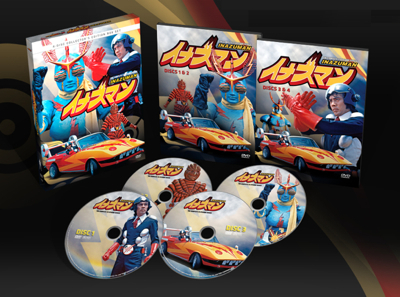
The Complete 25-Episode Series DVD Box Set

’70年代変身ヒーロー『イナズマン』のアメリカDVDに新発売!


Dynamic cover packaging by Erwin Baracao & Billy Ching of JNP.

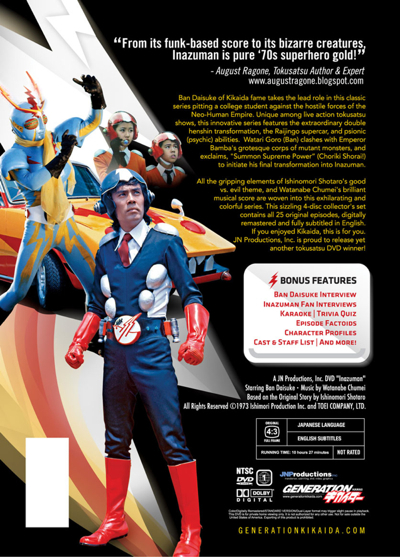
The colorful and action-packed INAZUMAN (1973) was one of many live-action superhero series produced in the early 1970s, during an unprecedented boom of such programs on Japanese television, lead out of the gate by P-Productions' SPECTREMAN (1971-72), Tsuburaya Productions' RETURN OF ULTRAMAN (1971-72), and Toei's KAMEN RIDER (1971-73). Developed for television by the KAMEN RIDER team of creative producer Tohru Hirayama (JOHNNY SOKKO) and manga author Shotaro Ishimori (CYBORG 009), INAZUMAN featured the key elements of Toei's popular progenitor, but unlike KAMEN RIDER and KIKAIDA, the hero was nether a cyborg nor an android, but rather an metamorphosing mutant with psionic powers. From it's funk-based score by Michiaki "Chumei" Watanabe to its bizarre creatures and non-stop action, INAZUMAN is pure '70s superhero gold!


Bold back cover design for JNP's release of INAZUMAN.

Goro Watari (Daisuke Ban), a seemingly normal university student, saves two youngsters from the clutches of the Neo-Human Empire, a secret society of mutants who plot to subjugate the world with their Fantom Army. The children bring him to the headquarters of the Youth League, a group of pure-hearted young mutants with psionic powers, led by Captain Sarra (Hideo Murota). Goro is awakened to his own extrasensory abilities, allowing him to transform — first into a pupal form, Sanagiman, and then — into the mighty, Inazuman. Drawing from symbolic powers of moth, like the Greek god Pysche, Inazuman wields lightning bolts against his enemies, and with the aid of the amazing flying car with a mind of its own, Raijingo, he challenges the evil minions of Emperor Bamba to liberate mankind.


The fantastic jacket and disc art for INAZUMAN.

Starring Daisuke Ban of KIKAIDA fame, INAZUMAN follows a string of fantastic classic tokusatsu releases on R1 DVD, KIKAIDA (1972-73), KIKAIDA 01 (1973-74) and KAMEN RIDER V3 (1973-74), beautifully produced and released by Honolulu-based JN Productions. Packaged in a glossy four-disc box set, INAZUMAN is digitally remastered (and superior to Toei Video's R2 release), completely unedited and uncut, and fully subtitled in English for the first time. This electrifying set also includes interviews with actor Daisuke Ban and Japanese and Hawaiian fans, Inazuman Karaoke, and more — I provided Character Profiles and Series Factoids, which feature exhaustive details on the guest stars and other behind-the-scenes minutia. With cool animated menus, superior image quality, and wonderfully produced extras, INAZUMAN comes highly recommended.

During its original run, INAZUMAN was an extremely popular series, and remains one of the pillars of the Henshin Hero genre to this day. If that's so, one might ask, why are there only 25 episodes? When INAZUMAN was originally broadcast, the saga was told in two parts, totaling 48 episodes. This DVD release features the first 25-episode "chapter", which then dovetailed into an immediate — and much darker — sequel, INAZUMAN FLASH (1974), for an additional 23 episodes. I'm hoping that — fingers crossed — INAZUMAN FLASH will be scheduled as the next release on the roster from JN Productions & Generation Kikaida for 2009. Meanwhile, the INAZUMAN Complete Series Box Set is available through the Generation Kikaida website for $99.95 (plus $7.00 Shipping & Handling).

Region Code 1 • NTSC • 4:3 Original Aspect Ratio • Japanese with  English Subtitles • Dolby Digital • 10 hours 27 minutes • Unrated

Monday, December 1, 2008

Monster of the Month
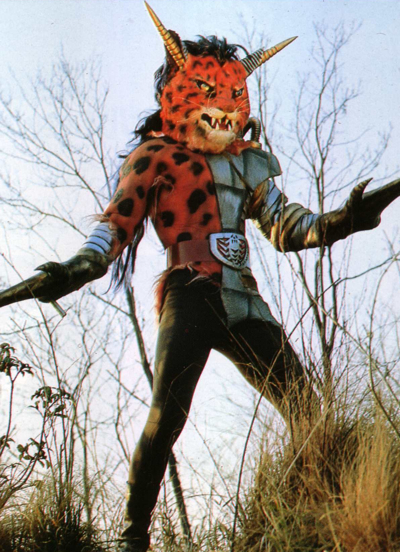
Destron Mutant: SCISSORS JAGUAR

デストロン怪人 ハサミジャガー 「仮面ライダーV3」より


©Ishimori Productions/Toei Company

Height: 194 cm • Weight: 86 kg • Origin: Atacama Desert, Chile • Original Appearance: KAMEN RIDER V3 (1973-74) Episode 1 "Rider No.3: His Name is V3!" & Episode 2 "The Last Testament of the Double Riders" • Design: Shotaro Ishimori/Akira Takahashi • Fabricator: Ekisu Productions • Suit Actor: Sadao Kobayashi • Voice Actor: Ritsuo Sawa

Surviving the destruction of Gel-Shocker, the fiendish Great Leader reorganized his forces into more powerful Destron organization. Destron’s first "hybrid mutant," fused with mechanical weaponry, was Scissors Jaguar. His mission, under Destron’s “Operation: Tokyo Annihilation”, was to eliminate witnesses of Destron’s movements, including Junko Tama, and the Kazami Family, who gave her shelter. Scissors Jaguar’s second mission was to destroy the headquarters of the Rider Boy Scouts, and its chief, Tobei Tachibana. While the tables are turned when Kamen Rider V3 arrives on the scene, Scissors Jaguar is joined by Turtle Bazooka to fight all three Kamen Riders.

Arguably, the Destron Mutants designed and created for KAMEN RIDER V3 were the pinnacle of the Kamen Rider series of the 1970s, including Scissors Jaguar. The exceptional synergy in the teamwork on this series, from Ishimori's rough sketches, refined by Takahashi, and realized by Ekisu Productions (under the guiding hand of creative producer Tohru Hirayama), rank as some of the finest ever crafted for a tokusatsu series. While there were many well-executed mutants in the series that followed, none of them had the iconic charm and dynamic look of the Destron Mutants. And you know what? They’re just cool as hell, too.