Thursday, May 15, 2008
TONIGHT ONLY! "CREATURE FEATURES" RETURNS
Don't You Dare Miss This Event Tonight in Oakland!
Classic Bob Wilkins in the mid-1970s. Has it really been that long?
WATCH HORROR FILMS—KEEP AMERICA STRONG is the new feature-length documentary all about San Francisco's fondly remembered program CREATURE FEATURES (1971-1984) is having it's world premiere — TONIGHT ONLY — at the amazing Grand Lake Theater in Oakland, CA (right across the Bay from San Francisco). This premiere event is a benefit for the "Bob Wilkins Alzheimer's Fund" to help our much beloved Horror Host with the care he needs. This man was my hero as a kid, and if you remember the show, please try to make it out — but if you can't make it, you may send in donations directly to the fund via the official Bob Wilkins website.
See last month's related story "The CREATURE FEATURES Documentary!" for more details!

Thursday, May 8, 2008
フランケンシュタインの怪獣 サンダ対ガイラ
THE WAR OF THE GARGANTUAS (1966)
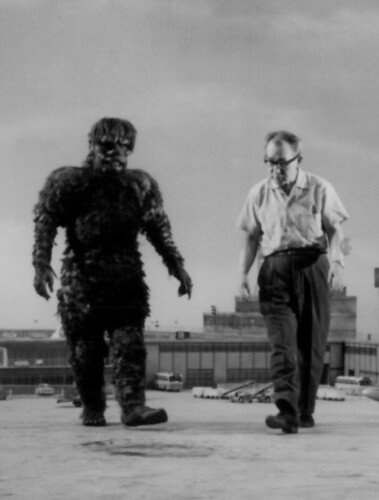
Tsuburaya directs Haruo Nakajima as Gaira, 1966.
THE WAR OF THE GARGANTUAS
Furankenshutain-no Kaiju Sanda tai Gaira (Toho, 1966), 88 minutes
Director ISHIRO HONDA • Director of Visual Effects EIJI TSUBURAYA
One of the most beloved of Toho's non-Godzilla kaiju eiga, THE WAR OF THE GARGANTUAS (Japanese title "Frankenstein's Monsters: Sanda vs. Gaira") was produced as a direct sequel to FRANKENSTEIN CONQUERS THE WORLD (1965), but this connection was obscured in the US version by co-producer Henry G. Saperstein. His reasoning was that the characters did not look enough like the Giant Frankenstein from the previous film — the four-year gap between the release of FRANKENSTEIN CONQUERS THE WORLD and THE WAR OF THE GARGANTUAS in the States, may be a better (and more logical) explanation.
The first draft of Mabuchi's screenplay featured the same trio of characters from the previous film, "James Bowen" (Nick Adams) "Sueko Togami" (Kumi Mizuno) and "Yuzo Kawaji" (Tadao Takashima), but for unknown reasons, Nick Adams was not available, and so the characters' names were changed and the parts recast, with Kumi Mizuno (MATANGO) being the holdover (as "Akemi Togawa"). Kenji Sahara, the star of RODAN (1956) and THE MYSTERIANS (1957) replaced Takashima (as "Yuzo Mamiya") and Adams was supplanted by Russ Tamblyn (THE HAUNTING) as "Paul Stewart." The rest of the cast is rounded out with the usual stable of character actors, including Jun Tazaki (ATRAGON), Yoshifumi Tajima (MOTHRA VS. GODZILLA), and Ren Yamamoto (GODZILLA).
Prominently featured in the film are the Self-Defense Forces' mobile Maser Cannons, one of the more evocative and iconic creations in the genre — a tradition that started with the Katusha Rocket Tanks in GODZILLA RAIDS AGAIN (1955), the Markalites in THE MYSTERIANS, and the Atomic Heat Ray Cannons in BATTLE IN OUTER SPACE (1959) and MOTHRA (1961). The principal behind the weapon was a concentrated microwave beam, used to disrupt the cellular structure of its targets. Designed by Mutsumi Toyoshima (the unsung genius behind some of Toho's famous "mecha"), the Maser Cannons were built upon the A-Cycle Light Ray Cannons previously featured in MONSTER ZERO (1965). The Maser Cannons were also featured in GODZILLA VS. GIGAN (1972), GODZILLA VS. MEGALON (1973), and while offshoots and variants appeared in the Godzilla films of the 1990s, the originals were revived for GODZILLA AGAINST MECHAGODZILLA (2002) and GODZILLA: TOKYO SOS (2003).
Another element that has made the film memorable was the Gargantuas themselves and the striking use of the monster suit actors' own eyes, emphasizing the physical performances of Haruo Nakajima (as Gaira, the Green Gargantua) and Hiroshi Sekita (as Sanda, the Brown Gargantua), and allowing for a realistic and unsettling effect. This element of realism is one of the contributing factors in the film's rabid cult following on both sides of the Pacific, coupled with Tsuburaya's highly detailed studio and outdoor miniature sets (roughly 1/10 scale) which achieve a greater illusion of reality — and the furious fight to the death between the monsters — making this one of Tsuburaya's best monster films. Unfortunately, Honda's original concepts concerning the Gargantuas' growth from another's cells (adding a threat of more such creatures), and the original ending, having the undersea volcano engulfing and destroying Tokyo in flaming magma (an ironic twist that Honda wanted to punctuate the ending with), were cut from the final script. Honda later stated that shooting these destruction scenes would have run the film well over budget.
There were a number of editorial changes made between the Japanese and American versions of the film that are worthy of spotlighting: Tamblyn was given more scenes for the US version, including those only featuring Japanese cast members in the original, emphasizing his central importance in the narrative (Tamblyn was also asked to loop his dialogue to remove any references to "Frankenstein"). S. Richard Krown replaced Ifukube's repetitious military march with more suspenseful stock library music cues (including cues cribbed from MONSTER ZERO), which actually help the scenes in question. And there are additional visual effects scenes, unused in the Japanese version, which were employed to great effect, and help to make the US version four minutes longer than the Japanese. Honda told the late Guy Tucker (in his 1996 book, "Age of the Gods"), "Actually, I find [the film] a little boring. I'm glad it's popular, but [I feel that it] doesn't really have much heart."
Executive Producer TOMOYUKI TANAKA and KENICHIRO TSUNODA Screenplay KAORU MABUCHI and ISHIRO HONDA Production Design TAKEO KITA Cinematography HAJIME KOIZUMI Film Editor RYOHEI FUJII Music AKIRA IFUKUBE Visual Effects Production Design YASUYUKI INOUE Monster Design TOHRU NARITA Visual Effects Photography SADAMASA ARIKAWA and SOKEI TOMIOKA [US Version]: Producers HENRY G. SAPERSTEIN and REUBEN BERCOVITCH Original Story RUBEN BERCOVITCH Dialogue Supervisor RILEY JACKSON Film Editor FREDERIC KNUDTSON Production Supervisor S. RICHARD KROWN
Starring RUSS TAMBLYN (Dr. Paul Stewart) KENJI SAHARA (Dr. Yuzo Mamiya) KUMI MIZUNO (Dr. Akemi Togawa) JUN TAZAKI (Colonel Hashimoto) NOBUO NAKAMURA (Professor Kita) YOSHIFUMI TAJIMA (Hirai, Maritime Safety Agency)) NIDAO KIRINO (Lieutenant Kazama) REN YAMAMOTO (Saburo Kameda) and KIP HAMILTON (Nightclub Singer)
Wednesday, May 7, 2008
HAPPY BIRTHDAY, DIRECTOR ISHIRO HONDA!
May 7, 1911 - February 28, 1993
誕生日おめでとう、本多猪四郎監督!
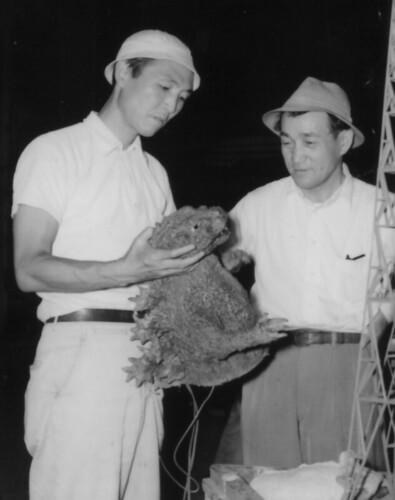
Honda (left) with Tsuburaya on the set of GODZILLA in 1954.
Honda (left) with Tsuburaya on the set of GODZILLA in 1954.
I KNOW LOWBROW ARTISTS IN HIGHBROW PLACES
Damn, I Really Love Monsters & Lowbrow Art!
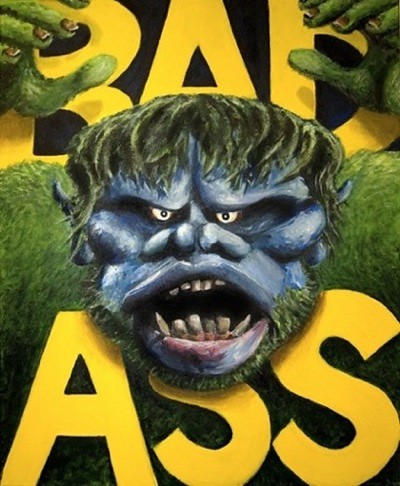
"Bad Ass." Acrylic on canvas 16" x 20." © David Durrett
A few months back, I was "knocked for a ghoul" (to paraphrase Toho's English language brochure for VARAN), when I saw one of David Durrett's pieces based on Ishiro Honda's much beloved THE WAR OF THE GARGANTUAS on a message board. I was especially struck by David's use of texture, color and caricature, which felt as if they were painted in the 1960s during the height of the Kustom Kulture boom — when Ed "Big Daddy" Roth reigned supreme with his knight errant, Rat Fink. The so-called "Lowbrow" art flooded children's hearts with monstrous glee with exaggerated bug-eyed creatures emblazoned on t-shits, trading cards, stickers and model kits. It's a style and sensibility that's been often imitated, but rarely captured.
Then came David Durrett. Born April 1964 in New Orleans, Louisiana, David is the Vice President of Client Service for the Dalton Agency, a full service ad agency in Jacksonville, Florida. A Graduate of Jacksonville University, summa cum laude in Commercial Art, he said "Right after I got out of school, all the hands-on graphics techniques I had learned gave way to computerized approaches, which was great for the industry and for clients, but didn’t appeal to me as an artist." When asked about his influences, he quickly stated, "I’ve been a lifelong fan of Al Hirschfeld, Mort Drucker (who hasn’t), and Ronald Searle. Among current popular artists I really like are Gary Baseman, Tim Biskup, Amanda Visell, and David Horvath—I have many of their toys to prove it."
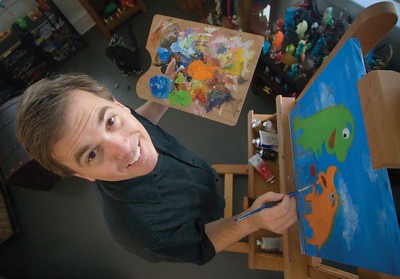
The Mad Monster Artist hard at work!
After seeing his amazing art, I had to ask why he had been "hiding" all of these years, "I’ve decided to get back into art for a number of reasons. Mainly, I’ve come to realize that my creative side is the part that’s really me, and it’s been dormant for too long. Also, the Lowbrow movement is perfect for artists with my personal history and sensibilities… suddenly, you can merge your art with the pop culture icons you’ve loved since childhood. I also am an avid toy collector, primarily of figures that render two-dimensional cartoon characters into three dimensions. That’s always fascinated me. With Lowbrow, and its offshoot Urban Vinyl, artists themselves are controlling how their characters are transformed into the third dimension, and I’m really into that."
When asked why he has started with the Gargantuas, David replied, "To so many of us, Japanese movie monsters are the stuff of our fondest Saturday morning memories, and Lowbrow gives us a chance to pay tribute as well as offer our own perspective on these characters that we view simultaneously with awe and amusement. (They’re also a lot of fun to render in acrylic.) I remember seeing THE WAR OF THE GARGANTUAS as one of the summer matinees my mother took me to at the old San Marco Theatre here in Jacksonville. GARGANTUAS was particularly memorable because what I knew as 'the Green one' was so frighteningly and excessively evil, and the fighting between the two was so relentless. Years later I got hold of a DVD and found that my 30-year-old memories were still spot-on."
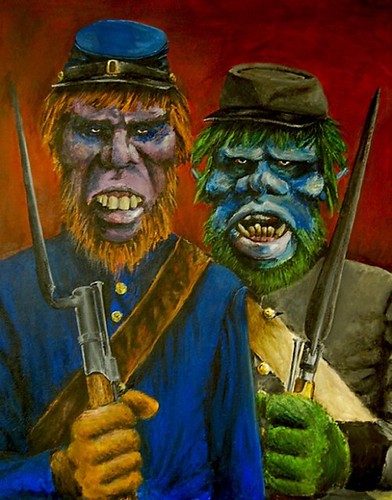
"The Brown & the Green." Acrylic on canvas 24" x 30". © David Durrett
Asked to comment on "The Brown and the Green," he said, "The brother-against-brother theme suggested one of those tragic stories you read about families torn apart by the Civil War (in fact the script includes such a reference), and I just had to put them into a Matthew-Brady-style portrait complete with full regalia and weaponry. It was a lot of fun to research the uniforms and rifles, and to render such varied surfaces as leather, brass, wood, cloth, gunmetal, and, of course, fur. Following August Ragone’s very encouraging comment that the painting was 'bad ass,' I realized that Gaira perfectly epitomizes the term and was worthy of a follow-up portrait."
"Simultaneously, I have begun pieces with titles ranging from 'Candid Gamera' to 'Toho Presents The Mikado.' I plan to have at least six paintings completed by G-Fest, where I will be offering prints and posters (maybe 'Bad Ass' T-shirts?) as a member of Artists’ Alley. I’ve launched a simple website, daviddurrett.com, where I plan to both show and offer my work. In addition to paying tribute to existing characters, I’d like to develop some of my own, which is a natural progression of subject matter among Lowbrow artists."
Check out David's site at daviddurrett.com and visit him this July 4th-6th at G-Fest in Chicago — his dynamic work redefines the term "Bad Ass" for the Monster Kid in everyone. I'm sure that we'll be hearing a lot more from David and his wonderful Lowbrow creations in the near future — I just hope he remembers me when he's famous!
Friday, May 2, 2008
TRAILER FOR "MONSTER X STRIKES BACK"
First Teaser Trailer Now Posted Online!
出た!「ギララの逆襲」予告編!!
It's "Guilalamania"! The first teaser trailer was posted last night on Cinemacafe's official MONSTER X STRIKES BACK webpage — Go! Go! Guilala!!
It's "Guilalamania"! The first teaser trailer was posted last night on Cinemacafe's official MONSTER X STRIKES BACK webpage — Go! Go! Guilala!!
Wednesday, April 30, 2008
HAPPY WALPURGIS NIGHT, EVERYONE!
Whatever You Are...

Countess Bathory rises again from LA NOCHE DE WALPURGIS (1970).
From Wikipedia: Walpurgisnacht is derived from Pagan spring customs. In the Norse tradition, Walpurgisnacht is considered the "Enclosure of the Fallen." It commemorates the time when Odin died to retrieve the knowledge of the runes, and the night is said to be a time of weakness in the boundary between the living and the dead. Bonfires were built to keep away the dead and chaotic spirits that were said to walk among the living then.
In Germany, Walpurgisnacht (or Hexennacht, meaning Witches' Night) is the night when allegedly the witches hold a large celebration on the Blocksberg and await the arrival of Spring. In some parts of northern coastal regions of Germany, the custom of lighting huge Beltane fires is still kept alive, to celebrate the coming of May, while most parts of Germany have a derived Christianized custom around Easter called "Easter fires".
Walpurgis (sw: Valborgsmässoafton or Valborg) is one of the main holidays during the year in Sweden, alongside Christmas and Midsummer holiday. One of the main traditions in Sweden is to light large bonfires, a custom which is most firmly established in Svealand, and which began in Uppland during the 18th century.
Today in Finland, Walpurgis Night (Vapunaatto, Valborgsmässoafton) is, along with New Year's Eve and Juhannus, the biggest carnival-style festivity that takes place in the streets of Finland's towns and cities. The celebration is typically centered on plentiful use of sparkling wine and other alcoholic beverages.
In Estonia, Volbriöö is celebrated as one of the main reasons to party across the country. Influenced by German culture, the night originally stood for the gathering and meeting of witches. Nowadays some people still dress up as witches and wander the streets in a carnival-like mood. The following day (May 1) is known as Kaatripäev (Hangover Day, derived from the German word 'Kater' meaning 'Hangover').
Whatever April 30th means (or doesn't mean) to you, please have a safe and sane, Walpurgisnacht!
Monday, April 28, 2008
CAN GIANT MAJIN TAKESHI "BEAT" KAIJU GUILALA?
It's the Ultimate War of the Colossal Beasts!
何だ? 大魔神たけし対大怪獣ギララ!?
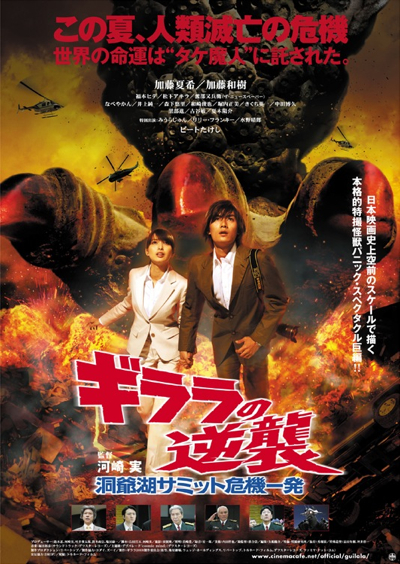
Coming to your galaxy this summer!
While the details surrounding Minoru Kawasaki’s upcoming MONSTER X STRIKES BACK: ATTACK THE G-8 SUMMIT (Girara-no Gyakushu Toyako Samitto-no Kiki Ippatsu), a spin off of the Shochiku Studio’s one-shot monster movie from 1967, THE X FROM OUTER SPACE (Uchu Daikaiju Girara), keep getting stranger and stranger — it’s also becoming bizarrely sublime in both the casting and the unveiling of a new colossal character to combat the giant space monster. But, is that any surprise coming from a Kawasaki film?
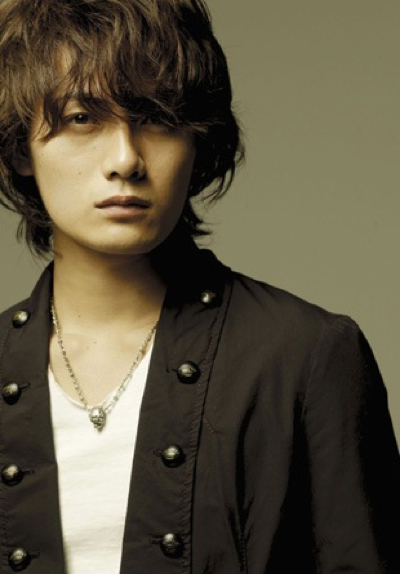
Actor/Singer Kazuki Kato.
Under the radar of most people outside of Japan are the starring roles, filled by two veteran tokusatsu television actors. 24 year-old actor-singer Kazuki Kato plays a photojournalist caught up in covering the onslaught of the monster Guilala. The popular Kato rose in fame playing Keigo Atobe in the stage presentations based on "The Prince of Tennis" manga and his television role as Daisuke Kazama/Kamen Rider Drake in KAMEN RIDER KABUTO (2006-07). He most recently played Shiro Kazami/Kamen Rider V3 in Ryuta Tasaki’s KAMEN RIDER: THE NEXT (2007).

Actress/Model Natsuki Kato.
His love interest in the film is a plucky news reporter played by 22-year old actress (and professed anime fan), Natsuki Kato, who first appeared in BURN! ROBOCON (1999-00) and was prominently featured in Kenta Fukasaku’s BATTLE ROYALE II: REQUIEM (2003). She can also been seen in Naoyuki Tomomatsu's STACY (2001) and Atsushi Muroga's GUN CRAZY 4: REQUIEM FOR A BODYGUARD (2002). Kato is also notable for playing the first official female Kamen Rider, Kamen Rider Femme, in Ryuta Tasaki’s KAMEN RIDER RYUKI: EPISODE FINAL (2002).
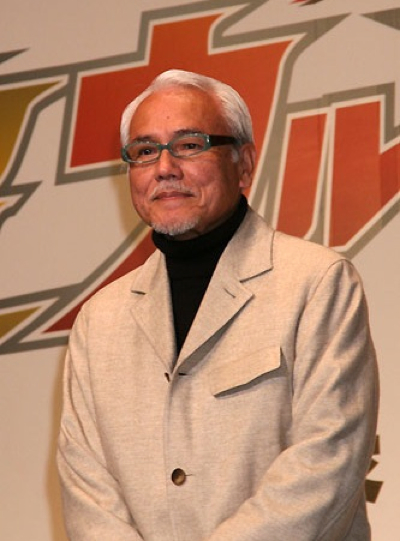
Recent photo of actor Susumu Kurobe.
Kawasaki has also sprinkled in a couple of old veterans, who are no strangers to fans around the world — Susumu Kurobe, who is best remembered as Hayata from the original ULTRAMAN series from 1966 has a prominent role as a military official (Kurobe also appeared in similar brief cameos in the recent series of Godzilla films). Kurobe also recently reprised his role as Hayata in the ULTRAMAN MOEBIUS television series and two feature film spin-offs, the latest of which, Takeshi Yagi's DECISIVE BATTLE! THE SUPER 8 ULTRA BROTHERS, opens in Japanese theaters this September. Mr. Kurobe has always been one of my heroes.
Recent photo of actor Yosuke Natsuki.
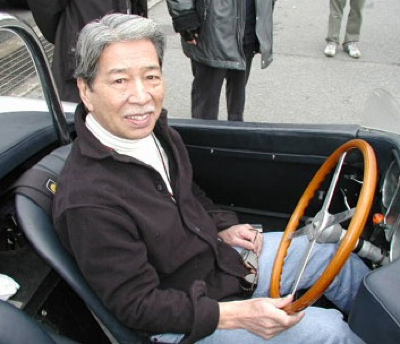
While his last role in a visual effects film was more than two decades ago, as Professor Hayashida in Koji Hashimoto’s RETURN OF GODZILLA (1984), Yosuke Natsuki has been cast in a featured role in the new film. Under contract with Toho in the late 1950s, Natsuki was a popular young actor whom appeared in everything from comedy programmers to dramatic war films, as well as action potboilers and period dramas, such as Kengo Furusawa’s SIEGE ON FORT BISMARCK (1963) and Hiroshi Inagaki’s CHUSHINGURA (1962). He also appeared in two classic monster movies directed by Ishiro Honda, GHIDRAH: THE THREE-HEADED and MONSTER and DOGORA: THE SPACE MONSTER (both 1964). Natsuki recently played Shibahara, the Karate Master in Shunichi Nagasaki's excellent BLACK BELT (Kuro-obi, 2007).
But wait! There’s more!
Japanese press sources have just announced that world-renown actor and director, “Beat” Takeshi Kitano, is appearing in the film as “Takemajin” (pronounced “tah-kay mah-gene”) — a guardian deity who grows to enormous proportions to take on the intergalactic interloper. Loosely based on the deity Fudomuyo-Oh, the new character first appears in the film as a 50 cm edifice (holding an umbrella in one hand and a fire extinguisher in the other). But, when things look their darkest, the statue comes to life as a 50-meter tall, 10,000-ton colossus. Kitano will actually don the suit of Takemajin.
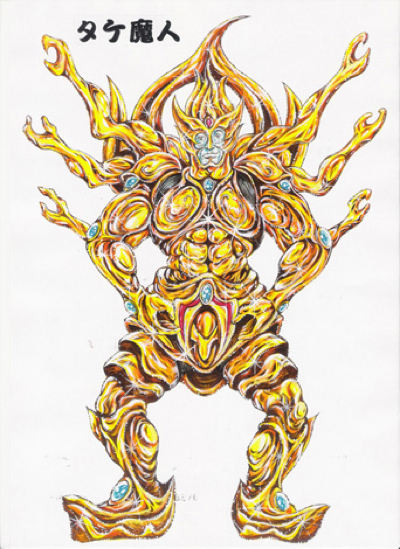
Early design for Takemajin.
Director Kawasaki thought that this would be a perfect role for Kitano, who is no stranger to comedy or elaborate costuming, since he used to play the Ultraman-like character, “Take-chan Man,” on the old “Ultra Quiz” game show, as well as wrote and starred in the “Uchimura Seven” sketches, which were parodies of the old ULTRAMAN television series. Kitano is also known by Japanese audiences for his penchant for dressing up in wacky costumes on the most inconspicuous (or inappropriate) occasions.
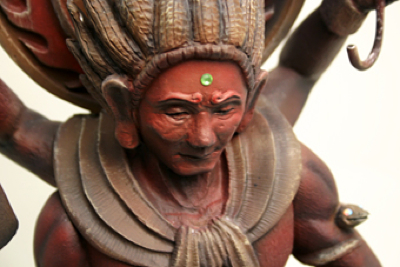
Kitano's mug on the statue of Takemajin.
In the story, the mystery surrounding Takemajin — which is also a take-off of Daiei Studio’s beloved DAIMAJIN trilogy from the 1960s — is at the center of the drama, and the avenging deity will make his dramatic appearance at the climax of the film. Kawasaki teased, “This is the culmination of Takeshi-san’s professional career... and in the last scene, there will be a shock similar to [the final duel] in Akira Kurosawa’s SANJURO.”
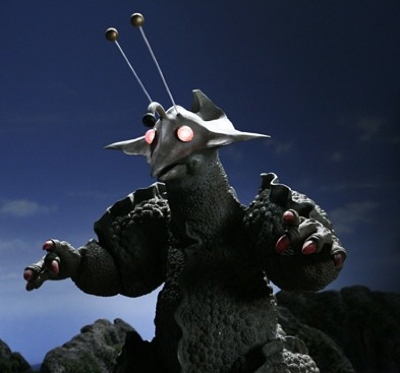
Who will prevail? Takemajin or Guilala?
MONSTER X STRIKES BACK: ATTACK THE G-8 SUMMIT goes into nationwide release in Japan this July. Personally, I can’t wait to see this film — it’s either going to be glorious or a glorious mess!
Coming to your galaxy this summer!
While the details surrounding Minoru Kawasaki’s upcoming MONSTER X STRIKES BACK: ATTACK THE G-8 SUMMIT (Girara-no Gyakushu Toyako Samitto-no Kiki Ippatsu), a spin off of the Shochiku Studio’s one-shot monster movie from 1967, THE X FROM OUTER SPACE (Uchu Daikaiju Girara), keep getting stranger and stranger — it’s also becoming bizarrely sublime in both the casting and the unveiling of a new colossal character to combat the giant space monster. But, is that any surprise coming from a Kawasaki film?
Actor/Singer Kazuki Kato.
Under the radar of most people outside of Japan are the starring roles, filled by two veteran tokusatsu television actors. 24 year-old actor-singer Kazuki Kato plays a photojournalist caught up in covering the onslaught of the monster Guilala. The popular Kato rose in fame playing Keigo Atobe in the stage presentations based on "The Prince of Tennis" manga and his television role as Daisuke Kazama/Kamen Rider Drake in KAMEN RIDER KABUTO (2006-07). He most recently played Shiro Kazami/Kamen Rider V3 in Ryuta Tasaki’s KAMEN RIDER: THE NEXT (2007).
Actress/Model Natsuki Kato.
His love interest in the film is a plucky news reporter played by 22-year old actress (and professed anime fan), Natsuki Kato, who first appeared in BURN! ROBOCON (1999-00) and was prominently featured in Kenta Fukasaku’s BATTLE ROYALE II: REQUIEM (2003). She can also been seen in Naoyuki Tomomatsu's STACY (2001) and Atsushi Muroga's GUN CRAZY 4: REQUIEM FOR A BODYGUARD (2002). Kato is also notable for playing the first official female Kamen Rider, Kamen Rider Femme, in Ryuta Tasaki’s KAMEN RIDER RYUKI: EPISODE FINAL (2002).
Recent photo of actor Susumu Kurobe.
Kawasaki has also sprinkled in a couple of old veterans, who are no strangers to fans around the world — Susumu Kurobe, who is best remembered as Hayata from the original ULTRAMAN series from 1966 has a prominent role as a military official (Kurobe also appeared in similar brief cameos in the recent series of Godzilla films). Kurobe also recently reprised his role as Hayata in the ULTRAMAN MOEBIUS television series and two feature film spin-offs, the latest of which, Takeshi Yagi's DECISIVE BATTLE! THE SUPER 8 ULTRA BROTHERS, opens in Japanese theaters this September. Mr. Kurobe has always been one of my heroes.
Recent photo of actor Yosuke Natsuki.
While his last role in a visual effects film was more than two decades ago, as Professor Hayashida in Koji Hashimoto’s RETURN OF GODZILLA (1984), Yosuke Natsuki has been cast in a featured role in the new film. Under contract with Toho in the late 1950s, Natsuki was a popular young actor whom appeared in everything from comedy programmers to dramatic war films, as well as action potboilers and period dramas, such as Kengo Furusawa’s SIEGE ON FORT BISMARCK (1963) and Hiroshi Inagaki’s CHUSHINGURA (1962). He also appeared in two classic monster movies directed by Ishiro Honda, GHIDRAH: THE THREE-HEADED and MONSTER and DOGORA: THE SPACE MONSTER (both 1964). Natsuki recently played Shibahara, the Karate Master in Shunichi Nagasaki's excellent BLACK BELT (Kuro-obi, 2007).
But wait! There’s more!
Japanese press sources have just announced that world-renown actor and director, “Beat” Takeshi Kitano, is appearing in the film as “Takemajin” (pronounced “tah-kay mah-gene”) — a guardian deity who grows to enormous proportions to take on the intergalactic interloper. Loosely based on the deity Fudomuyo-Oh, the new character first appears in the film as a 50 cm edifice (holding an umbrella in one hand and a fire extinguisher in the other). But, when things look their darkest, the statue comes to life as a 50-meter tall, 10,000-ton colossus. Kitano will actually don the suit of Takemajin.
Early design for Takemajin.
Director Kawasaki thought that this would be a perfect role for Kitano, who is no stranger to comedy or elaborate costuming, since he used to play the Ultraman-like character, “Take-chan Man,” on the old “Ultra Quiz” game show, as well as wrote and starred in the “Uchimura Seven” sketches, which were parodies of the old ULTRAMAN television series. Kitano is also known by Japanese audiences for his penchant for dressing up in wacky costumes on the most inconspicuous (or inappropriate) occasions.
Kitano's mug on the statue of Takemajin.
In the story, the mystery surrounding Takemajin — which is also a take-off of Daiei Studio’s beloved DAIMAJIN trilogy from the 1960s — is at the center of the drama, and the avenging deity will make his dramatic appearance at the climax of the film. Kawasaki teased, “This is the culmination of Takeshi-san’s professional career... and in the last scene, there will be a shock similar to [the final duel] in Akira Kurosawa’s SANJURO.”
Who will prevail? Takemajin or Guilala?
MONSTER X STRIKES BACK: ATTACK THE G-8 SUMMIT goes into nationwide release in Japan this July. Personally, I can’t wait to see this film — it’s either going to be glorious or a glorious mess!
Saturday, April 19, 2008
AUGUST RAGONE VS. JOHN STANLEY
Giant Against Giant... The Ultimate Battle!
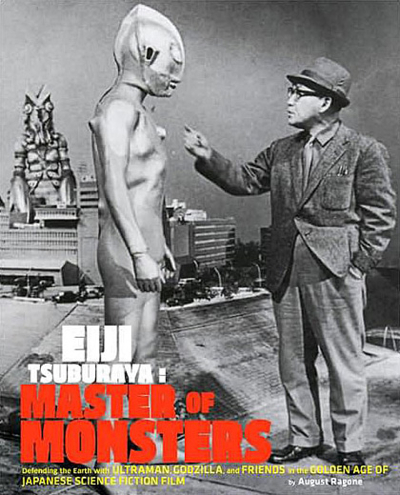
On Saturday, April 26th @ 2:00 pm, I will be appearing with author, columnist, filmmaker and former "Creature Features" host, John Stanley at Clayton Books in Clayton, California, for a monstrous double-feature book signing event. It's giant against giant in the ultimate struggle for supremacy of the world!
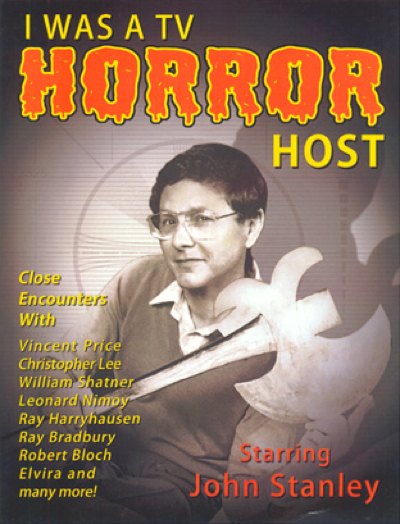
As a columnist for the San Francisco Chronicle. John Stanley covered the science fiction, fantasy, and horror scene for more than thirty years, and has authored a fistfull of books, including several editions of the lauded "Creature Features Movie Guide," which Leonard Maltin called "A must", even as Fangoria magazine called John, "The Leonard Maltin of Horror."
John will be appearing to bask in the glory of his recent magnum opus, "I Was a TV Horror Host" — a star-studded overview of the radio, film and television horror host, highlighted by a detailed behind-the-scenes look at his own journey on "Creature Features." As the legendary Ray Bradbury so aptly put it, "Everybody should read this book! EVERYBODY!"
And that means YOU!
Clayton Books is located at 5433 D Clayton Road, Clayton, CA 94517 (just past Walnut Creek on Ygnacio Valley Road). Call 925-673-3325 for more information.
Tuesday, April 15, 2008
WATCH HORROR FILMS, KEEP AMERICA STRONG
The CREATURE FEATURES Documentary!
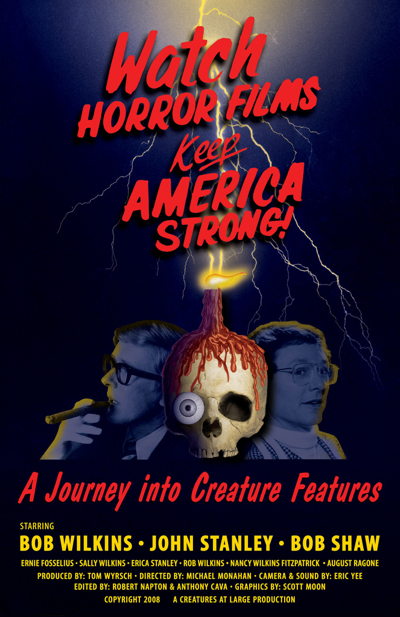
UPDATE: DUE TO OVERWHELMING DEMAND, A SECOND SHOW HAS BEEN ADDED AT 10:00 PM. BE SURE TO GET YOUR TICKETS EARLY — YOU DON'T WANT TO MISS THIS HISTORIC CELEBRATION OF "CREATURE FEATURES" (or the creature's going to get you tonight)!
The World Premiere Benefit Screening of WATCH HORROR FILMS — KEEP AMERICA STRONG for the Bob Wilkins Foundation will be screening on Thursday, May 15th at 7:00 PM & 10:00 PM at the historic Grand Lake Theater, 3200 Grand Avenue Oakland, California.
Produced by Tom Wyrsch (author of "Bob Wilkins Scrapbook") and written and directed by Michael Monahan (Associate producer of "American Scary"), WATCH HORROR FILMS — KEEP AMERICA STRONG is a new, feature-length documentary blending newly filmed interviews with crew, family and fans, with rare footage unseen since originally aired, celebrating the unique and lasting contributions of legendary "Creature Features" hosts Bob Wilkins and John Stanley to San Francisco Bay Area broadcasting.
An affectionate tribute to a special time and place, and to the special people who entertained and inspired a generation of entranced viewers, WATCH HORROR FILMS — KEEP AMERICA STRONG recalls a strange and wonderful era of locally-produced television. To this day, KTVU’s "Creature Features" (1971–1984) remains the most-loved, best-remembered local program in Bay Area history. “Watch Horror Films — Keep America Strong!” was the rallying cry of host Bob Wilkins as he lured unsuspecting audiences into viewing the type of film usually found clinging to the bottom of the cinematic barrel. After eight years, Bob passed the torch onto San Francisco Chronicle film critic, John Stanley.
Special guests attending the gala premiere of WATCH HORROR FILMS — KEEP AMERICA STRONG will include "Creature Features" host John Stanley, Sally Wilkins (the wife of Bob Wilkins), Bob Shaw (associate producer of "Creature Features"), Ernie Fosselius (the genius behind "Hardware Wars"), August Ragone (author of "Eiji Tsuburaya: Master of Monsters") – with more special guests to be announced.
In recent years, Bob Wilkins has struggled with the advanced stages of Alzheimer’s Disease. Proceeds from WATCH HORROR FILMS — KEEP AMERICA STRONG will go directly to the Bob Wilkins Foundation to assist in his care. The event is being presented by Creatures At Large.
This is a great cause, Bob Wilkins was a big part of my young life and I was lucky to be a part of his, and so I urge all those who ever wanted to thank Bob for all those great years of "Creature Features" and "Captain Cosmic" to attend, as well as anyone who fondly remembers the "Good Old Days" of San Francisco Bay Area television.
Plus, you get to roast me for my rambling and mumbling interview in the film! Now, you have no excuse to not attend!
Thursday, April 3, 2008
"UCHUSEN" QUARTERLY BEGINS RELAUNCH!
Legendary Japanese Tokusatsu Magazine Returns
新生「宇宙船」マガジン登場!
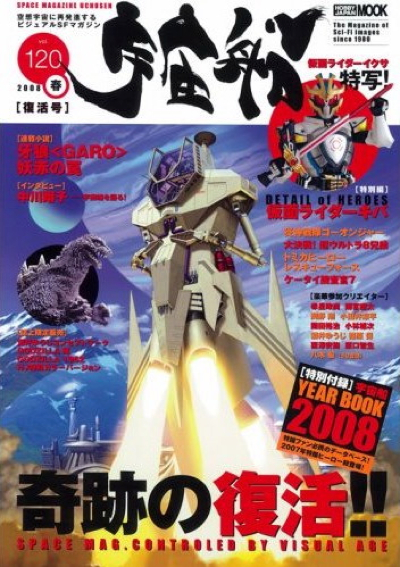
Reborn with new logo by director Kieta "Zeiram" Amemiya.
It's here! I have been waiting three years for its return, but have grown anxious since the official announcement last fall... and now, it's here! The legendary Uchusen (or "Spaceship") magazine has been reborn like a mythical phoenix! I feel like a kid waiting for his new issue of Famous Monsters to arrive in the mail. Some of you might be asking, "what's all of the fuss about?"
Originally launched in 1980 by Tokyo-based Asahi Sonorama publishing house, Uchusen was the premiere source for Japanese genre fans to learn about the latest in news from Japan and abroad on upcoming productions and extensive retrospectives — with an emphasis on classics of tokusatsu eiga and television. From the first issue, with Kaida's evocative cover — seen below and revisited in the cover of the relaunch seen above — readers were hooked. For 25 years, I was hooked, too, and couldn't wait to get my hands on the latest issue — each and every issue was a proverbial treasure trove of stills and information.
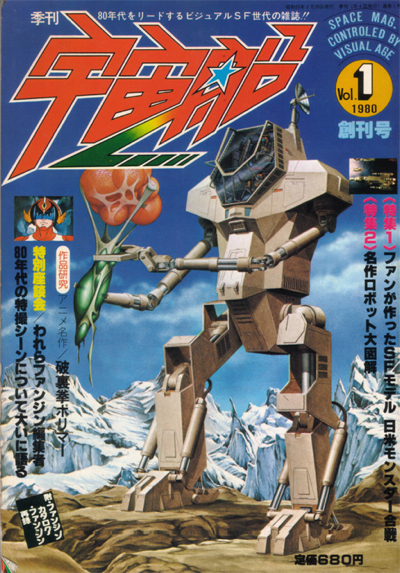
Premiere Issue, 1980 with Yuji Kaida cover and title design.
I first met the original editor, Saki Hijiri, at WesterCon 32 in San Francisco during the summer of 1979, when he and his crew (including now-famed illustrator Yuji Kaida) were putting together the first issue. During the convention and I was privy to see — as were fans in Chicago — some of Kaida's amazing cut-away drawings for famous SF automatons, such as Robby the Robot, which would appear in the premiere volume. Because of this fortunate meeting, I got my teenage mug in that very first issue promoting my Godzilla Fan Club and met many great people though that ad, at home and abroard, including the late Guy Tucker (author of Age of the Gods: The History of the Japanese Fantasy Film).
Over the years, American fans and professionals who were visited by Saki-san and Co. during their annual sojourns, were generously given copies of the latest issues, each packed with amazing photos and graphics. Uchusen also celebrated and exposed the outside world to the phenomenon of Garage Kits. Even though many people outside of Japan have never heard of Uchusen magazine, the influence it made on those in the Hollywood visual effects community, old and new, has yet to be told. Even I was impacted in strange ways. One day, I received a call at work from Saki-san who desperately needed someone to pick them up from San Francisco International Airport. My boss refused to let me leave early, so I walked. That job blew anyhow.
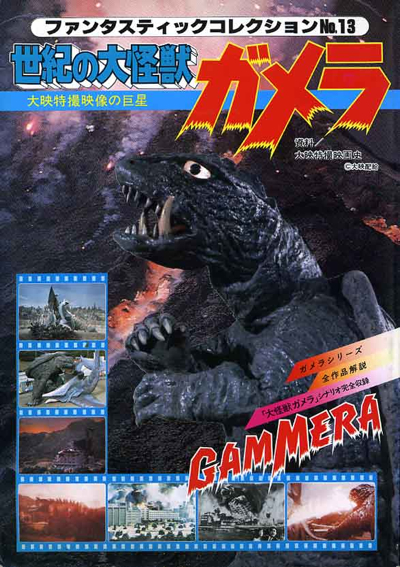
Fantastic Collection No.13: Gammera (1979).
Initially, the magazine grew out of a series of one-shot publications called Fantastic Collection, each covering a specific topic from SCIENCE NINJA TEAM: GATCHAMAN to GODZILLA, which were aimed at the young adult and adult fan, and were met with enthusiastic response and sales. So, Asahi Sonorama offered Saki-san and Co. a magazine of their own, as long as they continued working on Fantastic Collection series as well. Uchusen started out as a quarterly, and saw highs and lows right from the beginning (it was almost canceled when sales of #6 hit rock bottom, and was fortunately saved by the strong sales of the following issues), but managed to always be there, as it went to bi-monthly and back again to quarterly. Then, back to bi-monthly for the remainder of its run. Fans of Uchusen, such as myself and other readers around the world, had always relied on it to be there.
Then there's that annoying axiom, "All good things must come to an end." Over the last decade, the fandom-lauded magazine seemed to be losing its edge. There were fewer and fewer retrospective articles on Toho's Golden Age, and there was an overall feeling lacking with newer issues. Another problem also reared its ugly head — competition from similar upstart periodicals such as Newtype the Live (Kadokawa Publishing) and Toei Hero Max (Tatsumi Publishing), who were pulling away Uchusen's waning readership. While the magazine saw several editors at the helm after Saki-san departed, for better or worse, it began improving in content and interview subjects in 2004 — but, the inevitable could not be avoided.
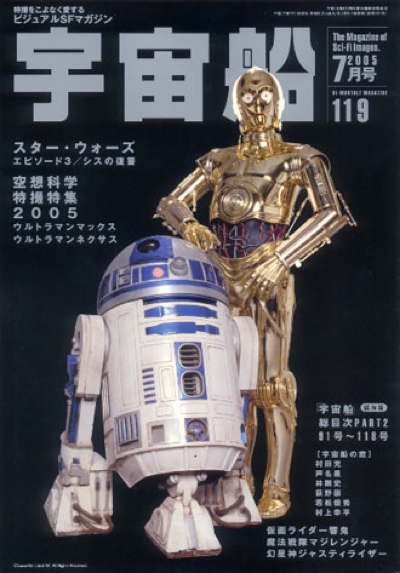
Final issue with Asahi Sonorama, 2005.
Due to declining sales, Asahi Sonorama felt that the magazine was "old fashioned," and therefore should go on hiatus, and when/if it returned, Uchusen would be completely re-imagined, said then-Chief Editor, Akihiro Fukuba in #119 (July 2005)... Uchusen's "last issue." While Newtype the Live and Toei Hero Max have continued successfully, the void left by their forerunner's impact was immeasurable. Sadly, there were no signs that the magazine would return, and it seemed as though the statements by Asahi Sonorama were a polite way of telling their readers, "Uchusen has left the building."
Things were looking especially dark last year, when Asahi Sonorama decided to call it quits. During their nearly fifty years in business, the publisher launched hundreds of successful magazines and specialty books — especially during the "Monster Boom" of the mid-to-late 1960s — and they were also the progenitors of the "Sonosheet" (or "flexi disc") record phenomenon in Japan. Today, the evocative art of their books and Sonosheet EPs give many Japanese fans in their 40s and 50s warm, fuzzy feelings, causing them to involuntarily sigh, "Natsukashii!" (akin to saying, "Ah, memories!").
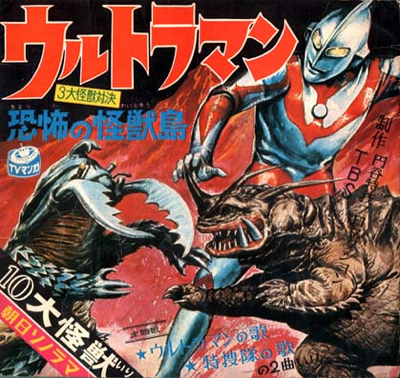
ULTRAMAN Sonosheet storybook EP, circa 1966.
Then, like an Angel swooping down from the heavens, rescue came the in form of the perennial and vastly popular Hobby Japan Co., which publishes — you guessed it — Hobby Japan magazine. The publishing company purchased the vast holdings to Asahi Sonorama's back catalogue, including their considerable tokusatsu materials and titles, including Uchusen magazine. Soon afterwards, it was announced online and via Hobby Japan that the re-birth of everyone's favorite "Space Mag Controlled by [the] Visual Age" was nigh. Now, it's back — and it's about time!
Do yourself a favor and grab yourself a copy of Uchusen #120 from Amazon Japan and see what all of the fuss it about!
Reborn with new logo by director Kieta "Zeiram" Amemiya.
It's here! I have been waiting three years for its return, but have grown anxious since the official announcement last fall... and now, it's here! The legendary Uchusen (or "Spaceship") magazine has been reborn like a mythical phoenix! I feel like a kid waiting for his new issue of Famous Monsters to arrive in the mail. Some of you might be asking, "what's all of the fuss about?"
Originally launched in 1980 by Tokyo-based Asahi Sonorama publishing house, Uchusen was the premiere source for Japanese genre fans to learn about the latest in news from Japan and abroad on upcoming productions and extensive retrospectives — with an emphasis on classics of tokusatsu eiga and television. From the first issue, with Kaida's evocative cover — seen below and revisited in the cover of the relaunch seen above — readers were hooked. For 25 years, I was hooked, too, and couldn't wait to get my hands on the latest issue — each and every issue was a proverbial treasure trove of stills and information.
Premiere Issue, 1980 with Yuji Kaida cover and title design.
I first met the original editor, Saki Hijiri, at WesterCon 32 in San Francisco during the summer of 1979, when he and his crew (including now-famed illustrator Yuji Kaida) were putting together the first issue. During the convention and I was privy to see — as were fans in Chicago — some of Kaida's amazing cut-away drawings for famous SF automatons, such as Robby the Robot, which would appear in the premiere volume. Because of this fortunate meeting, I got my teenage mug in that very first issue promoting my Godzilla Fan Club and met many great people though that ad, at home and abroard, including the late Guy Tucker (author of Age of the Gods: The History of the Japanese Fantasy Film).
Over the years, American fans and professionals who were visited by Saki-san and Co. during their annual sojourns, were generously given copies of the latest issues, each packed with amazing photos and graphics. Uchusen also celebrated and exposed the outside world to the phenomenon of Garage Kits. Even though many people outside of Japan have never heard of Uchusen magazine, the influence it made on those in the Hollywood visual effects community, old and new, has yet to be told. Even I was impacted in strange ways. One day, I received a call at work from Saki-san who desperately needed someone to pick them up from San Francisco International Airport. My boss refused to let me leave early, so I walked. That job blew anyhow.
Fantastic Collection No.13: Gammera (1979).
Initially, the magazine grew out of a series of one-shot publications called Fantastic Collection, each covering a specific topic from SCIENCE NINJA TEAM: GATCHAMAN to GODZILLA, which were aimed at the young adult and adult fan, and were met with enthusiastic response and sales. So, Asahi Sonorama offered Saki-san and Co. a magazine of their own, as long as they continued working on Fantastic Collection series as well. Uchusen started out as a quarterly, and saw highs and lows right from the beginning (it was almost canceled when sales of #6 hit rock bottom, and was fortunately saved by the strong sales of the following issues), but managed to always be there, as it went to bi-monthly and back again to quarterly. Then, back to bi-monthly for the remainder of its run. Fans of Uchusen, such as myself and other readers around the world, had always relied on it to be there.
Then there's that annoying axiom, "All good things must come to an end." Over the last decade, the fandom-lauded magazine seemed to be losing its edge. There were fewer and fewer retrospective articles on Toho's Golden Age, and there was an overall feeling lacking with newer issues. Another problem also reared its ugly head — competition from similar upstart periodicals such as Newtype the Live (Kadokawa Publishing) and Toei Hero Max (Tatsumi Publishing), who were pulling away Uchusen's waning readership. While the magazine saw several editors at the helm after Saki-san departed, for better or worse, it began improving in content and interview subjects in 2004 — but, the inevitable could not be avoided.
Final issue with Asahi Sonorama, 2005.
Due to declining sales, Asahi Sonorama felt that the magazine was "old fashioned," and therefore should go on hiatus, and when/if it returned, Uchusen would be completely re-imagined, said then-Chief Editor, Akihiro Fukuba in #119 (July 2005)... Uchusen's "last issue." While Newtype the Live and Toei Hero Max have continued successfully, the void left by their forerunner's impact was immeasurable. Sadly, there were no signs that the magazine would return, and it seemed as though the statements by Asahi Sonorama were a polite way of telling their readers, "Uchusen has left the building."
Things were looking especially dark last year, when Asahi Sonorama decided to call it quits. During their nearly fifty years in business, the publisher launched hundreds of successful magazines and specialty books — especially during the "Monster Boom" of the mid-to-late 1960s — and they were also the progenitors of the "Sonosheet" (or "flexi disc") record phenomenon in Japan. Today, the evocative art of their books and Sonosheet EPs give many Japanese fans in their 40s and 50s warm, fuzzy feelings, causing them to involuntarily sigh, "Natsukashii!" (akin to saying, "Ah, memories!").
ULTRAMAN Sonosheet storybook EP, circa 1966.
Then, like an Angel swooping down from the heavens, rescue came the in form of the perennial and vastly popular Hobby Japan Co., which publishes — you guessed it — Hobby Japan magazine. The publishing company purchased the vast holdings to Asahi Sonorama's back catalogue, including their considerable tokusatsu materials and titles, including Uchusen magazine. Soon afterwards, it was announced online and via Hobby Japan that the re-birth of everyone's favorite "Space Mag Controlled by [the] Visual Age" was nigh. Now, it's back — and it's about time!
Do yourself a favor and grab yourself a copy of Uchusen #120 from Amazon Japan and see what all of the fuss it about!
Tuesday, April 1, 2008
MR. GODZILLA GOES TO CHICAGO THIS JULY!
Haruo "Godzilla" Nakajima Invades G-Fest XV
この夏、中島春雄は「G-Fest XV」 のためのシカゴで上陸する!

Nakajima on the set of GODZILLA VS. THE SEA MONSTER (1966)
G-Fest XV, the annual convention devoted to Japanese monster movies and fantasy films will be held from July 4th through July 6th, 2008, at the Crowne Plaza Chicago O’Hare. This year's Guests of Honor will include:
HARUO NAKAJIMA - From Ishiro Honda's GODZILLA (1954) to Jun Fukuda's GODZILLA VS. GIGAN (1972), Nakajima was the primary Godzilla "suit actor" who also played the major monsters during the original run of Toho's Fantasy Films, such as Honda's RODAN (1956) and THE WAR OF THE GARGANTUAS (1966). Mr.Nakajima also appeared in numerous films produced at Toho Studios, including Akira Kurosawa's SEVEN SAMURAI (1954). Mr. Nakajima will be meeting and greeting with attendees and will also receive G-Fest's "Mangled Skyscraper Award" for 2008.
G-Fest XV's other guests will include former UFC fighter-turned-actor DON FRYE, who played the prominent character of "Captain Douglas Gordon" in Ryuhei Kitamura's GODZILLA FINAL WARS (2004). This is Frye's first appearance at G-Fest.
ROBERT SCOTT FIELD, who played "Android M-11" in GODZILLA VS. KING GHIDORAH (1991), returns once again to moderate live programming translations, as well as host his own sessions at G-Fest XV.
G-Fest XV's movie line up at the Pickwick Theatre this year will see the North American theatrical premiere of Kazuki Omori's GODZILLA VS. BIOLLANTE (1989), as well as screenings of Honda's MATANGO: ATTACK OF THE MUSHROOM PEOPLE (1963), DESTROY ALL MONSTERS (1968), Fukuda's GODZILLA VS. GIGAN (1972), Takao Okawara's OROCHI: THE EIGHT-HEADED DRAGON (1994), and Masaaki Tezuka's GODZILLA AGAINST MECHAGODZILLA (2002).
For more information, go to the official website at G-fan.com
Nakajima on the set of GODZILLA VS. THE SEA MONSTER (1966)
G-Fest XV, the annual convention devoted to Japanese monster movies and fantasy films will be held from July 4th through July 6th, 2008, at the Crowne Plaza Chicago O’Hare. This year's Guests of Honor will include:
HARUO NAKAJIMA - From Ishiro Honda's GODZILLA (1954) to Jun Fukuda's GODZILLA VS. GIGAN (1972), Nakajima was the primary Godzilla "suit actor" who also played the major monsters during the original run of Toho's Fantasy Films, such as Honda's RODAN (1956) and THE WAR OF THE GARGANTUAS (1966). Mr.Nakajima also appeared in numerous films produced at Toho Studios, including Akira Kurosawa's SEVEN SAMURAI (1954). Mr. Nakajima will be meeting and greeting with attendees and will also receive G-Fest's "Mangled Skyscraper Award" for 2008.
G-Fest XV's other guests will include former UFC fighter-turned-actor DON FRYE, who played the prominent character of "Captain Douglas Gordon" in Ryuhei Kitamura's GODZILLA FINAL WARS (2004). This is Frye's first appearance at G-Fest.
ROBERT SCOTT FIELD, who played "Android M-11" in GODZILLA VS. KING GHIDORAH (1991), returns once again to moderate live programming translations, as well as host his own sessions at G-Fest XV.
G-Fest XV's movie line up at the Pickwick Theatre this year will see the North American theatrical premiere of Kazuki Omori's GODZILLA VS. BIOLLANTE (1989), as well as screenings of Honda's MATANGO: ATTACK OF THE MUSHROOM PEOPLE (1963), DESTROY ALL MONSTERS (1968), Fukuda's GODZILLA VS. GIGAN (1972), Takao Okawara's OROCHI: THE EIGHT-HEADED DRAGON (1994), and Masaaki Tezuka's GODZILLA AGAINST MECHAGODZILLA (2002).
For more information, go to the official website at G-fan.com
Monday, March 17, 2008
モスラ
MOTHRA (1961)
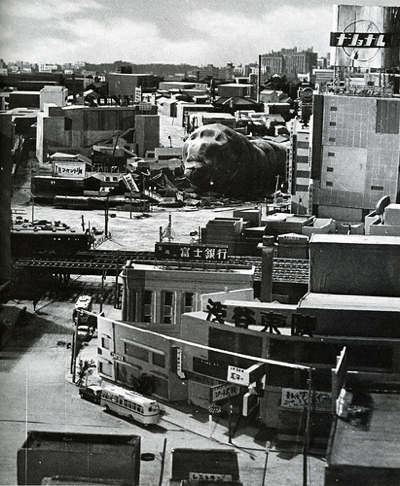
Staggering detail-perfect miniature of the Shibuya Ward in MOTHRA.
MOTHRA
Mosura (Toho, 1961), 101 minutes
Director ISHIRO HONDA • Director of Visual Effects EIJI TSUBURAYA
At the time of its production, MOTHRA was Toho's largest scale kaiju eiga (monster movie) made during the Golden Age, starting with GODZILLA and refined with RODAN. The studio solicited three novelists to each write one-third of a story, based on the treatment for the film, and serialized in the Weekly Asahi. Screenwriter Sekizawa only took basic cues from the short story, added the fairy tale atmosphere, and created a wonderful synergy between the three main characters. The climax in the fictional "New Kirk City" (a hybrid of San Francisco and NYC) was not in the original screenplay, but was commissioned by Columbia Pictures, due to the success of their Stateside releases of THE H-MAN (1958) and BATTLE IN OUTER SPACE (1959). The original ending was already shot and was jettisoned in favor of this new climax, which added far greater scope to the film.
A major element of MOTHRA is the wondrous and beautiful score by seasoned composer Yuji Koseki (1908-1989), who occasionally wrote film music (TOWER OF LILLIES), but whose career concentrated on penning hit songs for Nippon Columbia's pop stars. Koseki was not only chosen because of his previous work with pop sensation The Peanuts (twins Yumi and Emi Ito, who were cast as the "Little Beauties"), but because the film is essentially operatic — the music is an integral part of the story. Koseki had been instrumental in writing The Peanuts' biggest hits, and penned their songs for MOTHRA, "The Song of Mothra" (lyrics by Koji Yuki*) and "The Daughters of Infant Island" (lyrics by Susumu Ike*). Koseki and The Peanuts were the perfect choice for MOTHRA, as its fairly tale setting could have been lost in the heavy compositions of Akira Ifukube.
Tsuburaya's team had their work cut out for them, with the scope and size of the miniature sets needed, as well the sheer number of effects sequences required by the screenplay. The Minato Ward, landmarked by the massive Tokyo Tower, was the most enormous miniature set ever built at the time, and accurate, right down to the last house (in 1/100 scale to accommodate the four foot-long mechanical prop of the caterpillar). Other scenes of the caterpillar wrecking havoc was accomplished with a nearly thirty foot-long "costume," needing seven operators (with veteran monster suit actor Haruo "Godzilla" Nakajima in the lead). The sequence where Mothra thrashes the Shibuya Ward (and it's train station in glorious 1/20-scale) is now fully restored in this presentation. The volume and detail of the visual effects are pure motion picture spectacle — and 43 years after it's first release, is still awe-inspiring in its scope, craftsmanship and sheer audacity.
MOTHRA was a massive hit, selling over sold over nine million tickets (impressive for a country smaller than California). There is much to appreciate about viewing MOTHRA, but it is also the vital lynchpin in the development of the genre. No kaiju eiga, before or since, has touched its size and magnitude — a film like MOTHRA simply could not be produced today. Sekizawa's witty screenplay, spot-on acting from leads Frankie Sakai (SHOGUN), Kyoko Kagawa (HIGH AND LOW), Hiroshi Koizumi (LATE CHRYSANTHEMUMS) and Jerry Ito (YOU CAN SUCCEED, TOO), the wonderful vocals by The Peanuts, inspired direction by Honda and the visual detail of Tsuburaya, make MOTHRA irresistible entertainment — and one of the finest films ever produced by Toho Motion Picture Company.
Executive Producer TOMOYUKI TANAKA Screenplay SHINICHI SEKIZAWA (based on the stories by Shinichiro Nakamura, Takehiko Fukunaga and Yoshie Hotta) Production Design TAKEO KITA and TERUAKI ABE Cinematography HAJIME KOIZUMI Film Editor KAZUJI TAIRA Music YUJI KOSEKI Sound Effects ICHIRO MINAWA Visual Effects Production Design AKIRA WATANABE Optical Photography YUKIO MANODA Visual Effects Photography SADAMASA ARIKAWA
Starring FRANKIE SAKAI (Senichiro Fukuda, Nitto News Reporter) KYOKO KAGAWA (Michi Hanamura, Nitto News Photographer) HIROSHI KOIZUMI (Dr. Shinichi Chujo) KEN UEHARA (Dr. Harada) JERRY ITO (Clark Nelson) YUMI and EMI ITO (Little Beauties) AKIHIRO TAYAMA (Shinji Chujo) SATOSHI NAKAMURA (Nelson's Henchman) OSMAN "JOHNNY" YUSEF (Nelson's Henchman) OBER WYATT (Dr. Roth) ROBERT DUNHAM (New Kirk City Police Chief) ED KEANE (New Kirk City Mayor) and TAKASHI SHIMURA (Amano, Nitto News Editor)
*"Koji Yuki" was the pen name for Tomoyuki Tanaka, Ishiro Honda and Shinichi Sekizawa. "Susumu Ike" was the pen name of Koji Kajita, who was generally Honda's chief assistant director.
MOTHRA plays with BATTLE IN OUTER SPACE at Landmark's Clay Theater in San Francisco on March 20th as part of "Monsters of Mass Destruction: A Tribute to Eiji Tsuburaya" at 3:30 & 7:30 PM
宇宙大戦争
BATTLE IN OUTER SPACE (1959)
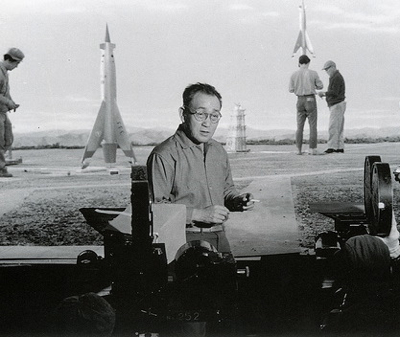
Tsuburaya prepares to shoot the Earth Forces' sortie to the Moon.
BATTLE IN OUTER SPACE
Uchu Daisenso (Toho, 1959), 90 minutes
Director ISHIRO HONDA • Director of Visual Effects EIJI TSUBURAYA
BATTLE IN OUTER SPACE opens with a shot of an evocative orbital space station, a title card pronouncing the year as "1965" — an odd date in retrospect, since we know that these advances did not come to pass (the first Moon landing still over a decade away). "Why 1965," one might ask? This is because the film is a loose sequel to THE MYSTERIANS (1957), and within that context, it makes perfect sense — the nations of the world dropped their petty hostilities to unite against a common foe, and were ultimately able to narrowly repel the invaders. In the eight years between the settings of THE MYSTERIANS and BATTLE IN OUTER SPACE, Mankind has absorbed the alien technology, and have advanced in science by leaps and bounds — and are just reaching out into space with these technological advancements.
Another confusing element for some viewers was that while a number of the characters from THE MYSTERIANS are carried over to this spectacle (both based on short stories by former test pilot-turned-science fiction writer, Jojiro Okami), the roles were cast with different actors (the original actors were unavailable when the production went into full swing). Most notably, Takashi Shimura (Kanbei in SEVEN SAMURAI) was replaced by Koreya Senda (GATE OF HELL) to essay "Dr. Adachi"; while the stunning Kyoko Anzai (TOKYO HOLIDAY) replaced Yumi Shirakawa (EARLY AUTUMN) as "Etsuko Shiraishi." BATTLE IN OUTER SPACE also features one of the largest non-Japanese supporting casts in a genre film, with Leonard Stanford (THEY WERE EXPENDABLE) stepping in for George Furness as "Dr. Richardson," while Harold Conway (TORA! TORA! TORA!) returned as "Dr. Immelman."
Even though the film lacks the presence of the great Takashi Shimura, it gained an intense performance from Yoshio Tsuchiya, who played "Rikichi" in SEVEN SAMURAI (1954), as the alien-enslaved "Yuichi Iwamura." Tsuchiya (b.1927) excelled in complex or tortured characters, and because of his acting prowess, was hand-picked for Kurosawa's ensemble of actors. Tsuchiya jumped at the chance to play the masked leader of the Mysterians, rather than play one of the human characters, despite the studio’s wishes, and continued to play roles as monsters or madmen in THE HUMAN VAPOR (1960), MATANGO (1963), MONSTER ZERO (1965) and DESTROY ALL MONSTERS (1968). Leading man, Ryo Ikebe (b. 1918), played "Ichiro Katsumiya," a top-billed leading man and renown actor who appeared in such films as Kaneto Shindo's PALE FLOWER (1964), and was still playing leading men well into his 40s. He also appeared in the science fiction films GORATH (1963) and THE WAR IN SPACE (1977).
Artist Shigeru Komatsuzaki (1915-2001), who conceived the iconic '50s spacecraft designs, also provided similar chores on THE MYSTERIANS, which refined by Art Director Akira Watanabe and his staff. Komatsuzaki would later go on to create one of the most memorable icons of science fiction cinema for ATRAGON (1963). BATTLE IN OUTER SPACE is one of the most action-oriented and miniature-filled of Toho's early special effects productions, trumping the vast majority of space pictures of the time, and Eiji Tsuburaya outdid himself in regards to the sheer number of effects scenes, especially during the final battle above the Earth — which floored audiences in 1959 — and can only be fully appreciated on the Big Screen, the way these films were meant to be seen.
Executive Producer TOMOYUKI TANAKA Original Story JOJIRO OKAMI Screenplay SHINICHI SEKIZAWA Production Design TERUAKI ABE Cinematography HAJIME KOIZUMI Film Editor KAZUJI TAIRA Music AKIRA IFUKUBE Sound Effects ICHIRO MINAWA Special Effects Production Design AKIRA WATANABE and SHIGERU KOMATSUZAKI Visual Effects Photography SADAMASA ARIKAWA Optical Photography HIDESABURO ARAKI
Starring RYO IKEBE (Major Ichiro Katsumiya) KYOKO ANZAI (Etsuko Shiraishi) KOREYA SENDA (Dr. Adachi) LEONARD STANFORD (Dr. Roger Richardson) HAROLD CONWAY (Dr. Immelman) YOSHIO TSUCHIYA (Yuichi Iwamura) HISAYA ITO (Kogure) NADAO KIRINO (Okada) ELSIE RITCHER (Sylvia) GEORGE WYMAN (Dr. Ahmed) ED KEANE (US General) and MINORU TAKADA (Defense Commander)
BATTLE IN OUTER SPACE plays with MOTHRA (1961) at Landmark's Clay Theater in San Francisco on March 20th as part of "Monsters of Mass Destruction: A Tribute to Eiji Tsuburaya" at 5:30 & 9:30 PM
Thursday, March 6, 2008
THE MONSTERS OF MASS DESTRUCTION!
Tribute to Eiji Tsuburaya in San Francisco

On March 20th, in celebration of the release of my book, EIJI TSUBURAYA: MASTER OF MONSTERS, San Francisco's Clay Theater will proudly present a spectacular Tohoscope double feature dedicated to the legendary director of visual effects (known in Japan as the "Tokusatsu-no Kamisama"). The event will feature beautiful 35mm scope prints of Ishiro Honda's MOTHRA (1961) and BATTLE IN OUTER SPACE (1959) for one night only — courtesy of Sony Repertory — where they belong, on the big screen!
The Clay will be screening the uncut Japanese-language version of MOTHRA, featuring scenes edited from the original U.S. release in 1962, and fully subtitled in English. The spectacle that is MOTHRA is one of my personal favorite of all of Toho's fantasy films from the Golden Era, and was a big hit on both sides of the Pacific: New York Times film critic, A.H. Weiler said, "There's that color, as pretty as can be, that now and then smites the eye with some genuinely artistic panoramas and décor designs... Fantastic though the plot may be, there are some genuinely penetrating moments, such as the contrast of the approaching terror and those patient, silvery-voiced little 'dolls,' serenely awaiting rescue. Several of the special effects shots are brilliant, such as the sight of a giant cocoon nestling against a large city's power station tower."
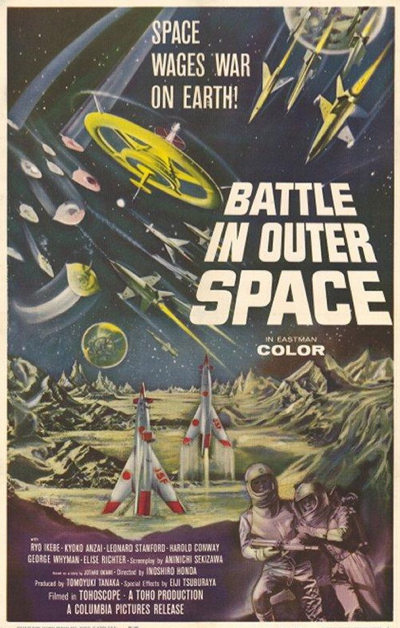
Meanwhile, BATTLE IN OUTER SPACE will be the English-language version produced and released by Columbia Pictures in 1960. A sequel to THE MYSTERIANS (1957), BATTLE IN OUTER SPACE is generally derided as a lesser film by some fans, but I find it more dramatically and technically accomplished than the former — the stakes are much higher, the destruction is world-wide, and the final confrontation above the Earth was the first of its kind (18 years before STAR WARS). New York Times film critic, Howard Thompson said, "Some of the artwork is downright nifty, especially in the middle portion, when an earth rocket soars to the moon to destroy the palpitating missile base... The Japanese have opened a most amusing and beguiling bag of technical tricks, as death-dealing saucers whiz through the stratosphere like fireflies... the lunar landscape is just as pretty as it can be."
For the evening performance, I will be on hand to introduce both features and sign copies of my book during the intermission (courtesy Super 7, who will be also selling related merchandise). For more information on this event, and how to order tickets, please click here: TOHO DOUBLE FEATURE @ Landmark After Dark.

Subscribe to:
Posts (Atom)