"There is so much writing in English on Japanese cinema that can't be accepted at face value — not because the writers are careless, but because the differences in culture and language are just too intricate. When I see August Ragone's name on a piece of writing, it gives me permission to place my faith in it completely. Among Japanese fantasy film historians, he's the best working in English." —Tim Lucas, Video Watchdog

Showing posts with label mothra. Show all posts

Monday, July 11, 2016

REST IN PEACE: YUMI ITO OF "THE PEANUTS"
APRIL 1, 1941 - MAY 18, 2016

ザ•ピーナッツの伊藤ユミさん死去


Yumi (right) and Emi from the Weekly Yomiuri, September 9, 1972.

The sad news was just released that the former singer has now been reunited with her twin sister Emi, who passed away four years ago. Japanese media traditionally respects the privacy of the families of celebrities when it comes to their passing, so the media withheld this from the public until the family agreed to make a formal statement, and was issued by a representative of Watanabe Productions, their former management company.


One of their first magazine covers, Mainichi Graphic (June 28, 1959).

Yumi Ito (born Tsukiko Ito) was the melodic vocalist of The Peanuts, while Emi, held down the harmonies. When they started out, the sisters sang the melodies together, until they signed with Watanabe Productions. Even though they were technically identical, the twins could be readily told apart as Emi had distinctive, trademark moles by her eyes. During their early career, Yumi would have false moles applied, so they would appear more identical.


Their debut 45 Single, "Kawaii Hana", released April 1959.

From the years 1959 through 1975, they were known as the world-famous pop duo, "The Peanuts". Discovered as "The Ito Sisters" in a Nagoya restaurant, they released their first hit single, "Kawaii Hana" (Pretty Flower) in April 1959, a lyrical version of Sidney Bechet's "Petite Fleur". Between that July and December, they appeared in five films for as many studios, debuting in THE WONDERFUL AGE OF 19 for Shochiku and BASTARDS IN A CAGE for Toho.


The original Single for "The Daughters of Infant", issued in 1961.

While they are perhaps best known in the States for Toho's spectacle, MOTHRA (1961), by the time Ishiro Honda's film went into production, The Peanuts were already veterans of seventeen feature films, two weekly television variety shows, and a weekly radio show. They would reprise their role as the "Little Beauties" for MOTHRA VS. GODZILLA and THE GREATEST BATTLE ON EARTH, both released in 1964. Further appearances of the "Little Beauties" employed pale substitutes.


First issue of "The Song of Mothra"/"The Daughters of Infant", 1978.

While the song, "The Daughters of Infant", was the first Single release in conjunction with MOTHRA, back in late 1961, it wasn't the original recording from the movie. The Single was arranged and conducted by Hiroshi Miyagawa, their constant collaborator, who went on to world fame for his music to the Space Battleship Yamato franchise. Both of the songs from the film, by Yuji Koseki, weren't issued on any release until 1978 — three years after The Peanuts retired.


With the cast of "Rawhide" (Brinegar, Fleming, and Eastwood), 1962.

The Peanuts were my first introduction to Japanese pop music, which was only reinforced by my Aunt Camille, who gifted me a big stack of colored wax of early '60s J-Pop, bought while she and her husband were stationed in Japan. She saw my obsession with Japan and made it grow with these 45 Singles. But, The Peanuts are magic, their vocal harmonies during the final curtain in MOTHRA, still raises goosebumps on me to this day. Now, I can't believe they're gone.


Yumi (left) and Emi in Daiei's musical LEAPING LADY DAIMYO, 1961.

After retiring from singing in 1975, Yumi turned her career towards another passion: fashion design. And while the women whose voices sang, beautiful, wondrous melodies and harmonies, have left us to be joined together in the next world, those of us left behind still hold now the incredible gift of their lovely voices recorded for all and our posterity to come. Yumi Ito was 75 years old.

Thursday, July 16, 2015

HOSTING SHOUT'S "KAIJU MOVIE MARATHON"
24-Hours of Japanese Monster Movies and Me!

新番組『怪獣映画大会』登場!


The monstrous event starts this Saturday at Midnight, Eastern Time!

Prepare yourselves for something monstrous on July 18th...

Shout! Factory TV has teamed up with the original monster fan magazine, Famous Monsters of Filmland, to bring you the Kaiju Movie Marathon! Featuring nine classic Showa-era kaiju eiga (Japanese monster movies) from Toho Studios, spotlighting Godzilla, including hand-picked episodes of Tsuburaya Productions' ULTRA Q (1966) and ULTRA SEVEN (1967), streaming live for 24 hours on July 18th (from midnight to midnight Eastern Time). Hosted by Yours Truly!

Back in March, I was approached by a creative team at Shout! Factory to see if I wanted to be involved in this project, and I couldn't say no. Not only because this would be a fantastic opportunity, but because it was a chance to become a full, red-blooded, American Horror Host, just like my childhood hero, Bob Wilkins of "Creature Features" fame (if just for one day). They forwarded a rough script and told me to "make it your own." And that's exactly what I did.

We shot all of my segments in late June and I hope that everyone will enjoy them — I tried to keep it light, have fun with the material, but also be informative, drop some little known facts, and be completely respectful to the films and the genre (why wouldn't I? I love these films). I brought along some of my favorite Bullmark figures, several original movie posters, and some "Creature Features" tributes to decorate the set (shot at Chronicle Books in San Francisco).

Director Brian Blum, Cameraman Michael Bloom, and I had a blast!

This weekend's event will stream at www.shoutfactorytvlive.com. For mobile, tablet and connected TV devices the marathon is accessible via the Pluto TV app. The marathon is also available via Pluto TV (CH 427) in the living room (Amazon Fire TV and Fire TV Stick, Android TV, Chromecast and Apple Airplay), on the go (apps for iOS, Android and Amazon) and at your fingertips on PCs, Macs via the web.

THE "KAIJU MOVIE MARATHON" SCHEDULE (All Times Eastern):

12:00 am — GODZILLA: The Uncut Japanese Original (1954)
01:45 am — ULTRA Q (1966)
05:15 am — ULTRA SEVEN (1967)
06:30 am — GODZILLA, KING OF THE MONSTERS (1954)
08:15 am — ULTRA SEVEN (1967)
09:00 am — RODAN (1956)
10:30 am — ULTRA SEVEN (1967)
11:15 am — GODZILLA RAIDS AGAIN (1955)
12:45 pm — ULTRA SEVEN (1967)
01:30 pm — GODZILLA VS. THE THING (1964)
03:15 pm — GHIDRAH, THE THREE-HEADED MONSTER (1964)
05:00 pm — MONSTER ZERO (1965)
06:45 pm — GODZILLA'S REVENGE (1969)
08:15 pm — TERROR OF MECHAGODZILLA (1975)
10:00 pm — Repeat: GODZILLA: The Uncut Japanese Original (1954)
11:45 pm — Repeat: GODZILLA'S REVENGE (1969)
01:15 am — Repeat: TERROR OF MECHAGODZILLA (1975)

Just a note on the episodes I picked for this special presentation; all of them were not picked as the best of their respective series, but as the best of the kaiju-oriented episodes of each show. So, tune in for the kaiju calamity on July 18th, and live tweet with #godzilla. Shout! Factory TV and Famous Monsters of Filmland will be giving away prizes to fans and viewers of the marathon, including a $100 gift certificate for Shout! Factory merchandize.

In the words of Bob Wilkins, remember to "Watch Horror Films... Keep America Strong!"

(Viewers outside North America can view via Channel 427 on Pluto TV.)

Thursday, June 5, 2014

UNVEILING TOHO STUDIOS' "GODZILLA" MURAL!
Hosted by Gareth Edwards and Akira Takarada

東宝スタジオのゴジラ巨大壁画が初お披露目 !


The 11-meter mural unveiled by Takarada and Edwards this morning.

Following up on my May 11th report on Toho's new mural, there was an official "unveiling" this past morning at the studios with the star of the first Godzilla film, Akira Takarada, and the director of the latest film, Gareth Edwards, acting as the "hosts" dressed up in special Big G happi coats. Interestingly, the mural was not originally intended to celebrate Godzilla's 60th Anniversary this year.


Reunited for the first time since the production of GODZILLA (2014).

Painted by Masao Hanawa, the mural was commissioned to go along with similar murals featuring scenes from Ishiro Honda's MOTHRA (1961) and Akira Kurosawa's SEVEN SAMURAI (1954), while the aging Toho Studios was undergoing numerous renovations, major facelifts, and upgrades to the studio grounds and buildings, which had been constructed, originally, in the 1930s.


Edwards, director of GODZILLA (2014), called the mural, "fantastic."

But, in the wake of the Tohoku Earthquake and Tsunami of 2011, work was postponed on the proposed Godzilla mural. So, in light of the 60th Anniversary and the release of the Edwards' production, Toho brought back Hanawa to move forward on the project. The famed painter not only created the SEVEN SAMURAI mural, but was also the art director of Tokyo DisneySea Resort.


Takarada's opinion of Hanawa's work was, "Subarashii" (wonderful)!

Using the 1994 Big G as his model, featured in Kensho Yamashita's GODZILLA VS. SPACE GODZILLA, the mural reportedly took three months to complete at the cost ¥8,000,000 (roughly $78,000 USD). Completed on May 31st, Godzilla will now stand over the front gates of Toho Studios into the foreseeable future — hopefully, where he continues to reign as the once and future King of the Monsters.


Click to watch Masao Hanawa at work on the Godzilla mural.

Photo source: Oricon News Inc. & Asahi.com

Wednesday, May 1, 2013

"MOTHRA" OVER FRISCO BAY ON MOTHER'S DAY!
Ishiro Honda's Classic Screening on May 12th

見よ、『モスラ』サンフランシスコ湾に現わる!


Original Japanese release poster for MOTHRA ('natch)! ©Toho, 1961

IMAGINE A MONSTER SO HUGE IT BLACKENED THE SKY! Join me as I host "Thrillville Theater" on Sunday, May 12th at The New Parkway in Oakland for a special screening of the uncut Japanese version of Ishiro Honda's 1961 spectacle, MOTHRA (w/English Subtitles)! I will blab about the film, share rare, behind-the-scenes images, and more! SEE! Eiji Tsuburaya's momentous miniature work as the featured creature smashes all in it's wake for the sake of the tiniest women in all creation! PLUS: Everyone attending will receive special Mothra door prizes (while supplies last) and Kimono My House will be on hand with a megaton of Mothra and Kaiju merchandize for sale! There will be only one screening, starting at 6:00 pm, so don't miss this night of food, beer, wine, couches, and MOTHRA at The New Parkway, 474 24th Street (near Telegraph), Oakland, California! Admission is only $6.00 (cheap) — order advance tix online from Brown Paper Tickets!

(Mothballs not included.)

Check in over at our Facebook Event Invite page!

Saturday, July 30, 2011

HAPPY BIRTHDAY, MOTHRA!
Original Japanese Premiere: July 30, 1961

お誕生日おめでとう、『モスラ』!


Behind-the-scenes color shot from MOTHRA (1961). ©Toho Co., Ltd.

Happy 50th Anniversary to one of my favorite kaiju eiga of all-time, directed by Ishiro Honda with visual effects by Eiji Tsuburaya. Click on this link to read my thoughts on one of the greatest giant monster movies ever made: MOTHRA! You're not getting older, girl; you're getting better!

Thursday, July 14, 2011

LET'S GET READY TO CRUMBLE!
Ragone Invades G-Fest XVIII


Preview of Matt Frank's illo of the author and Reionyx Team Silver!

Well, it's that time of the year again in Chicago... G-Fest, North America's only convention devoted to the Kaiju Eiga (or Japanese Monster Movie) milieu returns to the Crowne Plaza Chicago O'Hare in Rosemont, Illinois this weekend — right outside of Chicago — now in it's 18th year (!). This year's guests include actor Hiroyuki Watanabe (Gamera Trilogy, Ultraman Gaia, Karate Robo: Zaborgar), Director and Visual Effects Wizard Shinji Higuchi (Gamera Trilogy, Sinking of Japan, The Last Princess), Miniature Builder and Toy Sculptor Hiroshi Sagae, Android M-11 himself, Robert Scott Field (Godzilla vs. King Ghidorah), and yours truly.

Other notable celebrities will include award-winning artist Bob Eggleton (where do we start with this guy?), illustrator Matt Frank (Godzilla: Legends!), Damon Foster (Oriental Cinema), and Edward Holland (Monster Attack Team).

Here are some of the presentations which I will be participating in over the weekend, besides the usual zany antics:

Friday, July 15th
•2:00 pm: The 50th Anniversary of Mothra
Jay Johnson, Kevin Horn, Martin Arlt, and August Ragone (Hall 1)
•4:00 pm: 45 Years of Ultraman!
August Ragone and Edward Holland (Hall 2)

Saturday, July 16th
•1:00 pm: Japanese Superheroes
Jay Johnson, Lenell Bridges, and August Ragone (Hall 2)

Sunday, July 17th
•11:00 am: Lost In the Translation... and Space! (Hall 1)
Damon Foster, Ed Holland, August Ragone, and John Grace
•2:30 pm: Yokai Monsters: Japan’s Groovy Ghoulies (Hall 1)
August Ragone and Edward Holland

I will also be giving out swag from Kaiju Empire for their upcoming city-smashing, award-winning video game (and it hasn't even been released yet), Kaijuland (while supplies last). Not to mention the annual Godzilla Blood Party that takes place after the convention closes on Sunday night (don't ask)! I hope to see a lot of you there for the chaos! Next week, I'll be back in San Diego for this year's Comic-Con International! I only hope that I remember most of it once the dust settles...

For the full scoop on this year's G-Fest XVIII, please visit the official G-Fest website!

Tuesday, August 26, 2008

「三大怪獣・地球最大の決戦」
GHIDRAH: THE THREE-HEADED MONSTER (1964)


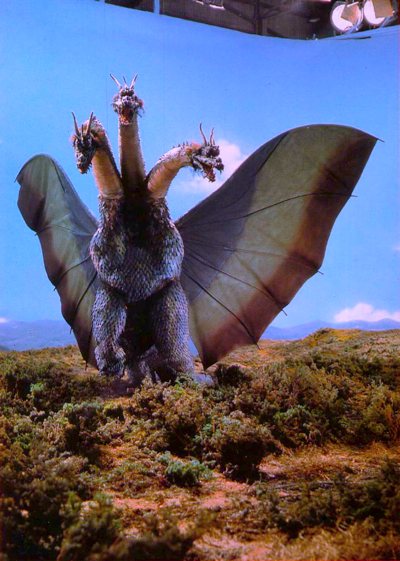
Publicity photoshoot blue color design for King Ghidorah.

GHIDRAH: THE THREE-HEADED MONSTER

San Daikaiju Chikyu Saidai-no Kessen, Toho, 1964, 85 minutes
Director ISHIRO HONDA • Visual Effects Director EIJI TSUBURAYA

"Three Giant Monsters: The Greatest Battle on Earth" (the film's Japanese title) was planned to feature all three of their biggest monster stars, Godzilla, Rodan and Mothra, who would team up to fight a new, and extraterrestrial menace. With the aim to appeal to general audiences, the narrative takes on a fairy tale-style approach, and while it is far more light-hearted than MOTHRA VS. GODZILLA, it rather compliments the Honda-Tsuburaya film that preceded it into theaters, DOGORA: THE SPACE MONSTER (all released the same year), although it features one of the greatest monsters in all cinema.

Shinichi Sekizawa's screenplay is more fantasy-oriented, centering on an Eastern princess (a descendant of aliens) marked for assassination, and written to appeal to a broader audience than the previous films. Honda said to the late Guy Tucker, "When I make a monster film, I never think that it will be for children. I want to imagine and express a story [to a wide audience], but it's always children who are the most interested." While the other monsters are portrayed fairly de rigueur during the most of the film, they suddenly become anthropomorphic, "I don't think that monsters should be comical characters, the audience is more entertained when [the monsters] strike fear in the hearts of the [human] characters." But, despite this, Honda effortlessly sweeps the audience into the story, with assured and swift direction.

Then, there’s the star of the film. Perhaps the most inspired creature the studio ever conceived, King Ghidorah was the idea of scenarist Sekizawa, who only described the monster as having "three heads, two tails, and a metallic roar like a bell." Akira Watanabe, whose sketches combined the mythical Yamata-no-Orochi from Japanese legend and traditional Chinese Dragons, were faithfully brought to life by the prosthetic crew in Toho’s Visual Effects Department, designed the realization of King Ghidorah. According to legend, the triple threat was conceived to be a menacing crimson, while gold was favored by visual effects director, Eiji Tsuburaya. In color publicity photos after the suit was completed, he was painted blue, with red, gold, and blue-striped wings, but it was decided that blue would become problematic with Blue Screen matte process. There've been many conflicting stories concerning this, and no definitive answer, so far. Regardless, the interplanetary invader created such an impact on audiences, that it has since remained one of the most popular monsters ever created by Toho.

Yosuke Natsuki (b.1936), who had just come off of Honda's DOGORA, top-lines the cast as Detective Shindo. A former model, Natsuki, was preened as one of Toho’s new, young leads, and made a number of films in the 1960s. But, he wasn’t a flash-in-the-pan, either, and starred in numerous popular television series, such as G-MEN ’75 (1975-82). Almost twenty years after GHIDRAH, Natsuki returned to the kaiju eiga with Koji Hashimoto’s THE RETURN OF GODZILLA (1984) and more recently in Minoru Kawasaki’s MONSTER X STRIKES BACK: ATTACK THE G-8 SUMMIT (2008) - he also provided the voice of Commander DEUS in ULTRASEVEN X (2007). Still quite active, the veteran actor recently scored important roles in François Rotger’s THE PASSENGER (2005) and Shunichi Nagasaki’s BLACK BELT (2007).

The spunky, and very in-demand, Yuriko Hoshi (WARRING CLANS) stars as Shindo's sister, Naoko, an investigative reporter for a series called "Mysteries of the 20th Century." Ozu regular, Hiroshi Koizumi (DAUGHTERS, WIVES AND A MOTHER), once again plays the scientist, a geologist named "Professor Murai" (both actors seemingly carried over from their similar roles in MOTHRA VS. GODZILLA). The beautiful Akiko Wakabayashi (BANDITS ON THE WIND) plays the unifying character, "Princess Salno," who went on to appear in YOU ONLY LIVE TWICE (1967). Her only starring role was in Luigi Filippo D'Amico’s AKIKO (1961). Originally, the assassin "Malmess" was to be played by actor Yoshio Tsuchiya (FUNERAL PROCESSION OF ROSES), but was held up on the lagging production of Akira Kurosawa's RED BEARD, and was replaced by character actor Hisaya Ito (A WOMAN’S LIFE).

Many of Tsuburaya's visual effects for the picture are thrilling, such as the birth of King Ghidorah, its awesome destruction of Yokohama and Tokyo, and the first battle between Godzilla and Rodan. His work here is as good as seen in MOTHRA VS. GODZILLA - with fantastic long shots of Godzilla and Rodan engaged in mortal combat - until battle reaches the slopes of Mt. Fuji. Here, the scenes between Godzilla and Rodan become static and stagey, oddly juxtaposed with fantastic shots of King Ghidorah’s wonton rampage, until Godzilla, Rodan and Mothra unite to drive off the interloper. The difference is somewhat jarring from the first half of the film, but Tsuburaya believed that this humanizing of the monsters would win over audiences.

Honda said, "I was hesitant to let Mothra act as the mediator... I felt that the monsters... were far too humanized." While the increasing anthropomorphic behavior of the colossi in the last quarter of the film seems to lower the bar that was set with MOTHRA VS. GODZILLA - it still doesn’t lower the entertainment value as a whole. Carried along by Maestro Akira Ifukube's wonderful fairy tale score (including a memorable song from The Peanuts), the visual treats of Tsuburaya, and the magnificence of King Ghidorah, GHIDRAH: THE THREE-HEADED MONSTER (the film's US title), is not only a memorable entry in the series, but also one of the most entertaining films of the kaiju eiga.

Executive Producer TOMOYUKI TANAKA Screenplay SHINICHI SEKIZAWA Production Design TAKEO KITA Cinematography HAJIME KOIZUMI Music AKIRA IFUKUBE Visual Effects Production Design AKIRA WATANABE Visual Effects Photography SADAMASA ARIKAWA [US Version] Additional Music and Sound Effects FILMSCORES INC. English Dialogue JOE BELLUCI Post-production Consultant RAY ANGUS

Starring YOSUKE NATSUKI (Detective Shindo) YURIKO HOSHI (Naoko Shindo) HIROSHI KOIZUMI (Professor Murai) AKIKO WAKABAYASHI (Princess Salno) HISAYA ITO (Malmess) AKIHIKO HIRATA (Chief Detective Okita) THE PEANUTS: EMI and YUMI ITO (The Little Beauties) and TAKASHI SHIMURA (Dr. Tsukamoto)

Thursday, August 7, 2008

「ゴジラ • エビラ • モスラ 南海の大決闘」 GODZILLA VS. THE SEA MONSTER (1966)


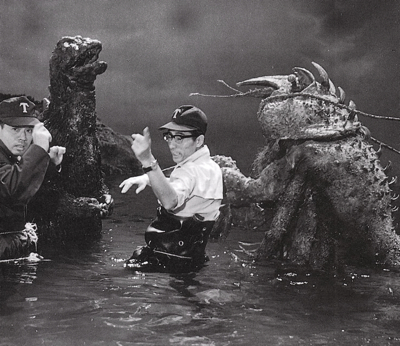
Sadamasa Arikawa (center) directing Haruo Nakajima (as Godzilla) and Hiroshi Sekita (as Ebirah).

GODZILLA VS. THE SEA MONSTER
Gojira-Ebira-Mosura Nankai-no Daiketto, 1966, 87 minutes
Director JUN FUKUDA • Visual Effects SADAMASA ARIKAWA • Visual Effects Supervisor EIJI TSUBURAYA

In 1965, there was a big change in the Visual Effects Department at Toho, with contracts ending and Tsuburaya pulling people and resources over to his own effects company, Tsuburaya Productions. Since he was spending so much time at his own studio, Tsuburaya chose his cinematographer, Sadamasa Arikawa, to divide chores as Visual Effects supervisors. Since Honda and Tsuburaya were busy with international co-productions (such as THE WAR OF THE GARGANTUAS), Tanaka handed the next Godzilla project over to popular action film director Jun Fukuda, who previously helmed the sci-fi thriller SECRET OF THE TELEGIAN (1960) and the colorful action-comedy 100 SHOT/100 KILLED (1965).

America's Rankin/Bass Productions, famous for its puppet animated television specials produced in Japan (such as "Rudolph the Red-Nosed Reindeer"), was shopping studios to take on a live-action feature film, based on their KING KONG cartoon series, produced by Toei Animation. The first screenplay, penned by Shinichi Sekizawa ("King Kong vs. Ebirah: Operation Robinson-Crusoe"), was rejected, but as negotiations continued, writers were put to work to submit further treatments which were offered to Rankin/Bass (eventually becoming KING KONG ESCAPES in 1967). While Toho was busy creating new monster films, such as THE WAR OF THE GARGANTUAS, there were no Godzilla projects on the boards for 1966,

The general consensus was that the Godzilla series needed a fresh direction, the relatively new medium of television was also keeping people away from theaters, so Tanaka thought that it was time to go after the teenage market with the same very same formula that made films such as the YOUNG GUY (starring Yuzo Kayama) so popular. There was also a very trendy interest in the exotic tropics, Hawaii and the South Seas, reflected in Japanese pop songs and movies of the early-to-mid-1960s. Tanaka thought that this could be exploited with the rejected screenplay for "King Kong vs. Ebirah," which incorporated these elements perfectly. Tanaka ordered the project into production, substituting Godzilla for King Kong, in a slightly revised screenplay entitled "Godzilla-Ebirah-Mothra: Big Duel in the South Seas."

The cast was top-lined by leading man Akira Takarada, the biggest box-office draw at the studio, playing the is-he-isn't-he master thief, who adds a worldly presence to the mostly youth cast. As the beautiful escapee, 29 year-old Mizuno was a last-minute marquee-value replacement for 19 year-old Starlet Noriko Takahashi (the dancing girl in FRANKENSTEIN CONQUERS THE WORLD), who originally was cast in the part, but fell ill due to acute appendicitis during principal photography. The driving electric guitar and jazz-infused soundtrack was composed by Masaru Sato (YOJIMBO) scoring his second Godzilla film (the first was GODZILLA RAIDS AGAIN in 1955) was quite a departure from Akira Ifukube’s bombastic marches. The lush photography was in the hands of Kazuo Yamada, who shot the majority of Hiroshi Inagaki’s memorable films, including CHUNSHINGURA (1962).

Fukuda approached this as pure escapism, with a fast-paced story that also weaves in Youth Movie elements with James Bondian histrionics — Takarada's hot-headed safecracker, a sinister organization bent on world domination through nuclear proliferation, and a band of teenagers swept up into the action, with whom the target audience could indentify. It is quite apparent that little was revised in the changing of the central monster from Kong to Godzilla, because of the odd Kong-like ticks adopted by Godzilla — his attention directed at a beautiful woman, his battles with a Giant Condor and a Jet Squadron, his boulder-throwing antics, and the rubbing of his nose (ala Kayama's character in the aforementioned YOUNG GUY series). The colorful film is an unusual, but highly enjoyable, adventure — despite its relatively lower budget — and is one of the most underrated of the 1960s entries.

(It's also the only Godzilla film to open with a Go-Go Contest!)


Executive Producer TOMOYUKI TANAKA Screenplay SHINICHI SEKIZAWA Production Design TAKEO KITA Cinematographer KAZUO YAMADA Film Editor RYOHEI FUJII Music MASARU SATO Visual Effects Production Design YOSHIYUKI INOUE Visual Effects Photography SOKEI TOMIOKA and YOICHI MANODA

AKIRA TAKARADA (Yoshimura) KUMI MIZUNO (Dayo) TORU WATANABE (Ryota) TORU IBUKI (Yatta) CHOTARO TOGIN (Ichino) HIDEO TSUNAZUKA (Niita) JUN TAZAKI (Outpost Commander) AKIHIKO HIRATA (Captain Dragonpatch) HISAYA ITO (Nuclear Physicist) HIDEYO AMAMOTO (Ship Captain) CHIEKO NAKAKITA (Kane, Ryota and Yatta's Mother) FUMIKO HONMA (Shinto Medium) IKIO SAWAMURA (Old Infant Islander) and THE BAMBI PAIR (The Little Beauties)

Wednesday, July 2, 2008

H-MEN, MOTHRAS & SPACE BATTLES, OH MY!
Sony Home Video issuing Toho classics to DVD


Should you shelve your Toho Video R2 DVDs or keep them? Read on.

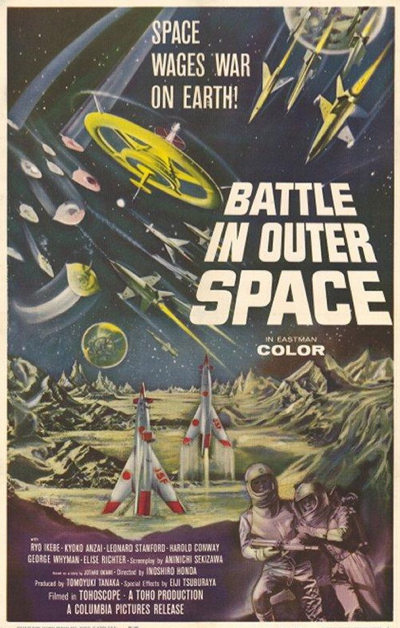
To quote Dr. Immelman from THE MYSTERIANS, "Good news! Good news!" The intrepid Ian Freidman of the HK Film News DVD blog has scored another exclusive interview with Michael Schlesinger of Sony Home Pictures Entertainment, called Return of the Classics. And while they discuss a lot of exciting news about upcoming releases (please check out the site for the complete interview), there is some exciting official news regarding the Columbia-held titles, THE H-MAN (1958), BATTLE IN OUTER SPACE (1959) and MOTHRA (1961). Here are some excerpts:

IF: "So what is the word on releases of dual US/Japanese versions of MOTHRA, THE H-MAN, and the BATTLE IN OUTER SPACE? The grey market has been filled with wide and subbed copies of the Japanese versions, but the English language version has only appeared on badly duped copies from 16MM, making them a desired inclusion."

MS: "The set is penciled in for ’09. It will contain those three plus REBIRTH OF MOTHRA 3 (1998), which somehow got overlooked for DVD. The intent is to have the uncut versions with Japanese tracks as well as the English dubs. MOTHRA and BATTLE IN OUTER SPACE are done; THE H-MAN is proving to be a bit trickier, but it should be completed in time."

IF: "Many fans have hoped that the actual US versions (in terms of credits and US version has opposed to the dub being placed over the Japanese version) will be released; do you think this will be possible?"

MS: "Probably not, since it would require twice as many discs. Besides, why would anyone want the cut-up versions? You don’t see people buying ONCE UPON A TIME IN AMERICA and then saying, “Aw, crap, I wanted the version that was 90 minutes shorter and re-edited in chronological order by some studio hack.” That’s a rather extreme analogy, but you get my point."

IF: "The reason I ask about the US versions is that Classic Media, put both the US and Japanese versions on one disc, if that's not possible, will the US credit sequences be included perhaps as an extra."

MS: "I'm sure some method will be worked out. We certainly don't expect people to try and read Japanese credits!"

IF: "Since some of the US versions were sequenced different and had different music, how will the dubs sync up with the Japanese tracks (do you have separate music, sound effects, and dialog tracks?"

MS: "That is an issue, and one that's holding up THE H-MAN. Again, much of the Toho business might be better posed to Grover [Crisp Head of Sony’s Restoration]."

While this is really exciting news, and it's about time that these films received a DVD release in North America, I'm a bit hesitant about making "hybrid" versions of the films. If Sony's Godzilla releases are any indication, we are not going to get the original Japanese credit sequences. For example, the original Japanese credit sequence for THE H-MAN is far superior than the US version — and longer — with the credits over a montage of a derelict fishing trawler, ending on the ship's wheel, which eerily seems to be steering without a pilot...

Additionally, again going by their earlier Godzilla releases, we will also not see the original Japanese Toho Scope logos at the start of each film — which will be replaced by a modern English version of the logo. This would be akin to cutting out the Shaw Brothers logo and replacing it with one in CGI. No one complained that the Classic Media DVDs contained the Toho logos or the original Japanese credit sequences (although the did drop the pre-logo "Thanks to the Maritime Safety Agency" card from GODZILLA) — nor has anyone complained of such for any other Toho releases by Media Blasters, Animeigo, Criterion, etc.

Actually, we want to have the original Japanese versions. Complete and uncut. Including logos and credits. Personally, I don't understand the need for creating these hybrids (except for possible television airings). While it may be too early to call foul at this point, we've been waiting for a decent release of these films for so long, that perhaps we're being a a little too nitpicky. For now, we're just going to have to wait and see if this is the case, or it's all much to do about nothing.

In meantime, keep checking back when more news breaks on either this blog or HK Film News DVD. Ian says that he's working on a follow-up interview with the man in charge of these restorations.

Thanks go out to Ian Freidman and Brad Thompson for passing this along to me, and Michael Schlesinger for pushing these releases through — salute!

UPDATE 07/09/08: When the major differences in the U.S. and the Japanese versions were brought to his attention, Michael Schlesinger responded thusly: "After the interview was published, I was informed that THE H-MAN and MOTHRA were not merely shortened but had scenes rearranged and some alternate footage. So yes, it would be best if both versions were included on those two. I'll be bringing this up when the time comes."

Monday, March 17, 2008

モスラ
MOTHRA (1961)


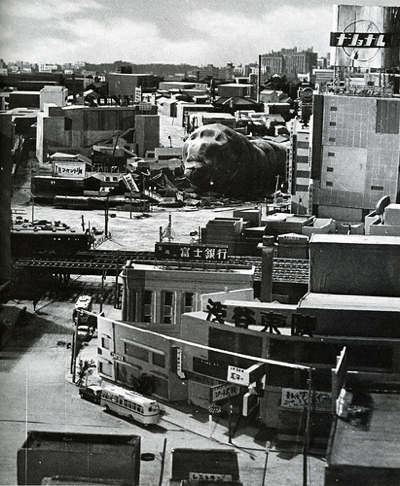
Staggering detail-perfect miniature of the Shibuya Ward in MOTHRA.

MOTHRA
Mosura (Toho, 1961), 101 minutes
Director ISHIRO HONDA • Director of Visual Effects EIJI TSUBURAYA

At the time of its production, MOTHRA was Toho's largest scale kaiju eiga (monster movie) made during the Golden Age, starting with GODZILLA and refined with RODAN. The studio solicited three novelists to each write one-third of a story, based on the treatment for the film, and serialized in the Weekly Asahi. Screenwriter Sekizawa only took basic cues from the short story, added the fairy tale atmosphere, and created a wonderful synergy between the three main characters. The climax in the fictional "New Kirk City" (a hybrid of San Francisco and NYC) was not in the original screenplay, but was commissioned by Columbia Pictures, due to the success of their Stateside releases of THE H-MAN (1958) and BATTLE IN OUTER SPACE (1959). The original ending was already shot and was jettisoned in favor of this new climax, which added far greater scope to the film.

A major element of MOTHRA is the wondrous and beautiful score by seasoned composer Yuji Koseki (1908-1989), who occasionally wrote film music (TOWER OF LILLIES), but whose career concentrated on penning hit songs for Nippon Columbia's pop stars. Koseki was not only chosen because of his previous work with pop sensation The Peanuts (twins Yumi and Emi Ito, who were cast as the "Little Beauties"), but because the film is essentially operatic — the music is an integral part of the story. Koseki had been instrumental in writing The Peanuts' biggest hits, and penned their songs for MOTHRA, "The Song of Mothra" (lyrics by Koji Yuki*) and "The Daughters of Infant Island" (lyrics by Susumu Ike*). Koseki and The Peanuts were the perfect choice for MOTHRA, as its fairly tale setting could have been lost in the heavy compositions of Akira Ifukube.

Tsuburaya's team had their work cut out for them, with the scope and size of the miniature sets needed, as well the sheer number of effects sequences required by the screenplay. The Minato Ward, landmarked by the massive Tokyo Tower, was the most enormous miniature set ever built at the time, and accurate, right down to the last house (in 1/100 scale to accommodate the four foot-long mechanical prop of the caterpillar). Other scenes of the caterpillar wrecking havoc was accomplished with a nearly thirty foot-long "costume," needing seven operators (with veteran monster suit actor Haruo "Godzilla" Nakajima in the lead). The sequence where Mothra thrashes the Shibuya Ward (and it's train station in glorious 1/20-scale) is now fully restored in this presentation. The volume and detail of the visual effects are pure motion picture spectacle — and 43 years after it's first release, is still awe-inspiring in its scope, craftsmanship and sheer audacity.

MOTHRA was a massive hit, selling over sold over nine million tickets (impressive for a country smaller than California). There is much to appreciate about viewing MOTHRA, but it is also the vital lynchpin in the development of the genre. No kaiju eiga, before or since, has touched its size and magnitude — a film like MOTHRA simply could not be produced today. Sekizawa's witty screenplay, spot-on acting from leads Frankie Sakai (SHOGUN), Kyoko Kagawa (HIGH AND LOW), Hiroshi Koizumi (LATE CHRYSANTHEMUMS) and Jerry Ito (YOU CAN SUCCEED, TOO), the wonderful vocals by The Peanuts, inspired direction by Honda and the visual detail of Tsuburaya, make MOTHRA irresistible entertainment — and one of the finest films ever produced by Toho Motion Picture Company.


Executive Producer TOMOYUKI TANAKA Screenplay SHINICHI SEKIZAWA (based on the stories by Shinichiro Nakamura, Takehiko Fukunaga and Yoshie Hotta) Production Design TAKEO KITA and TERUAKI ABE Cinematography HAJIME KOIZUMI Film Editor KAZUJI TAIRA Music YUJI KOSEKI Sound Effects ICHIRO MINAWA Visual Effects Production Design AKIRA WATANABE Optical Photography YUKIO MANODA Visual Effects Photography SADAMASA ARIKAWA

Starring FRANKIE SAKAI (Senichiro Fukuda, Nitto News Reporter) KYOKO KAGAWA (Michi Hanamura, Nitto News Photographer) HIROSHI KOIZUMI (Dr. Shinichi Chujo) KEN UEHARA (Dr. Harada) JERRY ITO (Clark Nelson) YUMI and EMI ITO (Little Beauties) AKIHIRO TAYAMA (Shinji Chujo) SATOSHI NAKAMURA (Nelson's Henchman) OSMAN "JOHNNY" YUSEF (Nelson's Henchman) OBER WYATT (Dr. Roth) ROBERT DUNHAM (New Kirk City Police Chief) ED KEANE (New Kirk City Mayor) and TAKASHI SHIMURA (Amano, Nitto News Editor)

*"Koji Yuki" was the pen name for Tomoyuki Tanaka, Ishiro Honda and Shinichi Sekizawa. "Susumu Ike" was the pen name of Koji Kajita, who was generally Honda's chief assistant director.

MOTHRA plays with BATTLE IN OUTER SPACE at Landmark's Clay Theater in San Francisco on March 20th as part of "Monsters of Mass Destruction: A Tribute to Eiji Tsuburaya" at 3:30 & 7:30 PM

Thursday, March 6, 2008

THE MONSTERS OF MASS DESTRUCTION!
Tribute to Eiji Tsuburaya in San Francisco


On March 20th, in celebration of the release of my book, EIJI TSUBURAYA: MASTER OF MONSTERS, San Francisco's Clay Theater will proudly present a spectacular Tohoscope double feature dedicated to the legendary director of visual effects (known in Japan as the "Tokusatsu-no Kamisama"). The event will feature beautiful 35mm scope prints of Ishiro Honda's MOTHRA (1961) and BATTLE IN OUTER SPACE (1959) for one night only — courtesy of Sony Repertory — where they belong, on the big screen!

The Clay will be screening the uncut Japanese-language version of MOTHRA, featuring scenes edited from the original U.S. release in 1962, and fully subtitled in English. The spectacle that is MOTHRA is one of my personal favorite of all of Toho's fantasy films from the Golden Era, and was a big hit on both sides of the Pacific: New York Times film critic, A.H. Weiler said, "There's that color, as pretty as can be, that now and then smites the eye with some genuinely artistic panoramas and décor designs... Fantastic though the plot may be, there are some genuinely penetrating moments, such as the contrast of the approaching terror and those patient, silvery-voiced little 'dolls,' serenely awaiting rescue. Several of the special effects shots are brilliant, such as the sight of a giant cocoon nestling against a large city's power station tower."


Meanwhile, BATTLE IN OUTER SPACE will be the English-language version produced and released by Columbia Pictures in 1960. A sequel to THE MYSTERIANS (1957), BATTLE IN OUTER SPACE is generally derided as a lesser film by some fans, but I find it more dramatically and technically accomplished than the former — the stakes are much higher, the destruction is world-wide, and the final confrontation above the Earth was the first of its kind (18 years before STAR WARS). New York Times film critic, Howard Thompson said, "Some of the artwork is downright nifty, especially in the middle portion, when an earth rocket soars to the moon to destroy the palpitating missile base... The Japanese have opened a most amusing and beguiling bag of technical tricks, as death-dealing saucers whiz through the stratosphere like fireflies... the lunar landscape is just as pretty as it can be."

For the evening performance, I will be on hand to introduce both features and sign copies of my book during the intermission (courtesy Super 7, who will be also selling related merchandise). For more information on this event, and how to order tickets, please click here: TOHO DOUBLE FEATURE @ Landmark After Dark.