"There is so much writing in English on Japanese cinema that can't be accepted at face value — not because the writers are careless, but because the differences in culture and language are just too intricate. When I see August Ragone's name on a piece of writing, it gives me permission to place my faith in it completely. Among Japanese fantasy film historians, he's the best working in English." —Tim Lucas, Video Watchdog

Showing posts with label King Ghidorah. Show all posts

Thursday, December 31, 2015

Wednesday, August 26, 2015

LEGENDARY MONSTER MAKER: KEIZO MURASE
All-New Photobook On His Monstrous Career!

新発売!洋泉社の「怪獣秘蔵写真集 造形師 村瀬継蔵」


Cover for this must-own photobook on classic Japanese monsters!

One of the most prolific publishing houses of genre subjects in Japan today, Yonsensha, has formally announced the impending release of their third, monstrous "Treasured Photobook" related to great figures who worked during the golden age of Japanese visual effects films at Toho Studios. Previous volumes featured the living legend, monster suit actor Haruo "Mr. Godzilla" Nakajima, and the late visual effects director, Koichi Kawakita.

Now, while starting out as an upstart in the late 1950s, working in the fabrication department under visual effects wizard, Eiji Tsuburaya, Keizo Murase's legacy started as a part-timer at Toho, with his prolific career exceeding beyond his work for the great Tsuburaya, and which continues even today. As with the previous volumes, this is a photo-filled book, with page-after-page of photographs, but very minimal text (not counting a lengthy interview with the monster maker), most taken by Murase himself.

Here's the hyperbole from the book's obi (paper book band):

"King Kong and Godzilla Armatures, a Blue King Ghidorah, and the Inside Baragon's Head. Never-Before-Published Photographs Have Been Collected for This Wondrous Monster Photobook."

"An assistant fabricator at Toho who helped create Mothra, King Kong, King Ghidorah, Baragon, etc. Sculptor Keizo Murase eye-witnessed the very moment of many monsters were born. As a camera hobbyist during his youth, the tremendous amount of photographs Murase personally captured of the monster-making process are revealed for the very first time. A breakthrough discovery that turns the history of fabrication onto its head!!"

"Matango, Titanosaurus, Takora, Greenman. Gyaos, Viras, Daimajin. Booska, Belocron, Vaxim, Yongary to the Mighty Peking Man... They're all here in this shocking photo collection!!"

"Plus, Keizo Murase's life as a fabricator is documented in an exclusive 16,000-character interview!"

While that sums up no further need for details, this publication is likely to exceed the roughly 400 pages for the previous volumes on Nakajima and the late Kawakita, since the MSRP is just over ¥1,000 ($8.31) higher than the latter. Hitting Japanese bookshelves this September 9th, "Treasured Kaiju Photobook: Keizo Murase, Monster-Maker", was supervised by modern kaiju-builder, Shinichi Wakasa (Godzilla 2000), and famed collector and toy-maker, Yuji Nishimura (the founder of M-Ichigo).

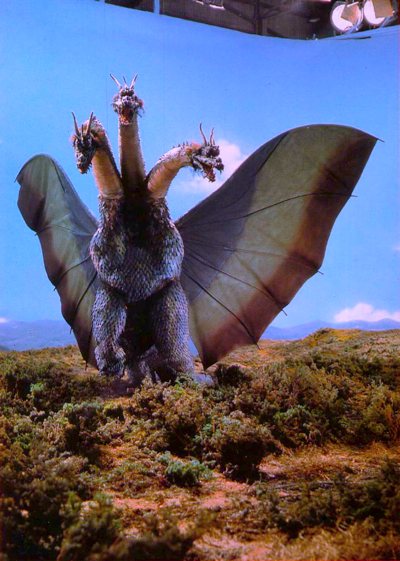
It goes without saying that this is a must-own, even if you don't read Japanese, because based on the previous volumes, "Keizo Murase, Monster-Maker", should measure up to over 95% photos versus text — and will surely be the book hardcore fans will be talking about for years to come. I mean, aren't your curious why the original King Ghidorah was blue and not gold?

Click on the link below to pre-order:
TREASURED KAIJU PHOTOBOOK: KEIZO MURASE, MONSTER-MAKER
Format: 8.2 x 5.9 inches
ISBN-10: 4800307562
ISBN-13: 978-4800307569
Release Date: September 9, 2015
MSRP: ¥5184 ($43.10 USD)

Special thanks to Shinichi Wakasa and Yasushi Shiroi for info, and a big shout-out to Takao Yoshiba for providing the cover image.

Thursday, July 16, 2015

HOSTING SHOUT'S "KAIJU MOVIE MARATHON"
24-Hours of Japanese Monster Movies and Me!

新番組『怪獣映画大会』登場!


The monstrous event starts this Saturday at Midnight, Eastern Time!

Prepare yourselves for something monstrous on July 18th...

Shout! Factory TV has teamed up with the original monster fan magazine, Famous Monsters of Filmland, to bring you the Kaiju Movie Marathon! Featuring nine classic Showa-era kaiju eiga (Japanese monster movies) from Toho Studios, spotlighting Godzilla, including hand-picked episodes of Tsuburaya Productions' ULTRA Q (1966) and ULTRA SEVEN (1967), streaming live for 24 hours on July 18th (from midnight to midnight Eastern Time). Hosted by Yours Truly!

Back in March, I was approached by a creative team at Shout! Factory to see if I wanted to be involved in this project, and I couldn't say no. Not only because this would be a fantastic opportunity, but because it was a chance to become a full, red-blooded, American Horror Host, just like my childhood hero, Bob Wilkins of "Creature Features" fame (if just for one day). They forwarded a rough script and told me to "make it your own." And that's exactly what I did.

We shot all of my segments in late June and I hope that everyone will enjoy them — I tried to keep it light, have fun with the material, but also be informative, drop some little known facts, and be completely respectful to the films and the genre (why wouldn't I? I love these films). I brought along some of my favorite Bullmark figures, several original movie posters, and some "Creature Features" tributes to decorate the set (shot at Chronicle Books in San Francisco).

Director Brian Blum, Cameraman Michael Bloom, and I had a blast!

This weekend's event will stream at www.shoutfactorytvlive.com. For mobile, tablet and connected TV devices the marathon is accessible via the Pluto TV app. The marathon is also available via Pluto TV (CH 427) in the living room (Amazon Fire TV and Fire TV Stick, Android TV, Chromecast and Apple Airplay), on the go (apps for iOS, Android and Amazon) and at your fingertips on PCs, Macs via the web.

THE "KAIJU MOVIE MARATHON" SCHEDULE (All Times Eastern):

12:00 am — GODZILLA: The Uncut Japanese Original (1954)
01:45 am — ULTRA Q (1966)
05:15 am — ULTRA SEVEN (1967)
06:30 am — GODZILLA, KING OF THE MONSTERS (1954)
08:15 am — ULTRA SEVEN (1967)
09:00 am — RODAN (1956)
10:30 am — ULTRA SEVEN (1967)
11:15 am — GODZILLA RAIDS AGAIN (1955)
12:45 pm — ULTRA SEVEN (1967)
01:30 pm — GODZILLA VS. THE THING (1964)
03:15 pm — GHIDRAH, THE THREE-HEADED MONSTER (1964)
05:00 pm — MONSTER ZERO (1965)
06:45 pm — GODZILLA'S REVENGE (1969)
08:15 pm — TERROR OF MECHAGODZILLA (1975)
10:00 pm — Repeat: GODZILLA: The Uncut Japanese Original (1954)
11:45 pm — Repeat: GODZILLA'S REVENGE (1969)
01:15 am — Repeat: TERROR OF MECHAGODZILLA (1975)

Just a note on the episodes I picked for this special presentation; all of them were not picked as the best of their respective series, but as the best of the kaiju-oriented episodes of each show. So, tune in for the kaiju calamity on July 18th, and live tweet with #godzilla. Shout! Factory TV and Famous Monsters of Filmland will be giving away prizes to fans and viewers of the marathon, including a $100 gift certificate for Shout! Factory merchandize.

In the words of Bob Wilkins, remember to "Watch Horror Films... Keep America Strong!"

(Viewers outside North America can view via Channel 427 on Pluto TV.)

Tuesday, April 2, 2013

2013 IS 1973: ZONE, THE SHOOTING STAR MAN
April 2, 1973 - September 24, 1973

ゾーンファイト・ パワー!


Eye-bleeding cover of a ZONE children's book (Shogakukan, 1973).

During the height of the Henshin Boom of the early 1970s, every network wanted their own superhero television series, and a number of studios were busy offering them proposals. One of the more conservative was Toho Co., Ltd., who had produced the popular RAINBOWMAN, THE WARRIOR OF PIETY the previous year, they also planned to capitalize on the phenomenon with the conception of GODZILLA VS. MEGALON (1973), which opened in cinemas on March 17th — featuring the very superheroic sidekick, Jet Jaguar.

Hot on it's heels, Toho and Mannensha Co. Ltd. unleashed ZONE, THE SHOOTING STAR MAN (shortened to ZONE FIGHTER for overseas sales) for the NTV (Nippon Television) network, with feature film monsters Godzilla, King Ghidorah, and Gigan appearing as guest stars (the Big G appears in five episodes). For 26 colorful and exciting episodes, Zone Fighter and his siblings sally forth against the vile alien forces of Garoga to protect their adopted home from destruction and bring peace to all mankind — with the help of Godzilla, of course!

Wednesday, August 5, 2009

BANDAI's GIANT MONSTER APPAREL!
Designer Daikaiju from Yoshihito Sugahara

バンダイの大怪獣 Tシャツ!


Sugahara breaths new life into the original! ©1954 Toho Co., Ltd.


A dynamic design of the golden triple-threat! ©1964 Toho Co., Ltd.


The original flying terrapin of terror! ©1965 Kadokawa Pictures


Guilala from THE X FROM OUTER SPACE! ©1967 Shochiku

These amazing high-end t-shirts, designed and executed by noted artist Yoshihito Sugahara, have been commissioned by Bandai's apparel division, and are available online and through various brick-and-mortar outlets in Japan only. Sugahara has designed a number of shirt for Bandai; everything from Ultraman through Toei Heroes, and are pretty damned impressive. While they may be well-worth tracking down for the hardcore fan, be forewarned: they range in price from $30-$39 USD.

I'll be also be featuring more samples of Bandai and Sugahara's tokusatsu t-shirt designs in future posts — stay tuned!

Tuesday, August 26, 2008

「三大怪獣・地球最大の決戦」
GHIDRAH: THE THREE-HEADED MONSTER (1964)


Publicity photoshoot blue color design for King Ghidorah.

GHIDRAH: THE THREE-HEADED MONSTER

San Daikaiju Chikyu Saidai-no Kessen, Toho, 1964, 85 minutes
Director ISHIRO HONDA • Visual Effects Director EIJI TSUBURAYA

"Three Giant Monsters: The Greatest Battle on Earth" (the film's Japanese title) was planned to feature all three of their biggest monster stars, Godzilla, Rodan and Mothra, who would team up to fight a new, and extraterrestrial menace. With the aim to appeal to general audiences, the narrative takes on a fairy tale-style approach, and while it is far more light-hearted than MOTHRA VS. GODZILLA, it rather compliments the Honda-Tsuburaya film that preceded it into theaters, DOGORA: THE SPACE MONSTER (all released the same year), although it features one of the greatest monsters in all cinema.

Shinichi Sekizawa's screenplay is more fantasy-oriented, centering on an Eastern princess (a descendant of aliens) marked for assassination, and written to appeal to a broader audience than the previous films. Honda said to the late Guy Tucker, "When I make a monster film, I never think that it will be for children. I want to imagine and express a story [to a wide audience], but it's always children who are the most interested." While the other monsters are portrayed fairly de rigueur during the most of the film, they suddenly become anthropomorphic, "I don't think that monsters should be comical characters, the audience is more entertained when [the monsters] strike fear in the hearts of the [human] characters." But, despite this, Honda effortlessly sweeps the audience into the story, with assured and swift direction.

Then, there’s the star of the film. Perhaps the most inspired creature the studio ever conceived, King Ghidorah was the idea of scenarist Sekizawa, who only described the monster as having "three heads, two tails, and a metallic roar like a bell." Akira Watanabe, whose sketches combined the mythical Yamata-no-Orochi from Japanese legend and traditional Chinese Dragons, were faithfully brought to life by the prosthetic crew in Toho’s Visual Effects Department, designed the realization of King Ghidorah. According to legend, the triple threat was conceived to be a menacing crimson, while gold was favored by visual effects director, Eiji Tsuburaya. In color publicity photos after the suit was completed, he was painted blue, with red, gold, and blue-striped wings, but it was decided that blue would become problematic with Blue Screen matte process. There've been many conflicting stories concerning this, and no definitive answer, so far. Regardless, the interplanetary invader created such an impact on audiences, that it has since remained one of the most popular monsters ever created by Toho.

Yosuke Natsuki (b.1936), who had just come off of Honda's DOGORA, top-lines the cast as Detective Shindo. A former model, Natsuki, was preened as one of Toho’s new, young leads, and made a number of films in the 1960s. But, he wasn’t a flash-in-the-pan, either, and starred in numerous popular television series, such as G-MEN ’75 (1975-82). Almost twenty years after GHIDRAH, Natsuki returned to the kaiju eiga with Koji Hashimoto’s THE RETURN OF GODZILLA (1984) and more recently in Minoru Kawasaki’s MONSTER X STRIKES BACK: ATTACK THE G-8 SUMMIT (2008) - he also provided the voice of Commander DEUS in ULTRASEVEN X (2007). Still quite active, the veteran actor recently scored important roles in François Rotger’s THE PASSENGER (2005) and Shunichi Nagasaki’s BLACK BELT (2007).

The spunky, and very in-demand, Yuriko Hoshi (WARRING CLANS) stars as Shindo's sister, Naoko, an investigative reporter for a series called "Mysteries of the 20th Century." Ozu regular, Hiroshi Koizumi (DAUGHTERS, WIVES AND A MOTHER), once again plays the scientist, a geologist named "Professor Murai" (both actors seemingly carried over from their similar roles in MOTHRA VS. GODZILLA). The beautiful Akiko Wakabayashi (BANDITS ON THE WIND) plays the unifying character, "Princess Salno," who went on to appear in YOU ONLY LIVE TWICE (1967). Her only starring role was in Luigi Filippo D'Amico’s AKIKO (1961). Originally, the assassin "Malmess" was to be played by actor Yoshio Tsuchiya (FUNERAL PROCESSION OF ROSES), but was held up on the lagging production of Akira Kurosawa's RED BEARD, and was replaced by character actor Hisaya Ito (A WOMAN’S LIFE).

Many of Tsuburaya's visual effects for the picture are thrilling, such as the birth of King Ghidorah, its awesome destruction of Yokohama and Tokyo, and the first battle between Godzilla and Rodan. His work here is as good as seen in MOTHRA VS. GODZILLA - with fantastic long shots of Godzilla and Rodan engaged in mortal combat - until battle reaches the slopes of Mt. Fuji. Here, the scenes between Godzilla and Rodan become static and stagey, oddly juxtaposed with fantastic shots of King Ghidorah’s wonton rampage, until Godzilla, Rodan and Mothra unite to drive off the interloper. The difference is somewhat jarring from the first half of the film, but Tsuburaya believed that this humanizing of the monsters would win over audiences.

Honda said, "I was hesitant to let Mothra act as the mediator... I felt that the monsters... were far too humanized." While the increasing anthropomorphic behavior of the colossi in the last quarter of the film seems to lower the bar that was set with MOTHRA VS. GODZILLA - it still doesn’t lower the entertainment value as a whole. Carried along by Maestro Akira Ifukube's wonderful fairy tale score (including a memorable song from The Peanuts), the visual treats of Tsuburaya, and the magnificence of King Ghidorah, GHIDRAH: THE THREE-HEADED MONSTER (the film's US title), is not only a memorable entry in the series, but also one of the most entertaining films of the kaiju eiga.

Executive Producer TOMOYUKI TANAKA Screenplay SHINICHI SEKIZAWA Production Design TAKEO KITA Cinematography HAJIME KOIZUMI Music AKIRA IFUKUBE Visual Effects Production Design AKIRA WATANABE Visual Effects Photography SADAMASA ARIKAWA [US Version] Additional Music and Sound Effects FILMSCORES INC. English Dialogue JOE BELLUCI Post-production Consultant RAY ANGUS

Starring YOSUKE NATSUKI (Detective Shindo) YURIKO HOSHI (Naoko Shindo) HIROSHI KOIZUMI (Professor Murai) AKIKO WAKABAYASHI (Princess Salno) HISAYA ITO (Malmess) AKIHIKO HIRATA (Chief Detective Okita) THE PEANUTS: EMI and YUMI ITO (The Little Beauties) and TAKASHI SHIMURA (Dr. Tsukamoto)