"There is so much writing in English on Japanese cinema that can't be accepted at face value — not because the writers are careless, but because the differences in culture and language are just too intricate. When I see August Ragone's name on a piece of writing, it gives me permission to place my faith in it completely. Among Japanese fantasy film historians, he's the best working in English." —Tim Lucas, Video Watchdog

Tuesday, May 12, 2009

"THE LAST DINOSAUR" STRIKES AGAIN!
Toho Video Issues Special Edition DVD

『極底探険船ポーラーボーラ』DVDに登場!


Cover art based on original release poster. © Toho Video

On May 22, Toho Video will be releasing a deluxe, special edition DVD of a 1977 film produced by Tsuburaya Productions and Rankin-Bass for the ABC Television network: Tsugunobu "Tom" Kotani's THE LAST DINOSAUR. Originally the first in a proposed five-picture deal, which includes THE BERMUDA DEPTHS (1978), THE IVORY APE (1980) and THE BUSHIDO BLADE (1981). Rankin-Bass had previously produced KING KONG ESCAPES (1967) with Toho.

THE LAST DINOSAUR was written by William Overguard (Steve Roper) and combines elements from Sir Arthur Conan Doyle's The Lost World, Edgar Rice Burroughs' At the Earth's Core and Universal International's 1957 science fiction film, THE LAND UNKNOWN. The wealthiest man in the world, industrialist Masten Thrust (Richard Boone), plans the greatest big game hunt of all time—tracking down a Tyrannosaurus Rex dwelling in a recently-discovered prehistoric pocket in deep in the Antarctic. Thrust's manned laser drill, Polar Borer, will get him there.

After its debut on ABC in February 1977, the film was released theatrically in Japan that October by Toho-Towa, and has only been issued once on VHS and LD in 1993. This completely remastered, anamorphic DVD release will contain the English and Japanese audio tracks, as well as an audio commentary track (in Japanese) with director Tsugunobu Kotani and Masumi Sekitani, the actress who played the cavewoman. The Japanese audio is from the original television broadcast (the original Japanese theatrical release was in English with Japanese subtitles). This release is also ten minutes longer than the 95-minute version shown originally on ABC-TV.

Also included in this DVD presentation is a special video message from actress Masumi Sekitani, a 13-minute interview with visual effects director Kazuo Sagawa, a production photo gallery (which includes storyboards, production designs, and behind-the-scenes photos), a 15-minute, behind-the-scenes production reel of the visual effects shoot (narrated by Kazuo Sagawa), and the original Japanese release trailer. Toho Video's MSRP is 4725 Yen (approximately $49.50 USD).

The first pressing of the DVD will contain a reproduction of the "special screening" ticket from the presentation at the Tokyo International Film Festival's "Natural TIFF" program last November. Additionally, customers will also find a coupon to order a pair of special, retro-style vinyl figures sculpted and created by the renowned M-1—one being the titular T-Rex and the other being the Polar Borer.


M-1's unpainted prototype T-Rex & Polar Borer vinyl figures.

In Tokyo this Saturday, a promotional late-night screening of three of Kotani's films at Theatre Shinjuku: THE LAST DINOSAUR (Kyokutei Tanken-sen Pora-bora), TOMORROW NEVER WAITS (Isoge! Wakamono, 1974) and LOVE IN A TEMPEST (Ai-no Arashi-no naka-de, 1978), will be preceded by an appearance and on-stage discussion with Kotani, called "The Secret of POLAR BORER." For those of you in the Tokyo Metropolitan area, or who will be there this weekend, click here for more details: cinemabox.com.

Sunday, May 3, 2009

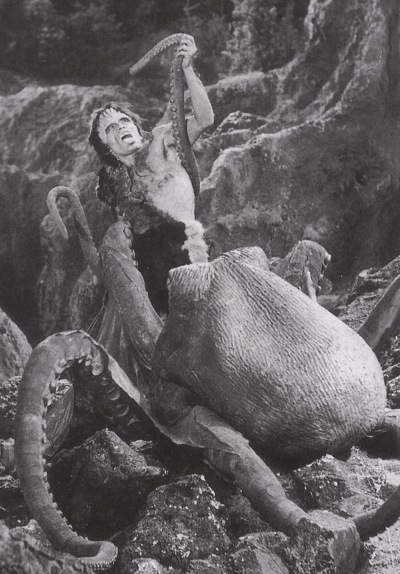
FRANKENSTEIN VS. THE GIANT DEVILFISH
Or "Pardon Me, Your Tentacles Are In My Soup!"

『フランケンシュタイン対大ダコ』の物語


Mystery! Colossal Frankenstein vs. Giant Devilfish! ©Toho Co., Ltd.

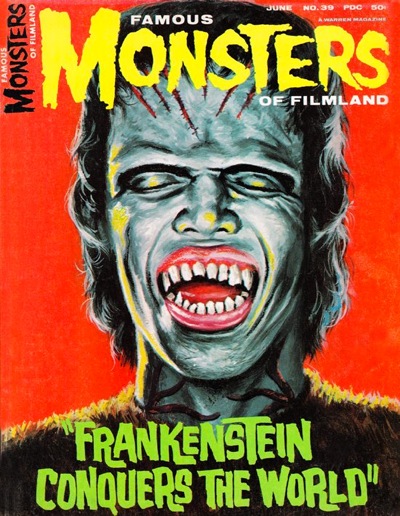
One of most oft-asked questions by fans of Japanese Fantasy Films fans on both sides of the Pacific is "What happened to that monster octopus that the giant Frankenstein was supposed to fight in FRANKENSTEIN CONQUERS THE WORLD?" For American fans, this question was originally raised due to and article (with accompanying photos) that appeared in "Famous Monsters of Filmland" #35 (later reprinted in #114 in 1975) as a sneak preview for the film's 1966 Stateside release by American International Pictures.

Readers of "Famous Monsters" discovered that the film was allegedly envisioned as "Frankenstein vs. the Giant Devilfish," according to Forry Ackerman's uncredited piece. Two stills accompanying the article featured this confrontation, but when we went to go see the film in theaters, no Giant Devilfish unspooled before our eyes. In fact, there were no fish of any kind in the picture at all (unless you count what was offered for lunch in the Toho's commissary).

So, while leaving the Grand Theater's triple feature in 1973 of ISLAND OF TERROR (1966), THE PROJECTED MAN (1967), and FRANKENSTEIN CONQUERS THE WORLD, I took a look at the display case again, and sure enough - as in "Famous Monsters" - there was a still of Frankenstein engaged in a water-struggle with a mammoth octopod! Did I miss something when I had to heed Nature's Call? Was I distracted by the other kids bouncing off the walls? Boy, was I a confused little monster kid, and was probably as confounded as Uncle Forry himself was.

Now the truth can be told! The "Devilfish" did indeed exist and it actually mixed it up with the hulking Frankenstein Giant. But first, let's take a step back to the evolution of the picture itself, known in Japan as FRANKENSTEIN VS. BARAGON (1965).

The Toho Motion Picture Company having met critical success with the hybrid "Irregular Fiction" (read: Science Crime Drama)/"Mutant Film," Ishiro Honda's THE HUMAN VAPOR (1960) - planned a sequel in which the Vapor Man brings the body of his beloved Fujichiyo to a practicing descendant of the original Dr. Frankenstein. The project was entitled, "Frankenstein vs. The Human Vapor", penned by Takeshi Kimura (MATANGO), never got past the screenplay stage. But, Frankenstein did not wait long, when producer John Beck presented Toho with Willis O'Brien's "King Kong vs. Frankenstein", although it was not meant to be. The concept was quickly eyed by Toho as a return vehicle for their own titan of terror, and responded with KING KONG VS. GODZILLA (but that's another story).

With the success of KING KONG VS. GODZILLA (1962), Toho opined that another western monster to pit against theirs should be their next film, but the tremendous cost of licensing King Kong from RKO (more than the cost to produce the picture itself), and had them looking for less expensive options. Eventually, they came back to "Frankenstein", since Mary Shelly's book was in the public domain. But, how would Toho come to pit the towering Godzilla against Frankenstein's human-sized Prometheus?

"Frankenstein vs. Godzilla," scripted by Shinichi Sekizawa (MOTHRA) contained elements that would be employed in FRANKENSTEIN VS. BARAGON, but ended with Godzilla being washed out to sea in a huge flood, while Frankenstein is consumed by the collapsing earth around him. With Sekizawa off to penning KING KONG VS. GODZILLA, the Frankenstein project ended up in the hands of Kimura. The president of United Productions of America, Henry G. Saperstein, after purchasing MOTHRA VS. GODZILLA (1964) and successfully licensing it to American International Pictures as GODZILLA VS. THE THING, became interested in the Giant Frankenstein scenario. Saperstein tapped Reuben Bercovitch (HELL IN THE PACIFIC) and Jerry Sohl (THE TWILIGHT ZONE) to flesh out a synopsis that could be turned into a screenplay.


The cover story that confused the world! (Art by Vic Prezio)

The final screenplay for FRANKENSTEIN VS. BARAGON concerned Nazi Germany handing over a trunk containing the immortal heart of the Frankenstein Monster to the Japanese in the last days of the war. Berlin was about to fall, and the Nazis didn't want such a precious scientific treasure to fall into Allied hands - perhaps wounded and dying soldiers could be cured by the secret of the Monster's Immortal Heart. But, sometime after the trunk arrived in Hiroshima, the city would meet the end of the war: The Atomic Bomb. The Immortal Heart, irradiated with all the horrific energy released by the destruction, began to mutate and grow a new body among the ruins of the vaporized city.

Soon, FRANKENSTEIN VS. BARAGON went into preproduction with Saperstein supplying a name American star to the proceedings. Toho wanted David Jansen, due to his high-profile status in Japan from his hit teleseries THE FUGITIVE (and were also courting COMBAT star Vic Morrow). Unfortunately, Jansen backed out at the 11th Hour, and next in line was Oscar-nominee Nick Adams, who had a hit series on the air in Japan, THE REBEL (1959-61). Adams also seemed more youthful and cheerful than Jansen on screen and he was given the role of Dr. Bowen. The script would somewhat follow Sekizawa's in basic structure, but drawing from ideas by Bercovitch and Sohl, and replacing Godzilla with a new antagonist: the subterranean monster, Baragon. But what about the Giant Devilfish?

According to an interview with director Ishiro Honda in "Toho Monster Graffiti" (Kindai Eigasha, 1991), FRANKENSTEIN VS. BARAGON "...was a co-production between Japan and America; if I remember correctly, it was with Benedict Productions [UPA's overseas production moniker]. You see, the money [budget] came from over there [laughter] ...so, there was an order from Benedict requesting us to add this octopus [to the last scene], and we complied - although we wondered about the logic that was involved, having this octopus popping out from the mountains [laughter]."

Kimura's screenplay: After defeating Baragon, with the raging fire swirling around him, Frankenstein begins to feel the ground beneath him heaving, as if it were alive. Suddenly Drs. Bowen, Togami and Kawaji notice than the giant is sinking into the ground, the massive battle having weakened the very earth itself. Slowly, Frankenstein disappears from sight; Dr. Bowen and party look on with subdued shock.

"Frankenstein is finally dead," sighs Togami.
Kawaji interjects, "He can't die. His heart will live forever."
Dr. Bowen adds, "He may be better off now; he couldn't live in this world."

The "Devilfish" was added to the script for the US version only (Honda would never allow such an outrageous occurrence in his cut): 

After defeating Baragon, and with the raging fire swirling around him, Frankenstein hauls the carcass to the end of a high precipice, and tosses the corpse into a ravine, where it is buried in an avalanche. Suddenly, from out of nowhere, a giant octopus from the craggy rocks, to which Dr. Bowen exclaims "A Devilfish!"
The mammoth octopus attacks the Frankenstein giant. Finally, worn from his exhausting battle with Baragon, the giant is pulled into a lake by the creature, and still fighting, sinks beneath the waters, apparently to his death. Dr. Bowen and party look on in subdued shock.

"Frankenstein is finally dead," sighs Togami.
Kawaji interjects, "He can't die. His heart will live forever."
Dr. Bowen adds, "He may be better off now; he couldn't live in this world."

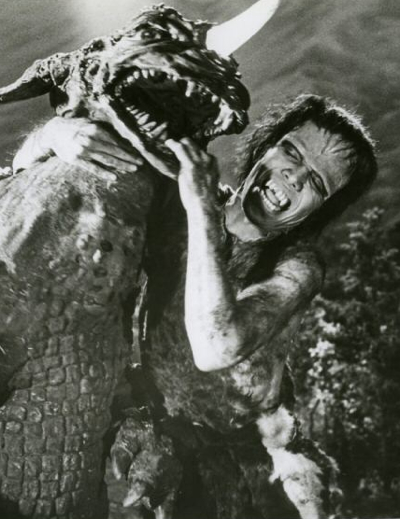
Honda prepared the sequence for the Japanese version, having veteran voice actor Goro Naya dub Adams' line "A Devilfish!" with "Daidako-da!" (It's a giant octopus!), and scoring it with Akira Ifukube's cue for the colossal cephalopod in KING KONG VS. GODZILLA (1962). Ultimately and ironically, the footage did not end up in either the Japanese or US versions of the film - following Kimura's script to the letter. The only difference in the two versions are several sequences that were specifically shot for the US version that would make Frankenstein appear more aggressive than the Japanese version, which portrayed him as a complete victim of a world he did not make and becoming aggressive only to save people threatened by the hungry wrath of Baragon.

Then, so why did Saperstein want to add this damned octo-thing into an already action-crammed finale in the first place? According to Director Honda: "Well, abroad the octopus was apparently supposed to be something demonic [a devilfish]; besides, [Benedict Productions] said that the special effects shot by [Eiji] Tsuburaya - the aforementioned Giant Octopus scenes in KING KONG VS. GODZILLA - were so spectacular, that no matter what, please shoot a scene like that for our film." To paraphase United World News reporter Steven Martin, "Perhaps Saperstein had too much sake."


Both versions end with the defeat of Baragon. ©Toho Co., Ltd.

For many years both Japanese and American fans were under the impression that the other's version contained the "missing devilfish," and both were wrong. It was not until 1983 when this author was given a VHS copy of the sequence by renown kaiju artist, Yuji Kaida, who was attending the San Diego Comic-Con. Two years later, Toho Video restored the footage and incorporated it into the film for their VHS and Laserdisc releases. But now, the original ending was gone! Couldn't they have just added it to the end of the tape/disc as a supplemental? Well, eventually in 1993, Toho Video did just that on a disc which also contains Benedict's "aggressive" Frankenstein scenes (unfortunately in Pan & Scan), also as a supplemental. This footage is also available on the subsequent Toho Video and Media Blasters DVD releases.

Honda lamented, "We went all the way to America for discussions with the people at Benedict [UPA], and then back again at Toho. Eventually, we ended up doing that Giant Octopus for them twice." Yes, the Giant Devilfish finally made its appearance to the world during the opening scenes of THE WAR OF THE GARGANTUAS (the very same marionette was also featured in an episode of Tsuburaya Productions' ULTRA Q, also in 1966). Guess what? Since the octo-limbed beast is seen being wrestled by Gaira - the Green Gargantua - who was an offshoot of the remains of the Frankenstein Giant... - see it coming? - it finally took place: "Frankenstein vs. the Giant Devilfish"!

And you though you were going to get away easy, didn't you?

(Updated and revised from a 1996 piece first featured in 2004 on my former website, Henshin! Online.)

Wednesday, April 29, 2009

GIANT MAJIN STRIKES AGAIN!
New Teleseries to Premiere in Japan this Fall

新番組「大魔神カノン』秋に登場!


Returning to life this October... but will we recognize him?

Over the last two decades, there have been numerous revivals and re-inventions of popular Japanese characters and remakes of beloved film franchises. Numerous attempts have been made to resurrect the avenging stone deity, Daimajin, first stirred to life in Kimiyoshi Yasuda's unforgettable 1966 Daiei production of the same name (and quickly spawned a pair of also memorable and iconic sequels), but all have failed to see the light of day. Until now...

In 1991, there were rumblings in the pages of Kinema Junpo, Japan's most respected cinema magazine, that high on the international success of Steve Barron's TEENAGE MUTANT NINJA TURTLES (1990), Golden Harvest had entered a deal with Daiei to produce a new DAIMAJIN film, starring Kevin Costner, who had just swept the Oscars with DANCES WITH WOLVES (1990). After the award-winning accolades garnered by GAMERA: THE GUARDIAN OF THE UNIVERSE (1995), Daiei announced that they would like to revive the hideous stone idol. There was nothing.

When Daiei changed hands and was sold to the giant Kadokawa Publishing empire in 2002, they also had future plans for Gamera and Daimajin. In 2005, eclectic fringe director, Takashi Miike, scored a hit with a re-imagining of Daiei's 1968 film, THE GREAT YOKAI WAR, and was summarily attached to a DAIMAJIN remake. Unfortunately, after the miserable box office receipts from Ryuta Tasaki's GAMERA: THE BRAVE (2006), Miike's DAIMAJIN project was cancelled by Kadokawa Pictures. Again nothing.

Then, on April 1, 2009*, the new issue of Kadokawa Publishing's Newtype: The Live, made an exclusive announcement—Daimajin would return in a new television series produced by Kadokawa Pictures: DAIMAJIN KANNON. Shigenori Takatera, a fan who became an Assistant Producer at Toei in 1986, is slated to produce. Takatera started his career with KAMEN RIDER BLACK (1987-88), worked his way up as the Chief Producer on RACING TASK FORCE: CARRANGER (1996-97) through STAR BEAST TASK FORCE: GINGAMAN (1998-99), and he then moved over to KAMEN RIDER KUUGA (2000-01) and KAMEN RIDER HIBIKI (2005-06).

While the Newtype: The Live article was very coy at divulging details, it does state that DAIMAJIN KANNON will be contemporary, instead of the feudal period-setting of the feature films, and will be aimed squarely at adult viewers, most likely guaranteeing a late-night broadcast (a network has not been announced). The article features an "image sketch" by To-ru Watanabe (Master of Epic), of a young girl, most likely the titular "Kannon" (or "Goddess of Mercy"), an avatar for Daimajin—following the template of the first film. Kadokawa describes the production as a "VFX Fantasy" remake of the original film.

Stay tuned to this blog for more details as they develop on this long-awaited return of Daimajin!

*April 1, known in the west as "April Fool's Day" is not observed in Japan. Therefore, this story is not a "prank," neither from here nor the source.

Wednesday, April 22, 2009

THE LAST SHOWAKAN PICTURE SHOW
Requiem For A Departed Tokyo Cinema

さらば、新宿昭和館よ!


The final marquee on April 30, 2002.

You could call it progress or you could call it an atrocity, but time and money march on, and as a result, we have now lost a treasure for Tokyo movie fans. Early in 2002, an announcement was made that the historic, infamous and largely ignored Shinjuku Showakan theater was to be closed after fifty-one years of unbroken screenings.

The reason for the closure? The theater could no longer support its operating costs, so the controlling members of the family-run business decided to go into a more lucrative venture with the property. Pachinko Parlor, anyone? Seven Eleven? Time marches on, destroying valuable institutions like the Shinjuku Showakan in the process.

One of the last of the old-time postwar cinemas in metropolitan Tokyo, the Showakan originally opened in 1932 and featured screenings of foreign films from Europe and America (when Japan later allied itself with Germany, all foreign films were banned). During the closing days of World War 2, the theater was flattened, along with the entire city, in the incendiary waves of fire bombing raids by United States Army Air Force B-29s.

Miraculously, the Showakan was rebuilt during the American Occupation and reopened for business in 1951 (about twelve months before the seven-year occupation ended), and began exclusively screening Japanese-produced motion pictures; mostly period chambara (swordplay) and ninkyo eiga, films made about heroic and honorable Yakuza at the turn of the century.

The new Showakan featured two screens; the main screen in the street-level theater, which had a capacity of 451 (including balcony seats), and the Chika Gekijo or "Underground Theater" (literally, not figuratively) was built under the main theater and was accessible through a separate entrance on the side of the main building.

After the Occupation, the Showakan began screening more daring and racy films — later to evolve into the pink eiga (soft-core porno films) — in their Underground Theater. The smut continued for decades to come, becoming a tradition that hung to the end as well (no pun intended). For at least twenty years, three new triple-bills of these 60 to 70 minute films were screened weekly.

This was also true for the Showakan proper — three new film programs, each and every week. During the late 1960s and 1970s, when the Showakan started specializing in yakuza eiga, it was the yakuza themselves who kept the theater going by patronizing the screenings in droves. As a side-effect, things would get hairy when they demanded free entry or brawls would break out in the auditorium! So authentic was the yakuza atmosphere of the theater that Toei Studios shot scenes for their films inside the Showakan.


The lights come up after the climatic screening.

A wealth of Japanese cinema history on and off screen — a place that should have been made into a shrine, if not declared a national landmark — was about to come to an end. The closure of the Shinjuku Showakan was coming, ironically, 13 years after the death of its namesake, Hirohito: The Showa Emperor, who reigned from 1925 to 1989.

Upon hearing the news of the closure, I made sure to attended the last two weeks of screenings at the Shinjuku Showakan theater on my most recent trip to Tokyo. After all, it was my obligation. I had been attending screenings at the theater since the mid-1980s, when I first lived in Japan. At first I was not sure if I'd like Yakuza movies, the now-defunct Kokusai Theater in San Francisco's Japantown never screened them — sticking to mostly to chambara and jidaigeki (fedual period) films.

But, I was seduced into the Showakan by the inclusion of the Sonny Chiba vehicle GANGSTER COP (Yakuza Deka, directed by Yukio Noda) on the bill. I was ill-prepared for Sadao Nakajima's THE IDIOT, THE UNTAMED AND THE THUG (Bakamasa Horamasa Toppamasa, 1976) — starring Bunta Sugawara — which blew me away. I wasn't the same person who entered the Showakan — that damned theater changed me.

Fast forward to the April 23, 2002: When I arrived in Tokyo, I was both excited to be a witness to the end, yet almost too sad to actually go through with it. It was like visiting a terminal relative on their deathbed and arriving in time only to see them as they draw their last breath.

Well, I bucked up and went by the theater the second day I was in town just to look at it. To just stare at Showakan to ready myself and see what films were playing on the second-to-last triple-feature before the end. Shinichi "Sonny" Chiba, Junko Fuji and Bunta Sugawara — a great lineup of stars graced the marquee and posters — their stern faces stared back at me, daring me to enter. Tatsuichi Takamori's YAKUZA WOLF: I BRING YOU DEATH (Okami Yakuza Koroshi-wa Ore-ga Yaru, 1972) — interestingly, a more FEMALE CONVICT SCORPION film than Chiba's usual actioners — Kosaku Yamashita's RED PEONY: FEMALE GAMBLER (Hibotan Bakuto, 1968) — the first in a long-running series — and Kinji Fukasaku's first entry in the seminal (can we use that word too much?) BATTLES WITHOUT HONOR AND HUMANITY (Jingi-naki Tatakai, 1972) series. Taking a deep breath, I made up my mind to attend the following night — the screening before the next (and last) change.

The next evening, I stood outside the Showakan for a long time just watching, just drinking in what was soon to be gone. The gomoku ramen settling in my stomach made me feel relaxed. One, two, three cigarettes. The last screening was about to begin. I snuffed out my Lucky Strike and walked over to purchase a ticket. After handing my ticket for resident illustrator Happy Ujihashi to tear, I entered the auditorium like it was Midnight Mass at the Vatican.

Soon, the films began to unspool as if the Showakan's impending doom was not coming. As for attendance, it was three-quarters full (I didn't check the balcony), and featured the usual suspects: salarymen, oyaji (old guys), some winos and a smattering of young hipsters. Strange. Young people in Japan hate old Japanese films, don't they? Meanwhile, the old coot who sat nosily behind me during Chiba's big finale, soon began snoring — but, it wouldn't be the Showakan without it. It somehow felt... right.


The balcony filters out at curtain call.

At curtain call, I stood in the lobby for a couple of minutes just drinking it all in, savoring each sight and sound. The walls, the floors and the tiles of the Showakan. Outside of the theater, I gulped down a Pocari Sweat, and then lit up a Lucky Strike. One cigarette, followed by another — just soaking up the atmosphere and the glare of the bulbs of the condemned Showakan. Finally, I walked away, but kept looking back.

Taking the Yamanote Line back to my ryokan (Japanese Inn) I was somehow elated... But, soon I started to realize that tomorrow would herald the beginning of the end. Melancholy began growing inside me. I somehow had to prepare myself for the inevitable, so I avoided going to see any other films before the Showakan's closure, and satisfied myself by rummaging through Tokyo's movie memorabilia shops — dwelling deep in the nostalgia for Japan's postwar Golden Age of Motion Pictures. You can smell the musty movie posters, can't you?

The night of nights finally came. The Showakan closed Tuesday, April 30 — the final triple-bill was Teruo Ishii's ABASHIRI PRISON (Abarashi Banchigaichi, 1965), the first entry in the 18-film series starring Ken Takakura and Tetsuro Tamba, One of Norifumi Suzuki's early efforts, BROTHERHOOD CODE: OPPOSITE SIDE OF THE SAKAZUKI CUP (Kyodai Jingi Gyakuen-no Sakazuki, 1968; 7th entry in the 9-film series) starring Saburo Kitajima, Tomisaburo Wakayama and Bunta Sugawara — and Tai Kato's monumental BLOOD OF HONOR (Meiji Kyokyakuden Sandaime Shume, 1965) with Koji Tsuruta and Junko Fuji. All were beautiful prints, for their age, and the audience was enthusiastic — there were more hipsters of all ages, who seemed out-of-place among the salarymen and oyaji.

Hey, there was even another whitey there as well: The Unknown Clown. Well, at any rate, that's what I always called him — a wacky gaijin expat who can be seen riding his bike through Shinjuku in full clown regalia (apparently, he's been doing this at least since the 1980s, when I first spotted him)! He came to the last show dressed for the occasion replete with a feathered mane fanning out from a plastic Tiger Mask matsuri mask! Oh, he brought beers, too, and sat right in front of me. "Hey, pass the Asahi Dry, please! One sip for me and one for my Homey — the Showakan."

Eventually, Shusuke Kikuchi's ending cue for BLOOD OF HONOR came to a reverberating crescendo and Showakan's curtain came down — and the house lights went up — for a final time. The capacity crowd rose to its feet in a standing ovation. It was then, through the applauding capacity crowd, that I spotted another gaijin in attendance, John Robinson (aka DJ Gnosis), who couldn't believe that the Showakan was now slipping into history.

As we stood whispering in the darkened auditorium, brilliant camera flashes combined with stunned silence and streaming tears for several minutes. Conversation began as the staff ushered everyone into the lobby, where we were sent off with sincere volleys of honto domo arigato (thank you very much) and gymnastic-like repetitions of deep bows as we left the Showakan for the last time.

About forty or more attendees, stood outside in the funeral-like drizzle, as if we were waiting for a Buddhist Priest to arrive and give the Showakan it's last rites. After a few minutes, the staff came out and thanked everyone for our support and performed another deep bow. Camera flashes. More tears. The doors were then shut for the last time. Hold on, August, hold on...


The last moviegoers leave the Showakan in silence.

Gradually, the flashes died down, and the crowd slowly and quietly departed one-by-one, or in small groups. At the very end, several people stood around talking about Old Skool Japanese films or the Showakan. Soon, I was the only person standing and staring at the end of an era — another chapter of Japanese cinema history now closed. Forever. I am grateful that I was there, and thankful for all the years of entertainment the Showakan has provided die-hard Japanese Cinemaniacs like myself — we were truly lucky.

Now, it was all over.

There are still two theaters left in Tokyo that specialize in screening Old Skool Japanese films. But, it is ironic that the Showakan closes as the younger Japanese movie fans are just starting to check out their own cinema history. "Since the Showakan closing was announced, attendance had gone up. Lots of the hip and trendy started coming... Too little, too late," observed John Robinson.

There may be some hope for the future — during my visit, there were ongoing tributes to Masamura Yasuzo, Japanese silent films, and other Old Skool Japanese pictures going on during Golden Week. A theater in the Nakano Ward was doing a series tribute to Toei's ninkyo yakuza films, while the Toho Asakusa Theater was screening an All-Night tribute to the films of Ishiro Honda: DOGORA THE SPACE MONSTER (1964), FRANKENSTEIN VS. BARAGON (1965), THE WAR OF THE GARGANTUAS (1966), GORATH (1963) and KING KONG ESCAPES (1967). These were pretty cool events and helped to ease the pain in the wake of the Showakan.

Perhaps these hipsters who starting turning out for the Showakan's Swan Songs, are also patronizing the others theaters still holding on. Hopefully, they will bear the torch for the coming generations of film fans, so that these wonderful gems of Japan's Golden Age of Cinema will not go silently into the night.

But still, the Showakan is gone. I am grateful that I was there to help honor and send her off into history. Long live the Shinjuku Showakan!


The doors of the Shinjuku Showakan being locked forever.

Orignally written and published on my former website, Henshin! Online, in August of 2002. All photos by the author.

Friday, April 17, 2009

Tuesday, March 24, 2009

BOB WILKINS RECEIVES A RONDO!
Inducted Into the "Monster Kid Hall of Fame"!


Classic publicity photo of Bob during his KTVU years.

Fellow Bob Wilkins & "Creature Features" Fans, it is my pleasure to proudly announce that our late, and much beloved, horror host, Bob Wilkins, has been inducted by the Rondo Awards this year, into the "Monster Kid Hall of Fame"! Bob joins this year's fellow inductees: Famous Monsters artist Ken Kelly, the late, great Lux Interior of The Cramps, legendary Spanish Horror star Paul Naschy, Jim and Marian Clatterbaugh, publishers of Monsters from the Vault magazine, and the late publisher of Castle of Frankenstein magazine, Calvin Beck.

For those who aren't familiar with him, Bob hosted horror films on KRCA-3 and KTXL-40 in Sacramento, and also in Oakland/San Francisco on KTVU-2 for more than twenty years, combined. Even though he left the airwaves more than twenty five years ago, he remains a legend to legions of fans in Northern California (including George Lucas and Tom Hanks), who grew up watching this mild-mannered, cigar-smoking host, introduce turkeys like The Vulture and Horror of Party Beach, as well as classics such as The Curse of Frankenstein and Kwaidan, with a sly, dry wit, and a wink to the viewer.

Bob was an inspiration to many, and helped those with whom he felt had talent—which doesn't explain me—but as someone who personally knew him during his peak years as a guest on his various shows, he not only gave me moral and financial support in producing some events (and my "Godzilla Fan Club"), but also inspired me that I could do anything. My story isn't special, really, because Bob showed that side of himself to many, many others. Most of whom, have gone on to successful careers in television, motion pictures, and other mediums—because Bob opened doors for them. He loved to give talent a boost, and for that, I thank him.

And now, I'd like to thank all of Bob's fans who lobbied for him to be recognized with this year's Rondo—and remember, "Watch Horror Films, Keep America Strong"!


For a complete list of this year's recipients of the 2008 "Rondo Hatton Award for Excellence in Classic Horror", please visit their official website at Rondo Awards.

For more on Bob Wilkins, and a fan celebration taking place this weekend in Sacramento, please visit the Official Bob Wilkins Website.

Wednesday, February 18, 2009

GREAT HAIRY BEAST!
Shinji Higuchi Unleashes GEHARA!!

樋口真嗣が製作総指揮『長髪大怪獣ゲハラ』新登場!


Mock movie poster for GEHARA in Old Skool-style. ©NHK 2009

Cult writer/Artist/Painter Master Jun Miura has teamed up with visual effects wizard Shinji Higuchi to create a 15-minute monster short for the NHK network's late-night series PLAY TV: PERFORM! (Tereasobi Pafoo!). The mini-movie, entitled GEHARA: THE LONG-HAIRED GIANT MONSTER (Chohatsu Daikaiju Gehara), will be broadcast as part of a 50-minute special on February 24th at 12:10 AM (Japan time). Over 325 entries were submitted to the producers when the project was announced last year.

Miura's plot features the monster-beleaguered nation of Japan being invaded by a bizarre colossal beast, with flowing black locks, and a newspaper reporter following the unfolding story. What makes this creature unique among Godzilla kith and kin, is that Gehara’s origins are rooted in traditional Japanese ghost stories, such as “The Black Hair” (Kurogami) featured in Masaki Kobayashi’s KWAIDAN (1964) and Sion Sono’s EXTE (2007).

But, this will not be a straight monster movie, rather, this mini-movie is yet another parody of the genre — on the heels of Minoru Kawasaki’s MONSTER X STRIKES BACK (2008) — in fact, one of the Self Defense Force plans to stop Gehara is called "Operation: Perm" (!), which features a Maser Cannon-like mobile weapon, looking suspiciously like a giant hair dryer on tank treads. Even though this is not being played straight, the involvement of Miura, who created and wrote the film, and Higuchi, who was the visual effects wizard behind the 1990s Gamera trilogy, should prove for interesting viewing.


Gehara raises it's shaggy head. ©NHK 2009

Directing his first professional feature is visual effects designer Kiyotaka Taguchi, whose low-budget indie kaiju eiga, simply titled “G”, has been wowing Youtube viewers with several clips and trailers, and is now on its way to make rounds at film festivals, starting next week at the world-renown Yubari International Fantastic Film Festival in Hokkaido, Japan. While the jury hasn't come in on the relative directorial talents of Taguchi, apparently, Higuchi, Miura and NHK are banking on him with GEHARA, which will also be screening at Yubari.

In the original treatment, the mysterious creature Gehara (the name is an anagram from the Japanese word “hige” or “beard” and “Ra” from “Gojira”) comes ashore during a monstrous typhoon, and begins to wreck havoc upon Tokyo. Eventually, the hairy beast is seemingly stopped by the Self Defense Forces’ Operation: Tokyo Drain. As a result, the beast is sucked into the city’s sewer system, but it begins to clog the works with its long hair, and ends up in a culvert. Left for dead, Gehara begins to revive, absorbing massive amounts of water beneath the streets of Tokyo’s fashionable Shibuya Ward, and it's long hair begins to grow… In the film, the monster attacks the city of Kanezawa.


Gehara tangles up Tokyo's usually reliable train system. ©NHK 2009

Higuchi and Miura have assembled an impressive cast for GEHARA: Ken Osawa (SAMURAI FICTION) as Newspaper Reporter Hideo Akihara, San Diego-born Mina Fujii as Momoko Akihara, Mitsuko Oka (VIRUS) as Tsuruko Akihara, Shiro Sano (GODZILLA 2000) as Professor Mikami, Tomorowo Taguchi (BULLET BALLET) as the Shrine Priest, Kanji Tsuda (GAMERA THE BRAVE) as Kubo the Fisherman, Hiroyuki Watanabe (ULTRAMAN GAIA) as JSDF Commander, Pierre Taki (ALWAYS: SUNSET ON THIRD STREET) as the Tank Commander and producer/commentator Terry Ito. While the film's score is credited to Akira Ifukube!

Will GEHARA: THE LONG-HAIRED GIANT MONSTER grow to become a fan favorite, or will it be cut to ribbons by critics?

• UPDATE 03/06/09: Watch the first eight minutes of GEHARA here! Then watch the last thee minutes (plus previews for the "next episode") here!

Link: NHK’s Official GEHARA Website
Link: Clip from NHK's 『テレ遊び パフォー!』(Play TV: Perform!)

Tuesday, February 17, 2009

WILKINS, TSUBURAYA & RAGONE @ WONDERCON
February 27th-March 1st • San Francisco


Commemorative Bob Wilkins poster by Mr. Lobo.

WonderCon returns to the Moscone Center in San Francisco, brought to you by the madmen behind the massive San Diego Comic Con International! This year, I will be hosting my usual Japanese Superheroes Now! presentation, as well as a behind-the-scenes journey to the Golden Age of Toho's kaiju eiga with Godzilla and the Master of Monsters. I also will be sitting in on a presentation on the late Horror Host Bob Wilkins, and there will be a special screening of the documentary Watch Horror Films, Keep America Strong. Hopefully I can squeeze a book signing in, too!

• Friday, February 27th
5:30-7:00 WATCH HORROR FILMS, KEEP AMERICA STRONG
For 14 years (1971-1984) Creature Features was one of the most popular programs in San Francisco Bay Area television history, hosted by the late Bob Wilkins for eight years (followed by John Stanley for another six). Wilkins' sharp wit and unusually droll humor and Stanley's celebrity interviews and encyclopedic knowledge are all part of Watch Horror Films, Keep America Strong, a feature-length documentary illuminating a bygone era of local television. Watch Horror Films also features interviews with Wilkins, Stanley, and other key figures — not to mention classic clips from the show! Room 220

• Saturday, February 28th
2:30-3:30 JAPANESE SUPERHEROES NOW: 2009!
Author August Ragone (Eiji Tsuburaya: Master of Monsters) returns for his 15th anniversary roundup of the latest superhero and kaiju productions from Japan: Kamen Rider Decade, Samurai Task Force: Shinkenger, Superior 8 Ultra Brothers and Ultra Galaxy: Giant Monster Battle Neo. Plus, see clips from recent stateside DVD releases, including Gamera the Brave, Inazuman, Super Robot: Red Baron, Kitaro, and more! Room 236/238

• Sunday, March 1st
3:00-4:00 A TRIBUTE TO BOB WILKINS
Join John Stanley, Bob Shaw, Rob Wilkins, Mr. Lobo, Ernie Fosselius, Tom Wyrsch and August Ragone for an information-packed journey through the life and career of the late Bob Wilkins, host of the Bay Area's mega-popular Creature Features horror movie show (1971-1979). The panel will share personal memories about Wilkins and show rare video clips and photos, as well as introduce scenes from the newly released DVD documentary, Watch Horror Films, Keep America Strong, which examines the history of one of the Bay Area's most beloved television legends. Room 220

4:00-5:00 GODZILLA AND THE MASTER OF MONSTERS
Author August Ragone (Eiji Tsuburaya: Master of Monsters) presents a visual tribute to Japan's Master of Monsters, Eiji Tsuburaya, the man who created the special effects for Godzilla and invented the kaiju eiga (giant monster movie) genre. See over a hundred rare, behind-the-scenes photographs from some of his major films, such as Godzilla, Rodan and Mothra, all in one big presentation! Room 220

Check out the WonderCon link for a full listing of their guests, events and programs.

Sunday, February 1, 2009

Monster of the Month
Doruge Demon: FRANKERUGE

ドルゲ魔人 フランケルゲ 「超人バロム・1」より


©Saito Productions/Toei Company

Height: 2.2 meters • Weight: 150 kilos • Origin: Abashiri, Hokkaido • Original Appearance: SUPERHUMAN BAROM-1 (1972) Episode 2 “Cursed Mutant: Frankeruge" • Design: Norio Maezawa • Fabricator: Keizo Murase • Voice Actor: Teiji Omiya

The evil Doruge facilitates the escape of a convicted murderer, Tetsu Kurosato, en route to prison, to convert him into a Dorugeman No. 2. Infected with the sinister Doruge Virus, spliced with the DNA of a Ligia oceanica (or Sea Slater), Kursato is mutated into the insidious Frankeruge. Carrying a police revolver stolen from Detective Kido in his escape, and his left arm alive with a one million-volt current, this grotesque agent of evil goes on a murderous rampage. Only Kentaro Shiratori and Takashi Kido, transforming into Barom-1, can stop the fiendish Frakeruge, whose only weakness is water.

Another of the bizarre "Agents of Evil" from BAROM-1, Frankeruge garnered his moniker from Mary Shelly's "Modern Prometheus"—the Frankenstein Monster—but save for their alchemic creation, the similarities end there. What really sells this monster for me is, not only Norio Maezawa's insane design, but also his human host, played by heavy Kyoichi Sato. A veteran of Toei's Yakuza eiga, Sato began his career as a bit player in several Toho films, including THE H-MAN (1958), but made his first notable appearance as a villain in Hideo Gosha's SWORD OF THE BEAST (1965).

But, at the end of the day, I don't know who's scarier, Frankeruge or Sato.

Wednesday, January 7, 2009

BOB WILKINS (1932-2009)
Popular Host of KTVU's "Creature Features"


Bob on the set of "Creature Features" at KTVU TV-2, circa 1971.

Bob Wilkins, the legendary and beloved host of KTVU's "Creature Features" has been suffering from advanced Alzheimer's for several years and saddled with rapidly declining health. Now, I am afraid to report that only four hours after I received word that his wife Sally, and Bob’s doctors, said that we should prepare for his passing, Robert Gene Wilkins, has left us. He's gone.

This is indeed sad, but inevitable news... His state was advanced and there was no hope to save him. Bob means a lot to me, not only as a legendary horror host I grew up with, but as a mentor. Man, Bob Wilkins was our hero — everyone at school talked about "Creature Features"! It was the greatest thing at the time — it's hard to explain the impact the show had on Bay Area viewers in the '70s. Especially the impact the show and its host, had on me — he was a personal friend, and like a father to me.

As a kid, I met Bob in the early '70s, and a few years later, was invited to be on his show to talk about Godzilla... I was only a kid, but Bob treated me like an adult, which was unlike most grown-ups. In fact, as nervous as I was (my leg was shaking the entire time), Bob asked me to come back to the show, to provide information on Japanese monster movies for "Creature Features." What a thrill, it seems so surreal now. In fact, I think it felt surreal back then, too. This too, is similarly, surreal.

When Bob launched the "Captain Cosmic" show in 1977, he invited me to come on the show to talk about THE SPACE GIANTS, and asked — a clueless teenager — for suggestions for other programs to run on "Cosmic." This was the kind of guy that Bob was. After the death of my Mom in early 1979 (my Dad was already deceased), Bob became like a surrogate family member, kept me in his thoughts, called me when he found opportunities for me, and put up the money to launch my short-lived "Godzilla Fan Club."

Bob phoned me one day, and told me to call a woman at Bill Graham Presents, who was looking for recordings of "monster sounds" to play before a Day on the Green concert. "The Monsters of Rock" (featuring AC/DC and Ted Nugent). So, I dubbed some sound effects from a couple of Japanese LPs, and was paid in cash and four backstage passes. Bob also offered an interview at KTVU to intern for a Cameraman position — which I turned down for fear of somehow blowing it and disappointing him.

Looking back on it now, Bob Wilkins was more than a surrogate family member, like an uncle, he was more like a father (well, a cool Step Dad, really). He means the world to me, and always will. Not for the shows he did, or being my favorite Horror Host of all time, but for the kind and generous man that he was, and will continue to be in my heart, for as long as I live.

Bob also meant a lot to so many others, more that you can imagine. So, if you were a fan of Bob Wikins and grew up with "Creature Features" and "Captain Cosmic" or were lucky enough to know him as a friend, please send your respects at his Official MySpace page or at the Official Bob Wilkins website — thank you.

Rest in Peace, Bob!
August Ragone
Your #1 Fan

Here's a classic Bob Wilkins Creature Features clip from the mid-'70s.

BOB WILKINS UPDATES: OBITUARIES & TRIBUTES


UPDATES (01/25/2008): The memorial service for Bob Wilkins on Saturday, January 24th at the Montclair Presbyterian Church in Oakland was very touching and also filled with much laugher and warm remembrances of Bob. One of them was that he begrudgingly attended Sunday Services with his wife and kids, and every week, he would fill out one of the comment cards found on the pews with "Get me out of here!" Another was that Bob would clip out interesting stories from the newspaper for his kids, and add his own one-line commentaries on them; one was a crime report about a Piedmont woman whose house was egged two nights in a row. Below the story, Bob wrote, "I guess Piedmont isn't all what it's cracked up to be."

Bob's children, Nancy and Rob, gave touching and funny eulogies, as did his widow, Sally. Nancy also sang "Unforgettable" with Rob on trumpet, and there was an excellent slideshow, sprinkled with video clips, representing a slice of Bob's truly wonderful life, which Sally described as being like Bob Clark's A CHRISTMAS STORY (1983). Some family and friends — and a couple of fans — were also invited to stand up and share some memories of Bob. Sure, there was reflection, sorrow, and tears. But, there was far more laugher that day, and I'm sure that's the way Bob would have wanted it, because he always wanted to see people happy, and he always wanted to make people laugh.

But, this is certainly not the end by any means. As John Stanley opened his eulogy at the memorial, "Bob Wilkins is not dead; he's alive in all of us!" And to underline this, "Creature Features" archivist Tom Wrysch announced that were will be two public extravaganzas to celebrate Bob Wilkins, one in Sacramento and the other in San Francisco, which will be large enough to accept the throngs of Bob Wilkins fans, and will be staged in the following months. The exact dates and venues to be announced — stay tuned for more details.

In the meantime, a recently-completed documentary, WATCH HORROR FILMS: KEEP AMERICA STRONG, will be screened at WonderCon taking place at the Moscone Center in San Francisco on February 27th—March 1st, with special guests participating and sharing their memories of the late, great Bob Wilkins. This event will also double as the DVD release of WATCH HORROR FILMS, which includes hours of extras, and copies of the documentary will be available for purchase at WonderCon.

The current issue of the San Jose Metro has published a lengthy and comprehensive feature on Bob Wilkins, which is required reading for fans and those who might not know who the "Creature Features" host was, and what made him tick. The Sacramento Bee published a wonderful piece, while other Nor Cal newspapers followed suit. January 9th's San Francisco Chronicle published a long and moving tribute, while Pat Craig's piece ran in several Bay Area papers, including The San Jose Mercury News and The Contra Costa Times.

There are also stories on several Nor Cal television station websites, including KTVU-2, KTXL-40 and KXTV-10 — please check them out for rare photos and clips. What I find amazing about these news stories, are the hundreds of responses on these respective websites, an outpouring of love for our host, which is a small indication of how popular and beloved Bob Wilkins remains — 28 years after he retired from television.

The first pair on online radio tributes for Bob Wilkins took place on Saturday evening, January 10th on the Rondo-Award winning Cult Radio A Go-Go with myself, John Stanley, Mr. Lobo, and Bob's webmaster, Scott Moon. You can download and listen to the show, here: CRAGG Bob Wilkins Tribute. On Monday evening, January 12th the The Joe Flynn Show dedicated their entire show to Bob Wilkins with clips and live chat.

For more information please visit the Official Bob Wilkins website.

Friday, January 2, 2009

Monster of the Month
Giant Fire Monster: ARON

大怪獣アロン 「マグマ大使」より


©P-Productions

Height: 50 meters • Weight: 320 metric tonnes • Origin: Planet Pal • Original Appearance: Episode 13-16 of THE SPACE GIANTS (1966-67) • Design & Fabrication: Fuminori Ohashi

A shapeshifting monster (with a bizarre humanoid form) that can generate internal temperatures so high, they cause the conflagration of entire worlds. After laying waste to the pacifist planet Pal, which refused to surrender, the evil intergalactic conqueror, Rodak, sent Aron to the Earth. Moving at 250 km/hour, Aron was able to quickly cause widespread destruction in its wake. Fortunately for mankind, Goldar was ready to defend us—although the intense heat issued by the monster, drawn from solar energy, made effective retaliation against him seemingly impossible.

Created by artist and sculptor, Fuminori Ohashi, the monster suit for Aaron was originally built for the Japan Radio Pictures production of AGON: THE ATOMIC DRAGON (1964), a four-part mini-series held from broadcast until 1968. Ohashi, who worked under Eiji Tsuburaya at Toho during the 1950s (and later under John Chambers on PLANET OF THE APES), modified Agon for THE SPACE GIANTS, and added the sabertooth fangs. The new suit made a brief appearance in the first episode as "dinosaur," and then became the better-known "Aron" for Episodes 13-16 of the series.

Thursday, January 1, 2009

HAPPY BIRTHDAY, HARUO NAKAJIMA!
They Called Him "Godzilla"! January 1, 1929

誕生日おめでとう ゴジラさん=中島春雄!


Enjoying some tea on the set of MOTHRA VS. GODZILLA (1964).

The Dean of Monster Suit Actors, Haruo Nakajima, got his start at the age of 20, as an uncredited background actor and stuntman at Toho Studios, working on Akira Kurosawa's STRAY DOG (1949). While the scene was an intense knock-down-drag-out-brawl, shot on a rather sweltering summer day, Nakajima laughed that, after all of the retakes, the footage unceremoniously ended up on the cutting room floor. Still, that didn't deter him, as he dutifully appeared, and died, in an endless succession sword films. As thankless as many of those stints were, Nakajima relishes the fact that, as "Bandit C", he was cut down by the stoic Kyuzo (Seiji Miyaguchi) in Kurosawa's SEVEN SAMURAI (1954).

But, it was a stunt that he volunteered for, that really brought him to everyone's attention at Toho. A scene in Ishiro Honda's World War II spectacle, EAGLE OF THE PACIFIC (1953), required a live stunt in which a pilot becomes immolated when his Zero Fighter, sitting on the deck of a aircraft carrier, is hit by an incendiary. Asking for volunteers, it was Nakajima who fearlessly stepped up to the plate, and performed the first such fire stunt in Japanese Cinema. With this accomplishment, Nakajima became the "go-to guy" for stunt work, so when it was decided that Godzilla would be brought to life primarily by a man in a suit, his was the first name that came to mind.

From Honda's GODZILLA (1954) through Jun Fukuda's GODZILLA VS. GIGAN (1972), Nakajima was the primary Godzilla performer, who was also tapped by Eiji Tsuburaya to essay all of the major monsters for Toho's Fantasy Films of the 1950s and 1960s. Among Nakajima's favorites is Gaira (the Green Gargantua) from Honda's THE WAR OF THE GARGANTUAS (1966). In the mid-1960s, Nakajima brought his considerable experience to television for ULTRA Q, ULTRAMAN, and ULTRA SEVEN. During this period, now considered a master at his craft, he helped to train a whole new generation of monster performers. In 1972, this all came to an end, when Toho disbanded its contract players, and Nakajima retired from monster acting.

Mr. Nakajima, despite recent health issues, traveled to Chicago last summer to attend G-FEST, where he received his "Mangled Skyscraper Award." During the ceremony, he was surprised by a proverbial flood of congratulatory letters from film professionals on both sides of the Pacific, extolling admiration for him and his work. While I had last met with him eight years ago at G-FEST in Hollywood, Nakajima was still as strong and tenacious as ever, still wielding that vice grip-like handshake, and a sharp and fiery tongue. Well, isn't that what one would come expect from Godzilla himself?

Cheers to Haruo Nakajima, King of the Monsters!