"There is so much writing in English on Japanese cinema that can't be accepted at face value — not because the writers are careless, but because the differences in culture and language are just too intricate. When I see August Ragone's name on a piece of writing, it gives me permission to place my faith in it completely. Among Japanese fantasy film historians, he's the best working in English." —Tim Lucas, Video Watchdog

Showing posts with label The War of the Gargantuas. Show all posts

Thursday, June 15, 2017

BANDAI UNLEASHES THE "GREEN GARGANTUA"! Vinyl Display Figure Breaks Loose in September

日本特撮の「サンダ対ガイラ」からガイラをバンダイソフビで発売。

Bandai Gaira blog-00
Bandai issues it's first vinyl figure of Gaira, the Green Gargantua!

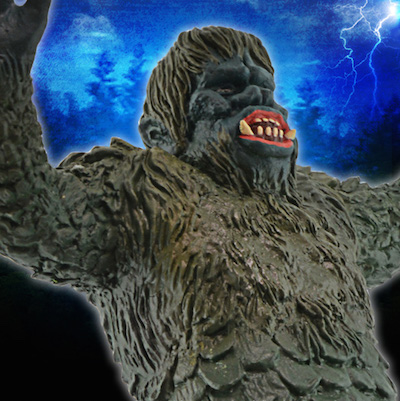
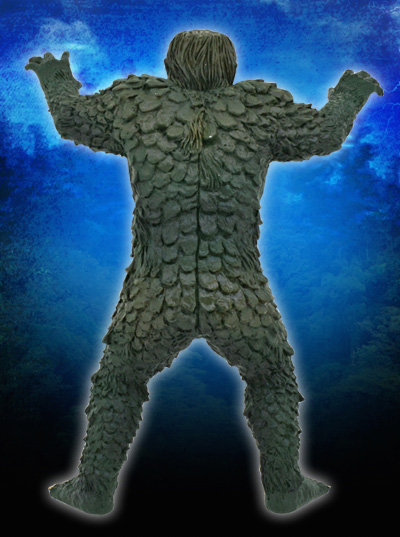
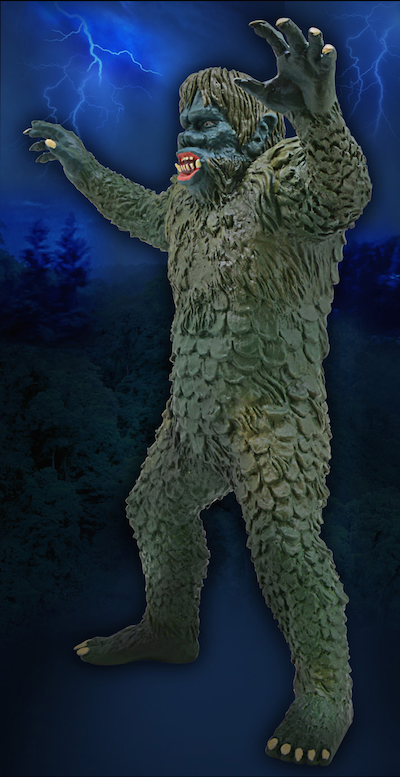
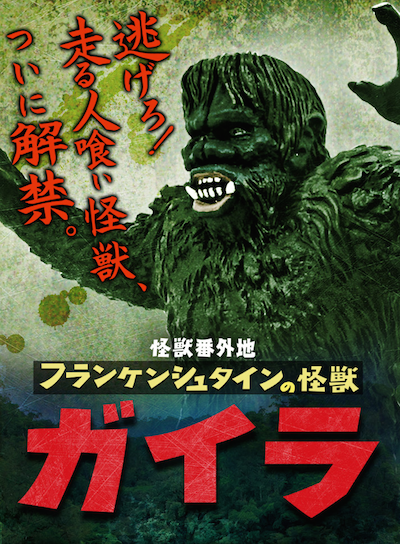
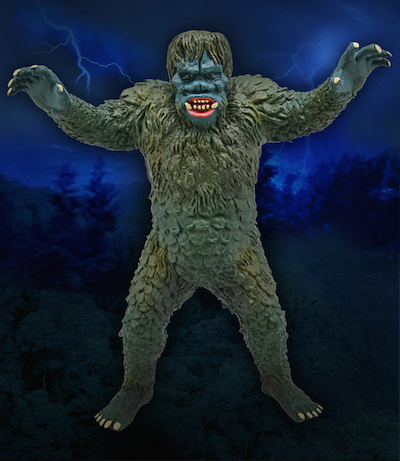
COLOSSAL GARGANTUAN BREAKING NEWS! Announced earlier today via the Twitter feed of the journal, Tokusatsu Hi-Ho (Special Effects Treasures), the online-only Bandai Premium service of the eponymous global toy juggernaut, will be issuing a 18 cm (7.08") soft vinyl figure of the fan favorite Green Gargantua, Gaira, from the popular Toho spectacle THE WAR OF THE GARGANTUAS (1966).

Bandai Gaira blog-002
Iconic aggressive pose developed by suit actor Haruo Nakajima!

Coinciding with this announcement, Tokusatsu Hi-Ho’s latest issue will feature an article on the upcoming figure as well as an interview with legendary monster suit maker Eizo Kaimai, who had created the very man-eating mutant this sofubi (soft vinyl figure) is based on – so, we can imagine that this has passed his snuff. Tokusatsu Hi-Ho Vol. 6 is available from bibliopolists in Japan, starting tomorrow.

Bandai Gaira blog-003
Run to the hills... Run for your lives... Gaira's looking for dinner!

The Bandai Premium website followed suit with four very important, key, details, and lots of images; which have transposed to this report (Bandai states that the actual product will differ from these intended for illustrative purposes). Most of the text on Bandai’s page for this figure is nothing more than a stream of colorfully hyperbolic points, such as “Beware! Run from this man-eating monster!”

Bandai Gaira blog-004
My Green Gargantua's back... and you're gonna be in trouble!

But, as mentioned above, there are four key pieces of information, the first being the size of the figure, which is 18 cm - which fits in with the original Bandai "Godzilla Series", to better appeal to adult collectors (relative movie sizes notwithstanding) - and the ad copy exclaiming, "This is the figure [we] always wanted to see in stores - now, at last, it's available via the Web!"

Bandai Gaira blog-008
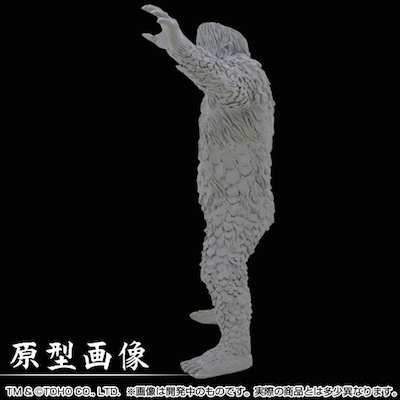
Sideview of the unpainted prototype for the upcoming release!

While, we've got the size of this thing nailed down, there's the matter of release date and - most importantly to all of you hyperventilating, nail-bitting, vinyl-sniffers out there - price. Each unit will be retailing for ¥3,999 JPY or $36.00 USD. Preorders through Bandai Premium's website go live at 11:00 am, June 16th (Japan Time). Scheduled for shipment this September, Gaira will be ready to  eat  meet you...

Bandai Gaira blog-009
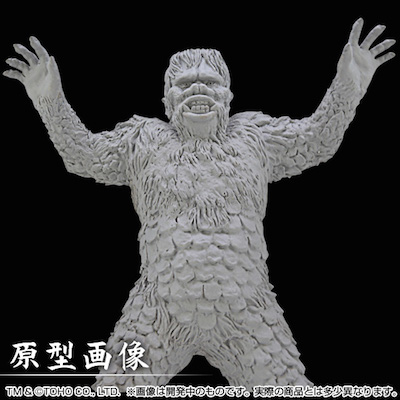
Kenji Seki's details pop in this shot of the unpainted prototype!

Last, but not least, the graphics and press features what appears to be a series line moniker, "Kaiju Bangaichi" (which can/may be roughly translated as "Monster No-Man's Land" or transliterated as "Monsters of Unknown Realms"). Even though we haven't stopped breathing into our paper bags, yet, could we soon see the Brown Gargantua, Sanda? And... Other giant monsters Bandai had previously passed over?

Bandai Gaira blog-01
Monstrous angled view of the popular bad guy from the 1966 movie!

Stay tuned for more gargantuan information as it comes up from the darkest depths to devour you! Or will you devour it?

Tuesday, February 23, 2016

RONDO HORROR AWARDS SEASON IS HERE AGAIN
And here I am... Begging for more votes. Sorry.

第14回「ロンド • ハットン クラシックホラー賞」始まる!


Kerry Gammill's awesome statuette of the late Rondo Hatton.

Here comes the Rondo Awards! Forget the inanity of the Academy Awards® and those flaccid Oscars© — it's time to vote for this year's nominees in 14th Annual Rondo Hatton Classic Horror Awards! Over the last year, I've been working with Shout Factory TV on several online marathons of Kaiju movies and Super Sentai teleseries, which pretty much qualifies me as a de-facto "Horror Host" — we're also planning more for this year, so stay tuned.

While I have not been nominated in that said category ("20. FAVORITE HORROR HOST OF 2015"), you can write me in on your ballots (which is not compulsory to complete; just vote for what or whom you want to). So, as for this "Favorite Horror Host" category, I suggest writing in: "August Ragone (San Francisco, Shout Factory TV's 'Kaiju Movie Marathon')".

Meanwhile, my blog has been officially nominated for the seventh consecutive year under "16. BEST WEBSITE OR BLOG OF 2015", which I also would love and appreciate your support. With that being said, I don't think I'll win — it's wonderful to keep receiving that "Honorable Mention" every year — it's just great being considered (perhaps I need to step my work on the blog?).

Another write-ins that should probably be recognized is our MONSTER ZERO/WAR OF THE GARGANTUAS double-feature, which I hosted last September at the Alamo Drafthouse Denver (write-in under "19. BEST FAN EVENT"). While you're at it, feel free to write me in under these, "26. MONSTER KID OF THE YEAR" and "27. THE MONSTER KID HALL OF FAME". I mean, why not? I've put in a lot of years into this game.

Putting myself aside, there are a great number of very talented folks who are up for nominations this year, so please (if you have the time) please give them your support for their amazing efforts. This is not mandatory, but it certainly would be kind of you — especially if you appreciate their fang-tastic work.

In order to submit your votes, simply copy the ballot after the jump and make your picks by highlighting your selection, or by putting an X by your selections, or by typing out your picks separately. Whatever is easiest. YOU DO NOT HAVE TO VOTE IN EVERY CATEGORY. Please e-mail your picks by April 10, 2016.

Cheers and thanks — here's the ballot for 14th Annual Rondo Hatton Classic Horror Awards!

Monday, October 29, 2012

THE 31 DAYS OF HALLOWEEN: DAY 29
The War of the Gargantuas & Monster Zero


Possibly the single greatest drive-in double feature of all time!

On the twenty-ninth day of Halloween, my true blood gave to me, twenty-nine Colossal Beasts, twenty-eight Haunted Houses, twenty-seven Poison Potions, twenty-six Pinewood Coffins, twenty-five Rattling Bones, twenty-four Creepy Crawlers, twenty-three Gypsy Curses, twenty-two Hissing Reptiles, twenty-one Tana Leaves, twenty Trembling Tendrils, nineteen Creepy Uncles, eighteen Eerie Cousins, seventeen Famous Monsters, sixteen Spiders Spinning, fifteen Witches Brewing, fourteen Voodoo Dollies, thirteen Ghosts a-Haunting, twelve Ghouls a-Grumbling, eleven Skulls a-Screaming, ten Zombies Feasting, nine Werewolves Howling, eight Mummies Crumbling, seven Vampires Preying, six Creatures S'laying, five Ghoulish Things, four Severed Limbs, three Shrunken Heads, two Devil Bats, and a Senior Lon Chaney!

Tuesday, October 26, 2010

MONSTER MASH: TRIBUTE TO ISHIRO HONDA
+ Screening of THE WAR OF THE GARGANTUAS!


Gaira ©Toho Co., Ltd. Art: Masano Koga, 1998

On Saturday, October 30th, editor of the national J-Pop mag Otaku USA, Patrick Macias and author of the lauded Eiji Tsuburaya: Master of Monsters, August Ragone respond to the Halloween call with a titanic tribute to the director of the original GODZILLA, Ishiro Honda.

With more than a nod towards the recently released book Mushroom Clouds and Mushroom Men: The Fantastic Cinema of Ishiro Honda by Peter Brothers, the provocative pair of kaiju fanboys contextualize Honda's prolific career with rare images and clips from classics of Japanese fantasy cinema such as RODAN, MOTHRA, THE MYSTERIANS, MONSTER ZERO, DESTROY ALL MONSTERS, ATRAGON, and BATTLE IN OUTER SPACE.

Plus! A special 16mm screening of Honda's THE WAR OF THE GARGANTUAS (1966), in which two hairy humanoids spawned from the colossal Frankenstein Monster (seen in FRANKENSTEIN CONQUERS THE WORLD), wreak havoc on — where else? — Tokyo.

Doors 7:30pm/Show at 8:00pm • Admission $6.00 • Free Hot Sake! • Come in Cosplay for cinematic trick-or-treats!

OTHER CINEMA / ATA Gallery
992 Valencia Street (@ 21st)
San Francisco, CA 94110

Sunday, May 3, 2009

FRANKENSTEIN VS. THE GIANT DEVILFISH
Or "Pardon Me, Your Tentacles Are In My Soup!"

『フランケンシュタイン対大ダコ』の物語


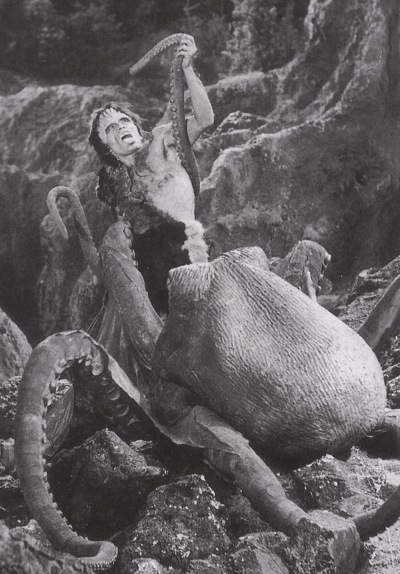
Mystery! Colossal Frankenstein vs. Giant Devilfish! ©Toho Co., Ltd.

One of most oft-asked questions by fans of Japanese Fantasy Films fans on both sides of the Pacific is "What happened to that monster octopus that the giant Frankenstein was supposed to fight in FRANKENSTEIN CONQUERS THE WORLD?" For American fans, this question was originally raised due to and article (with accompanying photos) that appeared in "Famous Monsters of Filmland" #35 (later reprinted in #114 in 1975) as a sneak preview for the film's 1966 Stateside release by American International Pictures.

Readers of "Famous Monsters" discovered that the film was allegedly envisioned as "Frankenstein vs. the Giant Devilfish," according to Forry Ackerman's uncredited piece. Two stills accompanying the article featured this confrontation, but when we went to go see the film in theaters, no Giant Devilfish unspooled before our eyes. In fact, there were no fish of any kind in the picture at all (unless you count what was offered for lunch in the Toho's commissary).

So, while leaving the Grand Theater's triple feature in 1973 of ISLAND OF TERROR (1966), THE PROJECTED MAN (1967), and FRANKENSTEIN CONQUERS THE WORLD, I took a look at the display case again, and sure enough - as in "Famous Monsters" - there was a still of Frankenstein engaged in a water-struggle with a mammoth octopod! Did I miss something when I had to heed Nature's Call? Was I distracted by the other kids bouncing off the walls? Boy, was I a confused little monster kid, and was probably as confounded as Uncle Forry himself was.

Now the truth can be told! The "Devilfish" did indeed exist and it actually mixed it up with the hulking Frankenstein Giant. But first, let's take a step back to the evolution of the picture itself, known in Japan as FRANKENSTEIN VS. BARAGON (1965).

The Toho Motion Picture Company having met critical success with the hybrid "Irregular Fiction" (read: Science Crime Drama)/"Mutant Film," Ishiro Honda's THE HUMAN VAPOR (1960) - planned a sequel in which the Vapor Man brings the body of his beloved Fujichiyo to a practicing descendant of the original Dr. Frankenstein. The project was entitled, "Frankenstein vs. The Human Vapor", penned by Takeshi Kimura (MATANGO), never got past the screenplay stage. But, Frankenstein did not wait long, when producer John Beck presented Toho with Willis O'Brien's "King Kong vs. Frankenstein", although it was not meant to be. The concept was quickly eyed by Toho as a return vehicle for their own titan of terror, and responded with KING KONG VS. GODZILLA (but that's another story).

With the success of KING KONG VS. GODZILLA (1962), Toho opined that another western monster to pit against theirs should be their next film, but the tremendous cost of licensing King Kong from RKO (more than the cost to produce the picture itself), and had them looking for less expensive options. Eventually, they came back to "Frankenstein", since Mary Shelly's book was in the public domain. But, how would Toho come to pit the towering Godzilla against Frankenstein's human-sized Prometheus?

"Frankenstein vs. Godzilla," scripted by Shinichi Sekizawa (MOTHRA) contained elements that would be employed in FRANKENSTEIN VS. BARAGON, but ended with Godzilla being washed out to sea in a huge flood, while Frankenstein is consumed by the collapsing earth around him. With Sekizawa off to penning KING KONG VS. GODZILLA, the Frankenstein project ended up in the hands of Kimura. The president of United Productions of America, Henry G. Saperstein, after purchasing MOTHRA VS. GODZILLA (1964) and successfully licensing it to American International Pictures as GODZILLA VS. THE THING, became interested in the Giant Frankenstein scenario. Saperstein tapped Reuben Bercovitch (HELL IN THE PACIFIC) and Jerry Sohl (THE TWILIGHT ZONE) to flesh out a synopsis that could be turned into a screenplay.
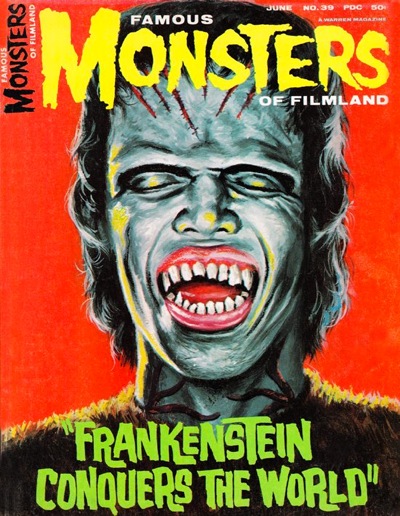

The cover story that confused the world! (Art by Vic Prezio)

The final screenplay for FRANKENSTEIN VS. BARAGON concerned Nazi Germany handing over a trunk containing the immortal heart of the Frankenstein Monster to the Japanese in the last days of the war. Berlin was about to fall, and the Nazis didn't want such a precious scientific treasure to fall into Allied hands - perhaps wounded and dying soldiers could be cured by the secret of the Monster's Immortal Heart. But, sometime after the trunk arrived in Hiroshima, the city would meet the end of the war: The Atomic Bomb. The Immortal Heart, irradiated with all the horrific energy released by the destruction, began to mutate and grow a new body among the ruins of the vaporized city.

Soon, FRANKENSTEIN VS. BARAGON went into preproduction with Saperstein supplying a name American star to the proceedings. Toho wanted David Jansen, due to his high-profile status in Japan from his hit teleseries THE FUGITIVE (and were also courting COMBAT star Vic Morrow). Unfortunately, Jansen backed out at the 11th Hour, and next in line was Oscar-nominee Nick Adams, who had a hit series on the air in Japan, THE REBEL (1959-61). Adams also seemed more youthful and cheerful than Jansen on screen and he was given the role of Dr. Bowen. The script would somewhat follow Sekizawa's in basic structure, but drawing from ideas by Bercovitch and Sohl, and replacing Godzilla with a new antagonist: the subterranean monster, Baragon. But what about the Giant Devilfish?

According to an interview with director Ishiro Honda in "Toho Monster Graffiti" (Kindai Eigasha, 1991), FRANKENSTEIN VS. BARAGON "...was a co-production between Japan and America; if I remember correctly, it was with Benedict Productions [UPA's overseas production moniker]. You see, the money [budget] came from over there [laughter] ...so, there was an order from Benedict requesting us to add this octopus [to the last scene], and we complied - although we wondered about the logic that was involved, having this octopus popping out from the mountains [laughter]."

Kimura's screenplay: After defeating Baragon, with the raging fire swirling around him, Frankenstein begins to feel the ground beneath him heaving, as if it were alive. Suddenly Drs. Bowen, Togami and Kawaji notice than the giant is sinking into the ground, the massive battle having weakened the very earth itself. Slowly, Frankenstein disappears from sight; Dr. Bowen and party look on with subdued shock.

"Frankenstein is finally dead," sighs Togami.
Kawaji interjects, "He can't die. His heart will live forever."
Dr. Bowen adds, "He may be better off now; he couldn't live in this world."

The "Devilfish" was added to the script for the US version only (Honda would never allow such an outrageous occurrence in his cut): 

After defeating Baragon, and with the raging fire swirling around him, Frankenstein hauls the carcass to the end of a high precipice, and tosses the corpse into a ravine, where it is buried in an avalanche. Suddenly, from out of nowhere, a giant octopus from the craggy rocks, to which Dr. Bowen exclaims "A Devilfish!"
The mammoth octopus attacks the Frankenstein giant. Finally, worn from his exhausting battle with Baragon, the giant is pulled into a lake by the creature, and still fighting, sinks beneath the waters, apparently to his death. Dr. Bowen and party look on in subdued shock.

"Frankenstein is finally dead," sighs Togami.
Kawaji interjects, "He can't die. His heart will live forever."
Dr. Bowen adds, "He may be better off now; he couldn't live in this world."

Honda prepared the sequence for the Japanese version, having veteran voice actor Goro Naya dub Adams' line "A Devilfish!" with "Daidako-da!" (It's a giant octopus!), and scoring it with Akira Ifukube's cue for the colossal cephalopod in KING KONG VS. GODZILLA (1962). Ultimately and ironically, the footage did not end up in either the Japanese or US versions of the film - following Kimura's script to the letter. The only difference in the two versions are several sequences that were specifically shot for the US version that would make Frankenstein appear more aggressive than the Japanese version, which portrayed him as a complete victim of a world he did not make and becoming aggressive only to save people threatened by the hungry wrath of Baragon.

Then, so why did Saperstein want to add this damned octo-thing into an already action-crammed finale in the first place? According to Director Honda: "Well, abroad the octopus was apparently supposed to be something demonic [a devilfish]; besides, [Benedict Productions] said that the special effects shot by [Eiji] Tsuburaya - the aforementioned Giant Octopus scenes in KING KONG VS. GODZILLA - were so spectacular, that no matter what, please shoot a scene like that for our film." To paraphase United World News reporter Steven Martin, "Perhaps Saperstein had too much sake."
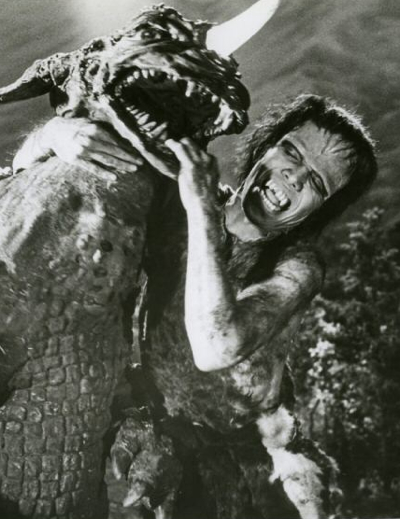

Both versions end with the defeat of Baragon. ©Toho Co., Ltd.

For many years both Japanese and American fans were under the impression that the other's version contained the "missing devilfish," and both were wrong. It was not until 1983 when this author was given a VHS copy of the sequence by renown kaiju artist, Yuji Kaida, who was attending the San Diego Comic-Con. Two years later, Toho Video restored the footage and incorporated it into the film for their VHS and Laserdisc releases. But now, the original ending was gone! Couldn't they have just added it to the end of the tape/disc as a supplemental? Well, eventually in 1993, Toho Video did just that on a disc which also contains Benedict's "aggressive" Frankenstein scenes (unfortunately in Pan & Scan), also as a supplemental. This footage is also available on the subsequent Toho Video and Media Blasters DVD releases.

Honda lamented, "We went all the way to America for discussions with the people at Benedict [UPA], and then back again at Toho. Eventually, we ended up doing that Giant Octopus for them twice." Yes, the Giant Devilfish finally made its appearance to the world during the opening scenes of THE WAR OF THE GARGANTUAS (the very same marionette was also featured in an episode of Tsuburaya Productions' ULTRA Q, also in 1966). Guess what? Since the octo-limbed beast is seen being wrestled by Gaira - the Green Gargantua - who was an offshoot of the remains of the Frankenstein Giant... - see it coming? - it finally took place: "Frankenstein vs. the Giant Devilfish"!

And you though you were going to get away easy, didn't you?

(Updated and revised from a 1996 piece first featured in 2004 on my former website, Henshin! Online.)
Thursday, May 8, 2008

フランケンシュタインの怪獣 サンダ対ガイラ
THE WAR OF THE GARGANTUAS (1966)

EijiGarg
Tsuburaya directs Haruo Nakajima as Gaira, 1966.

THE WAR OF THE GARGANTUAS
Furankenshutain-no Kaiju Sanda tai Gaira (Toho, 1966), 88 minutes
Director ISHIRO HONDA • Director of Visual Effects EIJI TSUBURAYA

One of the most beloved of Toho's non-Godzilla kaiju eiga, THE WAR OF THE GARGANTUAS (Japanese title "Frankenstein's Monsters: Sanda vs. Gaira") was produced as a direct sequel to FRANKENSTEIN CONQUERS THE WORLD (1965), but this connection was obscured in the US version by co-producer Henry G. Saperstein. His reasoning was that the characters did not look enough like the Giant Frankenstein from the previous film — the four-year gap between the release of FRANKENSTEIN CONQUERS THE WORLD and THE WAR OF THE GARGANTUAS in the States, may be a better (and more logical) explanation.

The first draft of Mabuchi's screenplay featured the same trio of characters from the previous film, "James Bowen" (Nick Adams) "Sueko Togami" (Kumi Mizuno) and "Yuzo Kawaji" (Tadao Takashima), but for unknown reasons, Nick Adams was not available, and so the characters' names were changed and the parts recast, with Kumi Mizuno (MATANGO) being the holdover (as "Akemi Togawa"). Kenji Sahara, the star of RODAN (1956) and THE MYSTERIANS (1957) replaced Takashima (as "Yuzo Mamiya") and Adams was supplanted by Russ Tamblyn (THE HAUNTING) as "Paul Stewart." The rest of the cast is rounded out with the usual stable of character actors, including Jun Tazaki (ATRAGON), Yoshifumi Tajima (MOTHRA VS. GODZILLA), and Ren Yamamoto (GODZILLA).

Prominently featured in the film are the Self-Defense Forces' mobile Maser Cannons, one of the more evocative and iconic creations in the genre — a tradition that started with the Katusha Rocket Tanks in GODZILLA RAIDS AGAIN (1955), the Markalites in THE MYSTERIANS, and the Atomic Heat Ray Cannons in BATTLE IN OUTER SPACE (1959) and MOTHRA (1961). The principal behind the weapon was a concentrated microwave beam, used to disrupt the cellular structure of its targets. Designed by Mutsumi Toyoshima (the unsung genius behind some of Toho's famous "mecha"), the Maser Cannons were built upon the A-Cycle Light Ray Cannons previously featured in MONSTER ZERO (1965). The Maser Cannons were also featured in GODZILLA VS. GIGAN (1972), GODZILLA VS. MEGALON (1973), and while offshoots and variants appeared in the Godzilla films of the 1990s, the originals were revived for GODZILLA AGAINST MECHAGODZILLA (2002) and GODZILLA: TOKYO SOS (2003).

Another element that has made the film memorable was the Gargantuas themselves and the striking use of the monster suit actors' own eyes, emphasizing the physical performances of Haruo Nakajima (as Gaira, the Green Gargantua) and Hiroshi Sekita (as Sanda, the Brown Gargantua), and allowing for a realistic and unsettling effect. This element of realism is one of the contributing factors in the film's rabid cult following on both sides of the Pacific, coupled with Tsuburaya's highly detailed studio and outdoor miniature sets (roughly 1/10 scale) which achieve a greater illusion of reality — and the furious fight to the death between the monsters — making this one of Tsuburaya's best monster films. Unfortunately, Honda's original concepts concerning the Gargantuas' growth from another's cells (adding a threat of more such creatures), and the original ending, having the undersea volcano engulfing and destroying Tokyo in flaming magma (an ironic twist that Honda wanted to punctuate the ending with), were cut from the final script. Honda later stated that shooting these destruction scenes would have run the film well over budget.

There were a number of editorial changes made between the Japanese and American versions of the film that are worthy of spotlighting: Tamblyn was given more scenes for the US version, including those only featuring Japanese cast members in the original, emphasizing his central importance in the narrative (Tamblyn was also asked to loop his dialogue to remove any references to "Frankenstein"). S. Richard Krown replaced Ifukube's repetitious military march with more suspenseful stock library music cues (including cues cribbed from MONSTER ZERO), which actually help the scenes in question. And there are additional visual effects scenes, unused in the Japanese version, which were employed to great effect, and help to make the US version four minutes longer than the Japanese. Honda told the late Guy Tucker (in his 1996 book, "Age of the Gods"), "Actually, I find [the film] a little boring. I'm glad it's popular, but [I feel that it] doesn't really have much heart."

Executive Producer TOMOYUKI TANAKA and KENICHIRO TSUNODA Screenplay KAORU MABUCHI and ISHIRO HONDA Production Design TAKEO KITA Cinematography HAJIME KOIZUMI Film Editor RYOHEI FUJII Music AKIRA IFUKUBE Visual Effects Production Design YASUYUKI INOUE Monster Design TOHRU NARITA Visual Effects Photography SADAMASA ARIKAWA and SOKEI TOMIOKA [US Version]: Producers HENRY G. SAPERSTEIN and REUBEN BERCOVITCH Original Story RUBEN BERCOVITCH Dialogue Supervisor RILEY JACKSON Film Editor FREDERIC KNUDTSON Production Supervisor S. RICHARD KROWN

Starring RUSS TAMBLYN (Dr. Paul Stewart) KENJI SAHARA (Dr. Yuzo Mamiya) KUMI MIZUNO (Dr. Akemi Togawa) JUN TAZAKI (Colonel Hashimoto) NOBUO NAKAMURA (Professor Kita) YOSHIFUMI TAJIMA (Hirai, Maritime Safety Agency)) NIDAO KIRINO (Lieutenant Kazama) REN YAMAMOTO (Saburo Kameda) and KIP HAMILTON (Nightclub Singer)

Wednesday, May 7, 2008

I KNOW LOWBROW ARTISTS IN HIGHBROW PLACES
Damn, I Really Love Monsters & Lowbrow Art!


"Bad Ass." Acrylic on canvas 16" x 20." © David Durrett

A few months back, I was "knocked for a ghoul" (to paraphrase Toho's English language brochure for VARAN), when I saw one of David Durrett's pieces based on Ishiro Honda's much beloved THE WAR OF THE GARGANTUAS on a message board. I was especially struck by David's use of texture, color and caricature, which felt as if they were painted in the 1960s during the height of the Kustom Kulture boom — when Ed "Big Daddy" Roth reigned supreme with his knight errant, Rat Fink. The so-called "Lowbrow" art flooded children's hearts with monstrous glee with exaggerated bug-eyed creatures emblazoned on t-shits, trading cards, stickers and model kits. It's a style and sensibility that's been often imitated, but rarely captured.

Then came David Durrett. Born April 1964 in New Orleans, Louisiana, David is the Vice President of Client Service for the Dalton Agency, a full service ad agency in Jacksonville, Florida. A Graduate of Jacksonville University, summa cum laude in Commercial Art, he said "Right after I got out of school, all the hands-on graphics techniques I had learned gave way to computerized approaches, which was great for the industry and for clients, but didn’t appeal to me as an artist." When asked about his influences, he quickly stated, "I’ve been a lifelong fan of Al Hirschfeld, Mort Drucker (who hasn’t), and Ronald Searle. Among current popular artists I really like are Gary Baseman, Tim Biskup, Amanda Visell, and David Horvath—I have many of their toys to prove it."


The Mad Monster Artist hard at work!

After seeing his amazing art, I had to ask why he had been "hiding" all of these years, "I’ve decided to get back into art for a number of reasons. Mainly, I’ve come to realize that my creative side is the part that’s really me, and it’s been dormant for too long. Also, the Lowbrow movement is perfect for artists with my personal history and sensibilities… suddenly, you can merge your art with the pop culture icons you’ve loved since childhood. I also am an avid toy collector, primarily of figures that render two-dimensional cartoon characters into three dimensions. That’s always fascinated me. With Lowbrow, and its offshoot Urban Vinyl, artists themselves are controlling how their characters are transformed into the third dimension, and I’m really into that."

When asked why he has started with the Gargantuas, David replied, "To so many of us, Japanese movie monsters are the stuff of our fondest Saturday morning memories, and Lowbrow gives us a chance to pay tribute as well as offer our own perspective on these characters that we view simultaneously with awe and amusement. (They’re also a lot of fun to render in acrylic.) I remember seeing THE WAR OF THE GARGANTUAS as one of the summer matinees my mother took me to at the old San Marco Theatre here in Jacksonville. GARGANTUAS was particularly memorable because what I knew as 'the Green one' was so frighteningly and excessively evil, and the fighting between the two was so relentless. Years later I got hold of a DVD and found that my 30-year-old memories were still spot-on."


"The Brown & the Green." Acrylic on canvas 24" x 30". © David Durrett

Asked to comment on "The Brown and the Green," he said, "The brother-against-brother theme suggested one of those tragic stories you read about families torn apart by the Civil War (in fact the script includes such a reference), and I just had to put them into a Matthew-Brady-style portrait complete with full regalia and weaponry. It was a lot of fun to research the uniforms and rifles, and to render such varied surfaces as leather, brass, wood, cloth, gunmetal, and, of course, fur. Following August Ragone’s very encouraging comment that the painting was 'bad ass,' I realized that Gaira perfectly epitomizes the term and was worthy of a follow-up portrait."

"Simultaneously, I have begun pieces with titles ranging from 'Candid Gamera' to 'Toho Presents The Mikado.' I plan to have at least six paintings completed by G-Fest, where I will be offering prints and posters (maybe 'Bad Ass' T-shirts?) as a member of Artists’ Alley. I’ve launched a simple website, daviddurrett.com, where I plan to both show and offer my work. In addition to paying tribute to existing characters, I’d like to develop some of my own, which is a natural progression of subject matter among Lowbrow artists."

Check out David's site at daviddurrett.com and visit him this July 4th-6th at G-Fest in Chicago — his dynamic work redefines the term "Bad Ass" for the Monster Kid in everyone. I'm sure that we'll be hearing a lot more from David and his wonderful Lowbrow creations in the near future — I just hope he remembers me when he's famous!