"There is so much writing in English on Japanese cinema that can't be accepted at face value — not because the writers are careless, but because the differences in culture and language are just too intricate. When I see August Ragone's name on a piece of writing, it gives me permission to place my faith in it completely. Among Japanese fantasy film historians, he's the best working in English." —Tim Lucas, Video Watchdog

Showing posts with label Akira Ifukube. Show all posts

Monday, November 10, 2014

"GODZILLA" ROARS AGAIN ON VINYL RECORDS!
King Records' Limited Edition Soundtrack LPs

伊福部昭生誕100年、ゴジラ誕生60周年記念企画 ! 


The retro jacket for King Records' GODZILLA Original Soundtrack!

For those who were excited by Death Waltz’s limited-edition vinyl LP for the Akira Ifukube original soundtrack for GODZILLA (1954), but lost out on getting a copy, you can now rejoice: Japanese label, King Records is gearing up to issue an analog release of their very own, along with the same for Ifukube’s KING KONG VS. GODZILLA (1962), as the “first complete limited-edition pressings” in Japan, on 180g vinyl LPs, just in time to celebrate both Ifukube’s centennial and the Big G’s 60th anniversary.

1960s Japanese movie poster vibe for KING KONG VS. GODZILLA!

For their first release, GODZILLA (KIJS-90015; 22 tracks, 37 minutes), King Records has gone back to the original 6mm master tapes, and striving for the best-ever sound quality, have employed the latest in mastering technology to match the warmth of the original masters as closely as possible. As for KING KONG VS. GODZILLA (KIJS-90016; 33 tracks, 50 minutes), the originals have been mixed down from the unprecedented 4-channel stereophonic masters to 2-channel stereo for the first time. The unique depth of the heavy bass has now been fully and faithfully reproduced for the first time (using the original 35mm film magnetic tapes as a guide).

The 6mm master tapes for GODZILLA with the original track listings!

Past and present CD releases, though forms of processing, including equalizing, frequencies, and other digital restrictions, could not fully represent the information native in the master tapes — therefore, the main impetus of the project was to replicate the original sound as closely as possible, in the name of posterity and for the heritage of Japanese film music. As for the jackets, it was decided to go with a retro-vintage design; GODZILLA sports art that mimics the 1954 theatrical program book, while KING KONG VS. GODZILLA apes the color and feel of the early-to-mid 1960s movie posters. Both LPs will street on December 24, 2014 for ¥3,600 Yen ($32.00 USD).

Please click the above-embedded links to order from Amazon Japan. It's unknown at press time whether there will be further LPs in this series, but if sales are strong, we could see MOTHRA VS. GODZILLA and GHIDRAH, THE THREE-HEADED MONSTER. To quote Debbie Harry, dreamin' is free...

Sunday, November 2, 2014

HAPPY 60th ANNIVERSARY, GODZILLA!
King of Monsters Debuted on November 3, 1954

ゴジラ生誕60年のアニバーサリー !


You're not getting older, Big G — you're getting better!

Has it really been 60 years since Godzilla was loosened upon the world? I remember when the Big G turned 25 in 1979, and since I was born long after 1954, it felt like he had been around an eternity from my young perspective. There was no time before him from my frame of reference. I grew up with Godzilla and he was already eternal. Little did we know that when I was growing up, Godzilla’s time was nigh; the first cycle of films that started in 1954 would be winding down by 1975. How could Godzilla not continue? His popularity in the US was at an all-time high — we still hadn’t gotten any of the films following GODZILLA VS. HEDORAH (1971) — he dominated local television, the pages of Famous Monsters and The Monster Times, and our thoughts.

As young Godzilla freaks, we drew pictures, created new monsters, and played with his toys (or made our own from dinosaurs figures) — even using the Aurora plastic model kit — but if you were lucky to live in Hawaii or California, you could buy what the kids in Japan had: 8” tall, soft vinyl “monster dolls” (we used to call them) with the iconic “Bullmark” logo branded on the bottom of their feet. As some of us got older, and remained fans, we organized, we started fan clubs, newsletters, fanzines, and hosted screenings. I was lucky to be retained as the “Godzilla/Japanese Film Expert” for our local horror host, Bob Wilkins, who had me talk about these films and television series on his shows, “Creature Features” and “Captain Cosmic,” thus pushing me in this direction.

The later films came, starting with GODZILLA VS. MEGALON in 1976 (our nation’s bicentennial), and his fans were legion, making the film a box office hit: There was no doubt that the Big G was the "King of the Monsters." Until the summer of 1977. STAR WARS exploded box office records around the world and Godzilla became an old hat, “So, 'last year.'” Even so, I — and others like me across North America — didn’t give up on our mon-star. Long before the Internet, we kept in contact through letters, fanzines, and phone calls. Still, even though Godzilla had been popular, he was looked down upon by many people — whether it was by those who still had a grudge against Japan or science fiction fans who saw the films as subpar — and so those of us who remained loyal, also had to be fiercely protective (not defensive) of the character and the films.

There were promises of revival movies that never materialized: “The Resurrection of Godzilla,” “Godzilla vs. the Devil,” and several US attempts, including a semi-remake, “Godzilla, King of the Monsters! 3D” (written by Fred Dekker and to be helmed by Steve Miner, which was more Gorgo than Godzilla). Finally, by the swelling nostalgic popularity at home, with record merchandise and home video sales, Toho announced an all-new Godzilla for 1984… It was a tenuous return, but one that would eventually spawn another thirteen films over the next two decades. In the 1990s, a new generation of US fans discovered the Big G and loved him. Old Timers discovered these new films, and new fanzines sprung up, as well as several conventions devoted to kaiju eiga.

This brave new fandom did not fade away, it has become stronger through cable and home video, the web, events and social networks. This has also grown to be embraced by those who just love monster movies and fantastic cinema — unscathed by the Roland Emmerich debacle — the reception to both editions of my book, “Eiji Tsuburaya: Master of Monsters” (Chronicle Books) has been phenomenal. New comic books, following in the footstomps those of the ‘70s and ‘90s, have taken off with a new, rabid following. And this summer's megabucks spectacle from Gareth Edwards won hearts and minds across the globe.

Everyone seems to have gone gaga for Godzilla. The Big G, kith and kin, have finally become “cool” (but we knew that already). After all, not only is Godzilla the first and greatest true kaiju ever to grace a motion picture screen, he is the one and true "King of the Monsters" — long live the king!

Dedicated to the memory of my childhood pal, Eric Worth

Wednesday, October 1, 2014

SCOOP! TOHO DISCOVERS LONG-LOST FOOTAGE!
Japanese Satellite Cable Premieres In November

日本映画専門の『ゴジラ』公開60周年記念「発掘!お宝特撮特集」


Were original 35mm elements for KING KONG VS. GODZILLA found?

While Toho’s Visual Effects films have been run before on the Nihon Eiga Senmon Channel (Japanese Movie Specialty Channel), and this past spring and summer saw a countdown of every Godzilla title on the Satellite Cable station to usher in the domestic release of Gareth Edwards’ GODZILLA (2014), there was more amazing news dropped on their website this past Wednesday morning in Japan, that will be another great cause for kaiju eiga fans across the globe to rejoice.

For "Unearthed! Treasures of Visual Effects Collection," four films will be broadcast during the Big G’s 60th Anniversary — a cross section of Honda and Tsuburaya’s best, which isn't special in of itself, nor the premiere of new HD transfers, but rather that two of the films will be hailed as celebrations in of themselves. One of them, fans have been hoping on for decades, while the other is a completely mind-boggling surprising announcement, which I never saw coming.

There's more BATTLE IN OUTER SPACE? OMG, gag me with a SPIP!

Here’s the biggest news, first: According to the NESC website, some of the lost negative elements for the full-length theatrical version of KING KONG VS. GODZILLA (1962) have recently been discovered and will be restored for this presentation. There is no word on when or where the source elements were found, but this is extremely good news since the missing material was previously culled from a worn, anamorphic 16mm print (no "new" scenes have been found or will be incorporated into the film).

NESC's website stated that while this broadcast will be the premiere of a new, “High Quality” version of KING KONG VS. GODZILLA, it was also announced that the missing footage of this presentation will be non-HD (the NESC stating it's an “up conversion"), so although viewers will see a complete presentation, they're forewarning that it's not a full HD restoration (which is set for a future date). No other details were revealed; just a comment asking fans to be patient.

Meh. This old movie... again!? Who cares!? It's not even in color!

The second big one was dropped in the same announcement and on the same page — and with even less information divulged: Toho has discovered over three minutes of missing footage from BATTLE IN OUTER SPACE (1959), presumably never seen before! NESC’s website is promoting this as the “Long Version” of the film, boasting a running time of 96 minutes (the running time of the previously released DVD versions run 90 minutes and 13 seconds).

Despite what appears to be a discrepancy in running times (which is to be sorted out, I’m sure), this is the discovery that I’m most excited about, as I absolutely am bonkers for this film. As a kid, it delivered everything the other space pictures promised, but didn’t (or couldn’t deliver on), and in “flaming color and Tohoscope” to boot! Sure, it might not contain any visual effects footage, and it could be just some dialogue scenes, or some exposition that won’t change our lives, but I could care less — I can’t wait!

The Amazing Colossal Frankie swings in his first HD transfer!

Also running will be the US version of GODZILLA, KING OF THE MONSTERS (1956), originally released theatrically in Japan in a faux “cinemascope” by masking the top and bottom of the 35mm frame. This HD transfer will be the first broadcast ever on television. Also making its HD premiere will be the original theatrical version of FRANKENSTEIN VS. BARAGON (1965), aka FRANKENSTEIN CONQUERS THE WORLD, sans the Giant Octopus shot for the export versions.

All of the films will be aired on the same day, November 24th (sans the original GODZILLA running on November 3rd and November 24th), for one broadcast only! Those with friends in Japan will probably be pressing them for copies of these broadcasts — a great year to be a fan of these films just got better — you can bet that I’ll be looking forward to seeing them as soon as I can!

An important clarification on KING KONG VS. GODZILLA:

There is no "new footage" and there are no "new scenes" being added into the film. If you have seen the Japanese version, then you've seen everything. What was found, were the 35mm source elements, which had previously been considered "lost" after the film was shortened for Toho Champion Festival screenings in the '70s. These missing scenes were replaced (for all subsequent Toho Video releases since the '80s) using a 16mm anamorphic print, and the jump in quality was jarring. So, while the there isn't going to be anything "new", it's going to look a lot better.

(Special thanks to Kevin Pyrtle for keeping me on my toes!)

Thursday, May 22, 2014

DEATH WALTZ' UNVEILS "GODZILLA" LP JACKET!
Regular & Limited Vinyl Pressing Out June 21st

福部昭の『ゴジラ』限定版LPレコード発行6月21日!


Cheung Chung Tat's jacket art featuring the 1990s-style Godzilla.

Back on March 12th, I broke the news that UK-based Death Waltz Recording Company had negotiated the rights to the full soundtrack of Akira Ifukube's score for GODZILLA (1954). Fully remastered from Toho's original audio materials, this release boasts the very first time the complete score has been pressed on vinyl, with exclusive art by Cheung Chung Tat. Interestingly, much like the Criterion Collection packaging, the cover art features a non-1954 Godzilla — here we have a Heisei-style Big G. You have to wonder what the process was in decided this, as I would've preferred a version of the king that actually appears in the film. Still, Tat's painting is admittedly spectacular (and the anachronistic Pacific War aircraft bare, not Rising Suns, but Death Waltz symbols — a nice touch).


Famed artist, Noriyoshi Ohrai captures the 1954 Godzilla perfectly.

All that minor art quibbling aside, Death Waltz is sparing no expense in creating this special presentation, which also features both deluxe and standard packaging for this historic soundtrack. Deluxe Gatefold Edition (limited to 400 units): 180g "Atomic Breath" (blue and white) vinyl, housed in a heavyweight tip-on, case-bound gatefold jacket printed on beautiful textured Galtex Prima card containing a full-color booklet (with liner notes by Japanese cinema expert Jasper Sharp and "Film On Wax" Editor Charlie Bridgen), and wrapped in an Obi strip (MSRP: £22.00). Standard Edition (limited to 400 units): 180g green vinyl pressing, housed inside a 350gsm single pocket jacket with a poster (MSRP: £17.00).

Here are Death Waltz' track listings (English translations seem to duplicate those contained in the 50th Anniversary release from La-La Land Records in 2004):

SIDE 1
Godzilla Approaches
Godzilla Main Title
Medley/ Ship Music / Sinking Of Eikou-Maru
Sinking Of Bingou Maru
Anxieties On Ootojima Island
Ootojima Temple Festival
Stormy Ootojima Island
Theme For Ootojima Island
Japanese Army March I
Horror Of The Water Tank
Godzilla Comes Ashore

SIDE 2
Godzilla’s Rampage
Desperate Broadcast
Godzilla Comes To Tokyo Bay
Intercept Godzilla
Tragic Sight Of The Imperial Capital
Oxygen Destroyer
Prayer For Peace
Japanese Army March II
Godzilla At The Ocean Floor
Ending
Secret Hidden Track

While these are not for sale to the US, when has that ever stopped fans from getting what they want? Until then, you can listen to the LP in full (for a limited time) on Empire Magazine online — and it sounds amazing!

Wednesday, March 12, 2014

AKIRA IFUKUBE'S "GODZILLA" SCORE ON VINYL!
Upcoming Audiophile Pressing from Death Waltz

伊福部昭の『ゴジラ』限定版LPレコード発行される!


A limited-edition complete GODZILLA score on vinyl is coming soon!

Talk about radioactive wax! Could a vinyl of Akira Ifukube's complete GODZILLA score soon be hitting turntables around the world? According to an image leaked on the interwebs today (posted below), containing a list for upcoming 180 gram vinyl audiophile pressings from the UK's Death Waltz Recording Company, it looks as though this may be true. Among the titles featured, such as Angelo Badalamenti's "Twin Peaks" and Fabio Frizzi's "The Beyond," was "Godzilla." Their website acknowledged the early leak and addressed them on their front page, including detailed information on some of the forthcoming releases, sans "Godzilla." Stay tuned for more details as they develop!


A close-up of the leaked listing of upcoming titles from DWRC.

(Thanks to Bloody-Disgusting for the heads up!)
Official Death Waltz Recording Company website

Monday, October 29, 2012

THE 31 DAYS OF HALLOWEEN: DAY 29
The War of the Gargantuas & Monster Zero


Possibly the single greatest drive-in double feature of all time!

On the twenty-ninth day of Halloween, my true blood gave to me, twenty-nine Colossal Beasts, twenty-eight Haunted Houses, twenty-seven Poison Potions, twenty-six Pinewood Coffins, twenty-five Rattling Bones, twenty-four Creepy Crawlers, twenty-three Gypsy Curses, twenty-two Hissing Reptiles, twenty-one Tana Leaves, twenty Trembling Tendrils, nineteen Creepy Uncles, eighteen Eerie Cousins, seventeen Famous Monsters, sixteen Spiders Spinning, fifteen Witches Brewing, fourteen Voodoo Dollies, thirteen Ghosts a-Haunting, twelve Ghouls a-Grumbling, eleven Skulls a-Screaming, ten Zombies Feasting, nine Werewolves Howling, eight Mummies Crumbling, seven Vampires Preying, six Creatures S'laying, five Ghoulish Things, four Severed Limbs, three Shrunken Heads, two Devil Bats, and a Senior Lon Chaney!

Saturday, February 12, 2011

キングコング対ゴジラ
KING KONG VS. GODZILLA (1962)


Eiji Tsuburaya (center, right) checks out Shoichi Hirose's suit-fitting.

KING KONG VS. GODZILLA
Kingu Kongu tai Gojira (Toho, 1962), 98 minutes
Director ISHIRO HONDA • Visual Effects Director EIJI TSUBURAYA

One of the most misunderstood and maligned films in the Godzilla series; KING KONG VS GODZILLA had a most bizarre and unfortunate genesis. But, that's Hollywood for you...

In the late 1950s, visual effects master Willis O'Brien (King Kong) found no luck in pitching his latest idea, "King Kong vs. Frankenstein", to studios, but it did catch the attention of former Universal producer John Beck. Beck took on the project, but also found it tough going until he came to Toho Studios, who were interested in a return vehicle for Godzilla (and another spectacle for their 30th Anniversary roster, which included Hiroshi Inagaki's Chushingura).

Beck was able to convince Toho to foot the entire licensing fees for King Kong, which amounted to 80 million yen (approximately $250,000 USD in 1962; adjusted to current inflation, approximately $1.8 million USD), which was three times the cost of the average Toho production at the time — this hefty price tag allowed Toho the rights to the character for five years.

Almost immediately, the studio execs began slashing the film’s budget, and one of the first things cut were Producer Tomoyuki Tanaka’s plans to shoot the Farou Island scenes on location in Sri Lanka (instead, they shot the scenes on Oshima Island, 62 miles offshore from Tokyo).

Keeping the budget restrictions in mind, director Ishiro Honda, visual effects director Eiji Tsuburaya, and scenarist Shinichi Sekizawa envisioned an entertainment picture along the lines of MOTHRA (1961), and screenwriting began in earnest. Cast in the lead was popular actor and comedian, Tadao Takashima (Emperor Meiji and the Russo-Japanese War, 1957), the father of actors Masanobu (Godzilla vs Biollante, 1989) and Masahiro (Godzilla vs Destroyah, 1995).

He was paired with Yu Fujiki (Samurai II: Duel at Ichijoji Temple, 1955), another comic genius, who was the unbilled "Eiko Maru" radio operator in the original GODZILLA — Honda would cast them together again in ATRAGON (1963). Actresses Mie Hama (The Merciless Trap, 1961) and Akiko Wakabayashi (Akiko, 1961) became superstars in their own right, and shared the distinction of becoming "Bond Girls" in YOU ONLY LIVE TWICE (1967). Wakabayashi gave up acting when she was married in 1968, while Hama pressed on, and is still active today.

RODAN's star, Kenji Sahara, plays Hama's inventor boyfriend in a supporting role. Mr. Tako, the greedy Advertising executive, was played by Ichiro Arishima (Young Blood is Burning, 1947), a physical comedian who was beloved by audiences as the "Japanese Chaplin", and was featured in over a hundred popular films and television shows.

The infamous Kong suit was not up to the par of what Toho's effects department could accomplish, especially in light of the rather effective Abominable Snowman in Honda’s HALF HUMAN (1955), due to the budget cutbacks imposed because of the high fees in securing the rights to the character. Even so, two suits were constructed, as well as several puppets — apparently, Tsuburaya wanted this incarnation of Kong to appear comical.

On the other hand, Godzilla appears more powerful than before, and established the "classic" look of the 1960s. While the miniature sets were as elaborate as ever, with mountains and rivers, Tsuburaya chose to shoot much the action at normal speed, which doesn't always allow these characters the illusion of mass and size.

Tsuburaya also permitted suit actors Haruo Nakajima and Shoichi Hirose to freely choreograph their fight scenes, and they chose Pro Wrestling, which was extremely popular in Japan at the time, and actually came up with some memorable — if outrageous — fight tactics.

Still, Honda's version is fast, furious, and entertaining as all get-out, and was never intended to be taken as seriously the original GODZILLA. Sekizawa wrote a satire on the rise of rampant commercialization in Japan, also reflected in Yazuo Masumura's GIANTS AND TOYS (1958), which is not apparent in Beck's version, and is neutered beyond reproach.

The unintentionally laughable scenes for the US version were amateurishly shot by the unremarkable actor-turned-director Thomas “Tom” Montgomery (The Many Loves of Dobie Gillis, 1961), and were cut haphazardly into Honda's, thus eliminating wonderful sequences from the original, to make room for Michael Keith (The Man and the Challenge, 1960) as the smug "UN Reporter Eric Carter", Harry Holcombe (Kisses for My President, 1964) as clueless "Dr. Arnold Johnson", and James Yagi (Bridge to the Sun, 1961) as the lost "UN Reporter Yutaka Omura".

All save for Akira Ifukube's Farou Island music, the maestro's thunderous stereo score was jettisoned whole by Beck — only to be replaced by jarring Universal library cues because they sounded less "Oriental" (culled from Creature From the Black Lagoon and Frankenstein Meets the Wolf Man). Apparently, Beck (who produced this version for $15,000 and pre-sold it to Universal-International for $200,000) never understood the film, and didn’t seem to catch on that it was done as a satire.

This was somewhat typical of the mishandling of these films in the early years, and why they are so misunderstood outside of Japan. Ironically, KING KONG VS. GODZILLA became the highest ticket-selling film of the entire Godzilla series in Japan (11.2 million tickets), while the US version broke summer box office records for Universal-International the following year.

For stealing his idea, O'Brien filed a suit against Beck, but couldn't afford to keep a lawyer to follow through, and sadly passed away before the film was released in the States. In the final outcome, it seems that John Beck was perhaps the most terrible monster of all.


Executive Producer TOMOYUKI TANAKA Screenplay SHINICHI SEKIZAWA Production Design TERUAKI ABE and TAKEO KITA Cinematographer HAJIME KOIZUMI Film Editor REIKO KANEKO Music AKIRA IFUKUBE Special Effects Production Design AKIRA WATANABE Special Effects Photography SADAMASA ARIKAWA Special Effects Director EIJI TSUBURAYA [US Version] Producer JOHN BECK Screenplay BRUCE HOWARD and PAUL MASON Music and Film Editor PETER ZINNER Director THOMAS MONTGOMERY

TADAO TAKASHIMA (Osamu Sakurai) KENJI SAHARA (Kazuo Fujita) YU FUJIKI (Kinsaburo Furue) MIE HAMA (Fumiko Sakurai) AKIKO WAKABAYASHI (Tamiye) JUN TAZAKI (General Masami Shinzo) SENKICHI OMURA (Konno) AKEMI NEGISHI (Faruo Island Dancer) YOSHIO KOSUGI (Faruo Island Chief) and ICHIRO ARISHIMA (Mr. Tako)

Tuesday, August 26, 2008

「三大怪獣・地球最大の決戦」
GHIDRAH: THE THREE-HEADED MONSTER (1964)


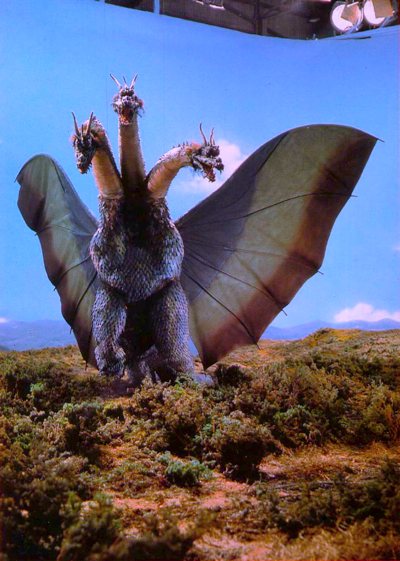
Publicity photoshoot blue color design for King Ghidorah.

GHIDRAH: THE THREE-HEADED MONSTER

San Daikaiju Chikyu Saidai-no Kessen, Toho, 1964, 85 minutes
Director ISHIRO HONDA • Visual Effects Director EIJI TSUBURAYA

"Three Giant Monsters: The Greatest Battle on Earth" (the film's Japanese title) was planned to feature all three of their biggest monster stars, Godzilla, Rodan and Mothra, who would team up to fight a new, and extraterrestrial menace. With the aim to appeal to general audiences, the narrative takes on a fairy tale-style approach, and while it is far more light-hearted than MOTHRA VS. GODZILLA, it rather compliments the Honda-Tsuburaya film that preceded it into theaters, DOGORA: THE SPACE MONSTER (all released the same year), although it features one of the greatest monsters in all cinema.

Shinichi Sekizawa's screenplay is more fantasy-oriented, centering on an Eastern princess (a descendant of aliens) marked for assassination, and written to appeal to a broader audience than the previous films. Honda said to the late Guy Tucker, "When I make a monster film, I never think that it will be for children. I want to imagine and express a story [to a wide audience], but it's always children who are the most interested." While the other monsters are portrayed fairly de rigueur during the most of the film, they suddenly become anthropomorphic, "I don't think that monsters should be comical characters, the audience is more entertained when [the monsters] strike fear in the hearts of the [human] characters." But, despite this, Honda effortlessly sweeps the audience into the story, with assured and swift direction.

Then, there’s the star of the film. Perhaps the most inspired creature the studio ever conceived, King Ghidorah was the idea of scenarist Sekizawa, who only described the monster as having "three heads, two tails, and a metallic roar like a bell." Akira Watanabe, whose sketches combined the mythical Yamata-no-Orochi from Japanese legend and traditional Chinese Dragons, were faithfully brought to life by the prosthetic crew in Toho’s Visual Effects Department, designed the realization of King Ghidorah. According to legend, the triple threat was conceived to be a menacing crimson, while gold was favored by visual effects director, Eiji Tsuburaya. In color publicity photos after the suit was completed, he was painted blue, with red, gold, and blue-striped wings, but it was decided that blue would become problematic with Blue Screen matte process. There've been many conflicting stories concerning this, and no definitive answer, so far. Regardless, the interplanetary invader created such an impact on audiences, that it has since remained one of the most popular monsters ever created by Toho.

Yosuke Natsuki (b.1936), who had just come off of Honda's DOGORA, top-lines the cast as Detective Shindo. A former model, Natsuki, was preened as one of Toho’s new, young leads, and made a number of films in the 1960s. But, he wasn’t a flash-in-the-pan, either, and starred in numerous popular television series, such as G-MEN ’75 (1975-82). Almost twenty years after GHIDRAH, Natsuki returned to the kaiju eiga with Koji Hashimoto’s THE RETURN OF GODZILLA (1984) and more recently in Minoru Kawasaki’s MONSTER X STRIKES BACK: ATTACK THE G-8 SUMMIT (2008) - he also provided the voice of Commander DEUS in ULTRASEVEN X (2007). Still quite active, the veteran actor recently scored important roles in François Rotger’s THE PASSENGER (2005) and Shunichi Nagasaki’s BLACK BELT (2007).

The spunky, and very in-demand, Yuriko Hoshi (WARRING CLANS) stars as Shindo's sister, Naoko, an investigative reporter for a series called "Mysteries of the 20th Century." Ozu regular, Hiroshi Koizumi (DAUGHTERS, WIVES AND A MOTHER), once again plays the scientist, a geologist named "Professor Murai" (both actors seemingly carried over from their similar roles in MOTHRA VS. GODZILLA). The beautiful Akiko Wakabayashi (BANDITS ON THE WIND) plays the unifying character, "Princess Salno," who went on to appear in YOU ONLY LIVE TWICE (1967). Her only starring role was in Luigi Filippo D'Amico’s AKIKO (1961). Originally, the assassin "Malmess" was to be played by actor Yoshio Tsuchiya (FUNERAL PROCESSION OF ROSES), but was held up on the lagging production of Akira Kurosawa's RED BEARD, and was replaced by character actor Hisaya Ito (A WOMAN’S LIFE).

Many of Tsuburaya's visual effects for the picture are thrilling, such as the birth of King Ghidorah, its awesome destruction of Yokohama and Tokyo, and the first battle between Godzilla and Rodan. His work here is as good as seen in MOTHRA VS. GODZILLA - with fantastic long shots of Godzilla and Rodan engaged in mortal combat - until battle reaches the slopes of Mt. Fuji. Here, the scenes between Godzilla and Rodan become static and stagey, oddly juxtaposed with fantastic shots of King Ghidorah’s wonton rampage, until Godzilla, Rodan and Mothra unite to drive off the interloper. The difference is somewhat jarring from the first half of the film, but Tsuburaya believed that this humanizing of the monsters would win over audiences.

Honda said, "I was hesitant to let Mothra act as the mediator... I felt that the monsters... were far too humanized." While the increasing anthropomorphic behavior of the colossi in the last quarter of the film seems to lower the bar that was set with MOTHRA VS. GODZILLA - it still doesn’t lower the entertainment value as a whole. Carried along by Maestro Akira Ifukube's wonderful fairy tale score (including a memorable song from The Peanuts), the visual treats of Tsuburaya, and the magnificence of King Ghidorah, GHIDRAH: THE THREE-HEADED MONSTER (the film's US title), is not only a memorable entry in the series, but also one of the most entertaining films of the kaiju eiga.

Executive Producer TOMOYUKI TANAKA Screenplay SHINICHI SEKIZAWA Production Design TAKEO KITA Cinematography HAJIME KOIZUMI Music AKIRA IFUKUBE Visual Effects Production Design AKIRA WATANABE Visual Effects Photography SADAMASA ARIKAWA [US Version] Additional Music and Sound Effects FILMSCORES INC. English Dialogue JOE BELLUCI Post-production Consultant RAY ANGUS

Starring YOSUKE NATSUKI (Detective Shindo) YURIKO HOSHI (Naoko Shindo) HIROSHI KOIZUMI (Professor Murai) AKIKO WAKABAYASHI (Princess Salno) HISAYA ITO (Malmess) AKIHIKO HIRATA (Chief Detective Okita) THE PEANUTS: EMI and YUMI ITO (The Little Beauties) and TAKASHI SHIMURA (Dr. Tsukamoto)

Thursday, May 8, 2008

フランケンシュタインの怪獣 サンダ対ガイラ
THE WAR OF THE GARGANTUAS (1966)

EijiGarg
Tsuburaya directs Haruo Nakajima as Gaira, 1966.

THE WAR OF THE GARGANTUAS
Furankenshutain-no Kaiju Sanda tai Gaira (Toho, 1966), 88 minutes
Director ISHIRO HONDA • Director of Visual Effects EIJI TSUBURAYA

One of the most beloved of Toho's non-Godzilla kaiju eiga, THE WAR OF THE GARGANTUAS (Japanese title "Frankenstein's Monsters: Sanda vs. Gaira") was produced as a direct sequel to FRANKENSTEIN CONQUERS THE WORLD (1965), but this connection was obscured in the US version by co-producer Henry G. Saperstein. His reasoning was that the characters did not look enough like the Giant Frankenstein from the previous film — the four-year gap between the release of FRANKENSTEIN CONQUERS THE WORLD and THE WAR OF THE GARGANTUAS in the States, may be a better (and more logical) explanation.

The first draft of Mabuchi's screenplay featured the same trio of characters from the previous film, "James Bowen" (Nick Adams) "Sueko Togami" (Kumi Mizuno) and "Yuzo Kawaji" (Tadao Takashima), but for unknown reasons, Nick Adams was not available, and so the characters' names were changed and the parts recast, with Kumi Mizuno (MATANGO) being the holdover (as "Akemi Togawa"). Kenji Sahara, the star of RODAN (1956) and THE MYSTERIANS (1957) replaced Takashima (as "Yuzo Mamiya") and Adams was supplanted by Russ Tamblyn (THE HAUNTING) as "Paul Stewart." The rest of the cast is rounded out with the usual stable of character actors, including Jun Tazaki (ATRAGON), Yoshifumi Tajima (MOTHRA VS. GODZILLA), and Ren Yamamoto (GODZILLA).

Prominently featured in the film are the Self-Defense Forces' mobile Maser Cannons, one of the more evocative and iconic creations in the genre — a tradition that started with the Katusha Rocket Tanks in GODZILLA RAIDS AGAIN (1955), the Markalites in THE MYSTERIANS, and the Atomic Heat Ray Cannons in BATTLE IN OUTER SPACE (1959) and MOTHRA (1961). The principal behind the weapon was a concentrated microwave beam, used to disrupt the cellular structure of its targets. Designed by Mutsumi Toyoshima (the unsung genius behind some of Toho's famous "mecha"), the Maser Cannons were built upon the A-Cycle Light Ray Cannons previously featured in MONSTER ZERO (1965). The Maser Cannons were also featured in GODZILLA VS. GIGAN (1972), GODZILLA VS. MEGALON (1973), and while offshoots and variants appeared in the Godzilla films of the 1990s, the originals were revived for GODZILLA AGAINST MECHAGODZILLA (2002) and GODZILLA: TOKYO SOS (2003).

Another element that has made the film memorable was the Gargantuas themselves and the striking use of the monster suit actors' own eyes, emphasizing the physical performances of Haruo Nakajima (as Gaira, the Green Gargantua) and Hiroshi Sekita (as Sanda, the Brown Gargantua), and allowing for a realistic and unsettling effect. This element of realism is one of the contributing factors in the film's rabid cult following on both sides of the Pacific, coupled with Tsuburaya's highly detailed studio and outdoor miniature sets (roughly 1/10 scale) which achieve a greater illusion of reality — and the furious fight to the death between the monsters — making this one of Tsuburaya's best monster films. Unfortunately, Honda's original concepts concerning the Gargantuas' growth from another's cells (adding a threat of more such creatures), and the original ending, having the undersea volcano engulfing and destroying Tokyo in flaming magma (an ironic twist that Honda wanted to punctuate the ending with), were cut from the final script. Honda later stated that shooting these destruction scenes would have run the film well over budget.

There were a number of editorial changes made between the Japanese and American versions of the film that are worthy of spotlighting: Tamblyn was given more scenes for the US version, including those only featuring Japanese cast members in the original, emphasizing his central importance in the narrative (Tamblyn was also asked to loop his dialogue to remove any references to "Frankenstein"). S. Richard Krown replaced Ifukube's repetitious military march with more suspenseful stock library music cues (including cues cribbed from MONSTER ZERO), which actually help the scenes in question. And there are additional visual effects scenes, unused in the Japanese version, which were employed to great effect, and help to make the US version four minutes longer than the Japanese. Honda told the late Guy Tucker (in his 1996 book, "Age of the Gods"), "Actually, I find [the film] a little boring. I'm glad it's popular, but [I feel that it] doesn't really have much heart."

Executive Producer TOMOYUKI TANAKA and KENICHIRO TSUNODA Screenplay KAORU MABUCHI and ISHIRO HONDA Production Design TAKEO KITA Cinematography HAJIME KOIZUMI Film Editor RYOHEI FUJII Music AKIRA IFUKUBE Visual Effects Production Design YASUYUKI INOUE Monster Design TOHRU NARITA Visual Effects Photography SADAMASA ARIKAWA and SOKEI TOMIOKA [US Version]: Producers HENRY G. SAPERSTEIN and REUBEN BERCOVITCH Original Story RUBEN BERCOVITCH Dialogue Supervisor RILEY JACKSON Film Editor FREDERIC KNUDTSON Production Supervisor S. RICHARD KROWN

Starring RUSS TAMBLYN (Dr. Paul Stewart) KENJI SAHARA (Dr. Yuzo Mamiya) KUMI MIZUNO (Dr. Akemi Togawa) JUN TAZAKI (Colonel Hashimoto) NOBUO NAKAMURA (Professor Kita) YOSHIFUMI TAJIMA (Hirai, Maritime Safety Agency)) NIDAO KIRINO (Lieutenant Kazama) REN YAMAMOTO (Saburo Kameda) and KIP HAMILTON (Nightclub Singer)

Monday, March 17, 2008

宇宙大戦争
BATTLE IN OUTER SPACE (1959)


Tsuburaya prepares to shoot the Earth Forces' sortie to the Moon.

BATTLE IN OUTER SPACE
Uchu Daisenso (Toho, 1959), 90 minutes
Director ISHIRO HONDA • Director of Visual Effects EIJI TSUBURAYA

BATTLE IN OUTER SPACE opens with a shot of an evocative orbital space station, a title card pronouncing the year as "1965" — an odd date in retrospect, since we know that these advances did not come to pass (the first Moon landing still over a decade away). "Why 1965," one might ask? This is because the film is a loose sequel to THE MYSTERIANS (1957), and within that context, it makes perfect sense — the nations of the world dropped their petty hostilities to unite against a common foe, and were ultimately able to narrowly repel the invaders. In the eight years between the settings of THE MYSTERIANS and BATTLE IN OUTER SPACE, Mankind has absorbed the alien technology, and have advanced in science by leaps and bounds — and are just reaching out into space with these technological advancements.

Another confusing element for some viewers was that while a number of the characters from THE MYSTERIANS are carried over to this spectacle (both based on short stories by former test pilot-turned-science fiction writer, Jojiro Okami), the roles were cast with different actors (the original actors were unavailable when the production went into full swing). Most notably, Takashi Shimura (Kanbei in SEVEN SAMURAI) was replaced by Koreya Senda (GATE OF HELL) to essay "Dr. Adachi"; while the stunning Kyoko Anzai (TOKYO HOLIDAY) replaced Yumi Shirakawa (EARLY AUTUMN) as "Etsuko Shiraishi." BATTLE IN OUTER SPACE also features one of the largest non-Japanese supporting casts in a genre film, with Leonard Stanford (THEY WERE EXPENDABLE) stepping in for George Furness as "Dr. Richardson," while Harold Conway (TORA! TORA! TORA!) returned as "Dr. Immelman."

Even though the film lacks the presence of the great Takashi Shimura, it gained an intense performance from Yoshio Tsuchiya, who played "Rikichi" in SEVEN SAMURAI (1954), as the alien-enslaved "Yuichi Iwamura." Tsuchiya (b.1927) excelled in complex or tortured characters, and because of his acting prowess, was hand-picked for Kurosawa's ensemble of actors. Tsuchiya jumped at the chance to play the masked leader of the Mysterians, rather than play one of the human characters, despite the studio’s wishes, and continued to play roles as monsters or madmen in THE HUMAN VAPOR (1960), MATANGO (1963), MONSTER ZERO (1965) and DESTROY ALL MONSTERS (1968). Leading man, Ryo Ikebe (b. 1918), played "Ichiro Katsumiya," a top-billed leading man and renown actor who appeared in such films as Kaneto Shindo's PALE FLOWER (1964), and was still playing leading men well into his 40s. He also appeared in the science fiction films GORATH (1963) and THE WAR IN SPACE (1977).

Artist Shigeru Komatsuzaki (1915-2001), who conceived the iconic '50s spacecraft designs, also provided similar chores on THE MYSTERIANS, which refined by Art Director Akira Watanabe and his staff. Komatsuzaki would later go on to create one of the most memorable icons of science fiction cinema for ATRAGON (1963). BATTLE IN OUTER SPACE is one of the most action-oriented and miniature-filled of Toho's early special effects productions, trumping the vast majority of space pictures of the time, and Eiji Tsuburaya outdid himself in regards to the sheer number of effects scenes, especially during the final battle above the Earth — which floored audiences in 1959 — and can only be fully appreciated on the Big Screen, the way these films were meant to be seen.


Executive Producer TOMOYUKI TANAKA Original Story JOJIRO OKAMI Screenplay SHINICHI SEKIZAWA Production Design TERUAKI ABE Cinematography HAJIME KOIZUMI Film Editor KAZUJI TAIRA Music AKIRA IFUKUBE Sound Effects ICHIRO MINAWA Special Effects Production Design AKIRA WATANABE and SHIGERU KOMATSUZAKI Visual Effects Photography SADAMASA ARIKAWA Optical Photography HIDESABURO ARAKI

Starring RYO IKEBE (Major Ichiro Katsumiya) KYOKO ANZAI (Etsuko Shiraishi) KOREYA SENDA (Dr. Adachi) LEONARD STANFORD (Dr. Roger Richardson) HAROLD CONWAY (Dr. Immelman) YOSHIO TSUCHIYA (Yuichi Iwamura) HISAYA ITO (Kogure) NADAO KIRINO (Okada) ELSIE RITCHER (Sylvia) GEORGE WYMAN (Dr. Ahmed) ED KEANE (US General) and MINORU TAKADA (Defense Commander)


BATTLE IN OUTER SPACE plays with MOTHRA (1961) at Landmark's Clay Theater in San Francisco on March 20th as part of "Monsters of Mass Destruction: A Tribute to Eiji Tsuburaya" at 5:30 & 9:30 PM