"There is so much writing in English on Japanese cinema that can't be accepted at face value — not because the writers are careless, but because the differences in culture and language are just too intricate. When I see August Ragone's name on a piece of writing, it gives me permission to place my faith in it completely. Among Japanese fantasy film historians, he's the best working in English." —Tim Lucas, Video Watchdog

Showing posts with label King Kong. Show all posts

Sunday, May 8, 2016

"KING KONG VS. GODZILLA" 4K REMASTER SHOTS Teaser Compares Old Master & New Restoration!

4Kリマスター完全版『キングコング対ゴジラ』の比較ショット!

KKVSG 4K Chirashi Blog
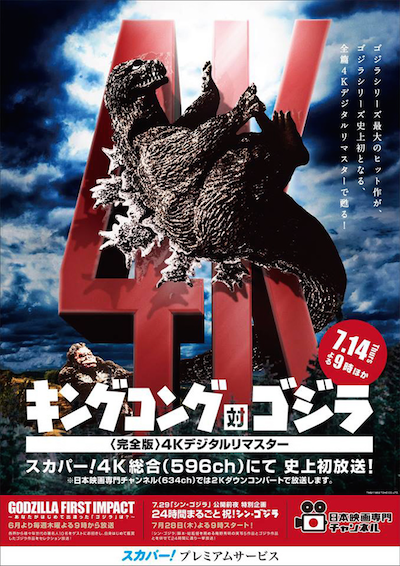
Chirashi (handbill) heralding the premiere broadcast of the 4K Scan!

On October 1st of 2015, I reported on the then-upcoming Nihon Eiga Senmon Channel's satellite cable broadcast of a newly-completed and restored version of KING KONG VS. GODZILLA (read more here), which was followed up this past May 1st's breaking story on the 4k remaster of the film, which has been in sore need of a proper restoration for more than forty years (read more here).

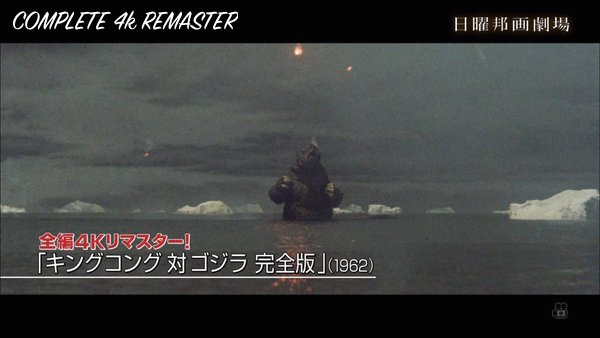
Here are screenshots from a teaser trailer that just began running, comparing the 2015 restoration with the 2016 4k Remaster bowing on the satellite cable provider this coming July. The full teaser trailer was unavailable at press time but will be featured in a future update once it has been uploaded by NESC. For now, there are eight images for you to compare.

KKVSG-02


Stay tuned to this blog for more updates on this story as they break!

Tuesday, October 6, 2015

31 DAYS OF HALLOWEEN: BOB WILKINS LIVES!
"A Free Shrunken Head With Every Purchase!"


Bob with Dan Ferris, proprietor of the Cinema Shop, KTVU-2, 1971.

Northern California's beloved host of KTVU Channel 2's "Creature Features" (not to mention his stints at Sacramento's KRCA-3 and KTXL-40) is being celebrated in my dreadful creepy countdown to Halloween, each and every eerie day this monstrous month, in a sinister series vampiric vintage ads and blood rare photographs...

Bob Wilkins lives!

Read more about Bob Wilkins and "Creature Features", here — and don't forget to visit the official Bob Wilkins website!

Wednesday, October 1, 2014

SCOOP! TOHO DISCOVERS LONG-LOST FOOTAGE!
Japanese Satellite Cable Premieres In November

日本映画専門の『ゴジラ』公開60周年記念「発掘!お宝特撮特集」


Were original 35mm elements for KING KONG VS. GODZILLA found?

While Toho’s Visual Effects films have been run before on the Nihon Eiga Senmon Channel (Japanese Movie Specialty Channel), and this past spring and summer saw a countdown of every Godzilla title on the Satellite Cable station to usher in the domestic release of Gareth Edwards’ GODZILLA (2014), there was more amazing news dropped on their website this past Wednesday morning in Japan, that will be another great cause for kaiju eiga fans across the globe to rejoice.

For "Unearthed! Treasures of Visual Effects Collection," four films will be broadcast during the Big G’s 60th Anniversary — a cross section of Honda and Tsuburaya’s best, which isn't special in of itself, nor the premiere of new HD transfers, but rather that two of the films will be hailed as celebrations in of themselves. One of them, fans have been hoping on for decades, while the other is a completely mind-boggling surprising announcement, which I never saw coming.

There's more BATTLE IN OUTER SPACE? OMG, gag me with a SPIP!

Here’s the biggest news, first: According to the NESC website, some of the lost negative elements for the full-length theatrical version of KING KONG VS. GODZILLA (1962) have recently been discovered and will be restored for this presentation. There is no word on when or where the source elements were found, but this is extremely good news since the missing material was previously culled from a worn, anamorphic 16mm print (no "new" scenes have been found or will be incorporated into the film).

NESC's website stated that while this broadcast will be the premiere of a new, “High Quality” version of KING KONG VS. GODZILLA, it was also announced that the missing footage of this presentation will be non-HD (the NESC stating it's an “up conversion"), so although viewers will see a complete presentation, they're forewarning that it's not a full HD restoration (which is set for a future date). No other details were revealed; just a comment asking fans to be patient.

Meh. This old movie... again!? Who cares!? It's not even in color!

The second big one was dropped in the same announcement and on the same page — and with even less information divulged: Toho has discovered over three minutes of missing footage from BATTLE IN OUTER SPACE (1959), presumably never seen before! NESC’s website is promoting this as the “Long Version” of the film, boasting a running time of 96 minutes (the running time of the previously released DVD versions run 90 minutes and 13 seconds).

Despite what appears to be a discrepancy in running times (which is to be sorted out, I’m sure), this is the discovery that I’m most excited about, as I absolutely am bonkers for this film. As a kid, it delivered everything the other space pictures promised, but didn’t (or couldn’t deliver on), and in “flaming color and Tohoscope” to boot! Sure, it might not contain any visual effects footage, and it could be just some dialogue scenes, or some exposition that won’t change our lives, but I could care less — I can’t wait!

The Amazing Colossal Frankie swings in his first HD transfer!

Also running will be the US version of GODZILLA, KING OF THE MONSTERS (1956), originally released theatrically in Japan in a faux “cinemascope” by masking the top and bottom of the 35mm frame. This HD transfer will be the first broadcast ever on television. Also making its HD premiere will be the original theatrical version of FRANKENSTEIN VS. BARAGON (1965), aka FRANKENSTEIN CONQUERS THE WORLD, sans the Giant Octopus shot for the export versions.

All of the films will be aired on the same day, November 24th (sans the original GODZILLA running on November 3rd and November 24th), for one broadcast only! Those with friends in Japan will probably be pressing them for copies of these broadcasts — a great year to be a fan of these films just got better — you can bet that I’ll be looking forward to seeing them as soon as I can!

An important clarification on KING KONG VS. GODZILLA:

There is no "new footage" and there are no "new scenes" being added into the film. If you have seen the Japanese version, then you've seen everything. What was found, were the 35mm source elements, which had previously been considered "lost" after the film was shortened for Toho Champion Festival screenings in the '70s. These missing scenes were replaced (for all subsequent Toho Video releases since the '80s) using a 16mm anamorphic print, and the jump in quality was jarring. So, while the there isn't going to be anything "new", it's going to look a lot better.

(Special thanks to Kevin Pyrtle for keeping me on my toes!)

Saturday, February 12, 2011

キングコング対ゴジラ
KING KONG VS. GODZILLA (1962)


Eiji Tsuburaya (center, right) checks out Shoichi Hirose's suit-fitting.

KING KONG VS. GODZILLA
Kingu Kongu tai Gojira (Toho, 1962), 98 minutes
Director ISHIRO HONDA • Visual Effects Director EIJI TSUBURAYA

One of the most misunderstood and maligned films in the Godzilla series; KING KONG VS GODZILLA had a most bizarre and unfortunate genesis. But, that's Hollywood for you...

In the late 1950s, visual effects master Willis O'Brien (King Kong) found no luck in pitching his latest idea, "King Kong vs. Frankenstein", to studios, but it did catch the attention of former Universal producer John Beck. Beck took on the project, but also found it tough going until he came to Toho Studios, who were interested in a return vehicle for Godzilla (and another spectacle for their 30th Anniversary roster, which included Hiroshi Inagaki's Chushingura).

Beck was able to convince Toho to foot the entire licensing fees for King Kong, which amounted to 80 million yen (approximately $250,000 USD in 1962; adjusted to current inflation, approximately $1.8 million USD), which was three times the cost of the average Toho production at the time — this hefty price tag allowed Toho the rights to the character for five years.

Almost immediately, the studio execs began slashing the film’s budget, and one of the first things cut were Producer Tomoyuki Tanaka’s plans to shoot the Farou Island scenes on location in Sri Lanka (instead, they shot the scenes on Oshima Island, 62 miles offshore from Tokyo).

Keeping the budget restrictions in mind, director Ishiro Honda, visual effects director Eiji Tsuburaya, and scenarist Shinichi Sekizawa envisioned an entertainment picture along the lines of MOTHRA (1961), and screenwriting began in earnest. Cast in the lead was popular actor and comedian, Tadao Takashima (Emperor Meiji and the Russo-Japanese War, 1957), the father of actors Masanobu (Godzilla vs Biollante, 1989) and Masahiro (Godzilla vs Destroyah, 1995).

He was paired with Yu Fujiki (Samurai II: Duel at Ichijoji Temple, 1955), another comic genius, who was the unbilled "Eiko Maru" radio operator in the original GODZILLA — Honda would cast them together again in ATRAGON (1963). Actresses Mie Hama (The Merciless Trap, 1961) and Akiko Wakabayashi (Akiko, 1961) became superstars in their own right, and shared the distinction of becoming "Bond Girls" in YOU ONLY LIVE TWICE (1967). Wakabayashi gave up acting when she was married in 1968, while Hama pressed on, and is still active today.

RODAN's star, Kenji Sahara, plays Hama's inventor boyfriend in a supporting role. Mr. Tako, the greedy Advertising executive, was played by Ichiro Arishima (Young Blood is Burning, 1947), a physical comedian who was beloved by audiences as the "Japanese Chaplin", and was featured in over a hundred popular films and television shows.

The infamous Kong suit was not up to the par of what Toho's effects department could accomplish, especially in light of the rather effective Abominable Snowman in Honda’s HALF HUMAN (1955), due to the budget cutbacks imposed because of the high fees in securing the rights to the character. Even so, two suits were constructed, as well as several puppets — apparently, Tsuburaya wanted this incarnation of Kong to appear comical.

On the other hand, Godzilla appears more powerful than before, and established the "classic" look of the 1960s. While the miniature sets were as elaborate as ever, with mountains and rivers, Tsuburaya chose to shoot much the action at normal speed, which doesn't always allow these characters the illusion of mass and size.

Tsuburaya also permitted suit actors Haruo Nakajima and Shoichi Hirose to freely choreograph their fight scenes, and they chose Pro Wrestling, which was extremely popular in Japan at the time, and actually came up with some memorable — if outrageous — fight tactics.

Still, Honda's version is fast, furious, and entertaining as all get-out, and was never intended to be taken as seriously the original GODZILLA. Sekizawa wrote a satire on the rise of rampant commercialization in Japan, also reflected in Yazuo Masumura's GIANTS AND TOYS (1958), which is not apparent in Beck's version, and is neutered beyond reproach.

The unintentionally laughable scenes for the US version were amateurishly shot by the unremarkable actor-turned-director Thomas “Tom” Montgomery (The Many Loves of Dobie Gillis, 1961), and were cut haphazardly into Honda's, thus eliminating wonderful sequences from the original, to make room for Michael Keith (The Man and the Challenge, 1960) as the smug "UN Reporter Eric Carter", Harry Holcombe (Kisses for My President, 1964) as clueless "Dr. Arnold Johnson", and James Yagi (Bridge to the Sun, 1961) as the lost "UN Reporter Yutaka Omura".

All save for Akira Ifukube's Farou Island music, the maestro's thunderous stereo score was jettisoned whole by Beck — only to be replaced by jarring Universal library cues because they sounded less "Oriental" (culled from Creature From the Black Lagoon and Frankenstein Meets the Wolf Man). Apparently, Beck (who produced this version for $15,000 and pre-sold it to Universal-International for $200,000) never understood the film, and didn’t seem to catch on that it was done as a satire.

This was somewhat typical of the mishandling of these films in the early years, and why they are so misunderstood outside of Japan. Ironically, KING KONG VS. GODZILLA became the highest ticket-selling film of the entire Godzilla series in Japan (11.2 million tickets), while the US version broke summer box office records for Universal-International the following year.

For stealing his idea, O'Brien filed a suit against Beck, but couldn't afford to keep a lawyer to follow through, and sadly passed away before the film was released in the States. In the final outcome, it seems that John Beck was perhaps the most terrible monster of all.


Executive Producer TOMOYUKI TANAKA Screenplay SHINICHI SEKIZAWA Production Design TERUAKI ABE and TAKEO KITA Cinematographer HAJIME KOIZUMI Film Editor REIKO KANEKO Music AKIRA IFUKUBE Special Effects Production Design AKIRA WATANABE Special Effects Photography SADAMASA ARIKAWA Special Effects Director EIJI TSUBURAYA [US Version] Producer JOHN BECK Screenplay BRUCE HOWARD and PAUL MASON Music and Film Editor PETER ZINNER Director THOMAS MONTGOMERY

TADAO TAKASHIMA (Osamu Sakurai) KENJI SAHARA (Kazuo Fujita) YU FUJIKI (Kinsaburo Furue) MIE HAMA (Fumiko Sakurai) AKIKO WAKABAYASHI (Tamiye) JUN TAZAKI (General Masami Shinzo) SENKICHI OMURA (Konno) AKEMI NEGISHI (Faruo Island Dancer) YOSHIO KOSUGI (Faruo Island Chief) and ICHIRO ARISHIMA (Mr. Tako)