"There is so much writing in English on Japanese cinema that can't be accepted at face value — not because the writers are careless, but because the differences in culture and language are just too intricate. When I see August Ragone's name on a piece of writing, it gives me permission to place my faith in it completely. Among Japanese fantasy film historians, he's the best working in English." —Tim Lucas, Video Watchdog

Tuesday, June 18, 2013

ALL-NEW "SOUL OF CHOGOKIN: YAMATO 2199"
Bandai's 3rd Diecast Version Is the Charm!

超合金魂 宇宙戦艦ヤマト2199が今冬発売!


New SOC Yamato 2199 brochure from the 2013 Tokyo Toy Show.

“Chogokin” is a magic word for a generation of children in the 1970s and 1980s, meaning “Ultra Alloy” — derived from the name of the metal used to build the titular super robot in MAZINGER Z (1972-74) — was a line of diecast toys jammed with numerous gimmicks hidden within their metal chassis (each having their own unique approach), igniting the passions of boys across Japan. Launched in 1972 by Popy, the character toy division of Bandai, the line has come to represent a timeless aesthetic, which was revived in 1997, with the launch of the “Soul of Chogokin” line, aimed at Big Boys (yes, we grown-up types).

The Soul of Popynica BPX-01: Space Battleship Yamato from 2001.

Continuing to this day, the SOC line has already introduced two versions of the Space Battleship Yamato — the first being part of the short-lived “Soul of Popynica” line (for vehicles and spacecraft) and code numbered BPX-01, released in 2001, which was an amalgam of Yamato designs based on a consensus of various representations of the ship. Since Yamato refuses to die, Bandai decided to release an additional version, in anticipation of the live action film, and so on November 27, 2010, the SOC GX-57 was issued, based on the classic animated version. Both featured a number of gimmicks, including light, sound effect, and music features.

The Soul of Chogokin GX-57: Space Battleship Yamato from 2010.

Now, with the success of SPACE BATTLESHIP YAMATO: 2199, Bandai is giving the iconic ship another SOC treatment. This time, in order to achieve a more realistic proportion, since the original designs were contradictory, this version employs the same 3D modeling data used for the new animated series (employed on last year’s 1/1000 plastic model kit). Thus, boasting a completely new shape than the previous versions, overcoming problems inherent in realizing the old school 2D design into a 3D product. In this sense, the new SOC is perfect — especially when compared to previous versions.

The all-new Soul of Chogokin: Space Battleship Yamato 2199.

One of the new features of the 2199 version of Yamato is the radical difference of concept in terms of the fighter hanger and hatch. In the new series, in order to accommodate a large compliment of fighters in a limited space, they are stored and deployed from a mechanical ring and palette system. This is faithfully reproduced in the new SOC with attention to minute detail. The ring itself is made of metal, and features the same action as in the anime. Additionally, the exit and re-entry hatch opens, and has a working launch catapult for the Cosmo Falcons.

Detail of the Hanger, Ring System, and Hatch/catapult System.

As with the previous SOC editions, this version also features a range of gimmicks operated by remote control. In terms of playable audio, a wide range of sound effect recordings are used in the new series, and some of the key effects were chosen for solo as well as multiple playback, completing the image of Yamato. In particular, there are two firings of the main guns that can be selected: The positron cannons (Shock Cannons) and the artillery rounds (Type-3 Fusion Shells). When you turn on the main power, the Wave Motion Engine fires up, while the engine nozzle and bridges begin to light up.

Wave Motion and Sub Engine nozzles with animated LED gimmick.

The multi-colored LED light gimmicks, which can be controlled independently, also include the Wave Motion Gun firing sequence with a series of vivid lighting effects, and the signature build-up and firing sound effects. Another important aural element of Yamato is the music. As with previous SOCs, you can play five full cues from the score: 1. “The Yamato Advances”, 2. “Yamato, Into the Vortex”, 3. “Sortie of the Enemy Ships”, 4. “The Yamato Saga Theme”, and 5. “The Black Tigers.”

Improved Wave Motion Gun animated LED firing gimmick.

■ Set Contents
• Space Battleship Yamato
• Removable Stabilizer Wing × 2
• Replacement Rocket Anchor × 2
• Cosmo Zero × 2
• Cosmo Falcon × 4
• Carrier-based aircraft for Ring × 6
• Base Stand with Remote Control

Bow detail with CIC, Bridge, and Captain's Cabin LED lights.

■ Batteries (sold separately)
• AAA battery × 2 (main body)
• AAA battery × 2 (for remote control)

Detail of Smokestack Missile Firing Silo.

■ Product Specifications
Approximate length: 425mm or 17.75" (Space Battleship Yamato)
Materials: ABS plastic, diecast, etc.

SOC Yamato 2199 on display at the 2013 Tokyo Toy Show.

■ MSRP: 27,300 yen (Including 5% tax)
Release Date: Winter 2013

Thursday, June 13, 2013

"YAMATO: 2199 CHAPTER 6" BOWS JUNE 15th!
Blu-ray & DVD Release Follows On July 26th

「宇宙戦艦ヤマト2199」第六章、6月15日上映!


Promo heralding the final two chapters and the television broadcast.

Opening in sixteen Japanese cinemas this weekend (up four from the previous theatrical release), is the highly-anticpated 6th Chapter of the SPACE BATTLESHIP YAMATO: 2199 feature films, REACHED! THE LARGE MAGELLANIC CLOUD (Totatsu! Dai Mageran) — featuring the decisive confrontation at the Rainbow Star Cluster in order for the Yamato to complete her mission. The release of the Blu-ray and DVD will follow on July 26th, while the 7th and final chapter, AND THE SHIP SAILS ON (Soshite Fune-wa Yuku), will follow on August 24th.


The amazing 120-second Chapter 6 trailer with English Subtitles!

Conceived as a remake of the classic 1974 series, known in the US as STAR BLAZERS, the story follows the "Quest for Iscandar" story arc, with a number of changes and additional characters, but entirely grounded in the original look and sound, to great dramatic effect. Where other remakes fail, YAMATO: 2199 soars — going above and beyond the term "remake" — exceeding all expectations and pulling the viewer, both old fan and those discovering Yamato for the first time, right into the drama, action, and top-shelf animation.


Juzo Okita, Captain of the Space Battleship Yamato.

While the story may be familiar to Old Skoolers, Supervising Director Yutaka Izubuchi (RahXephon) has not only gained their respect in keeping the basic designs of the original intact, from characters to ships, but also adding to that universe, making it larger in scope and far richer in depth. All the while retaining key elements and incidents, as a first-generation fan, Izubuchi has made it surprisingly fresh without sullying our memories, and manages to strike all the proper cords — in a truly sincere and non-manipulative way.


General Domel of the Great Gamilas Empire, the Wolf of Space.

Izubuchi truly loves what he calls "First Yamato" and that shines through in every facet of the production, and makes YAMATO: 2199 brilliant — pulling elements from not only the wealth of movies and teleseries, but also from various abandoned story ideas, manga adaptations, novels, and other official Yamato ephemera of the first wave. This allows YAMATO: 2199 to stand on its own foundations — and if I dare say, it's the best science fiction anime in decades. But, as another first-generation fan (before Star Blazers), I'm prejudiced.


What is the mysterious past of Operations Officer Yuki Mori?

Using a business model made popular by GUNDAM UNICORN, YAMATO: 2199 was planned as a 26-episode series, which would be cut into a series of seven feature films, screened for two weeks in select theaters every two months, with respective home video releases following six weeks later (as individual episodes). The series began weekly broadcast this past April on MBS television network affiliates to cultivate a third tier of viewers. This success has helped to fuel the production, giving fans a sense of involvement.


Bandai's new 2199 SOC of the famous space battleship due in winter.

Other platforms promoting the new series has included special online previews and VOD sales. Not only has this contributed to the success, but so has the careful and calculated planning and release of a wide variety of merchandise, including items sold exclusively in theaters — including limited edition Blu-rays and DVDs. Hobby monolith, Bandai, has also followed suit with a series of high-quality model kits, with more on the way, including Bandai's third large-scale diecast and plastic Soul of Chogokin edition of the Yamato coming this winter.


Vol. 6 jacket art by Nobuteru Yuuki featuring Dessler and Celestra.

The home video release of Volume 6 will contain a total of four half-hour episodes (19-22), plus a selection of special features, clocking in at 126 minutes of content for ¥8,190 for the Blu-ray (BCXA-0490, Region-free) and ¥7,140 for the DVD (BCBA-4321, Region 2). The DVD will be presented in 16:9 Anamorphic, Dual Layer, and Dolby Digital Stereo. Conversely, the Blu-ray will be presented in AVCHD, BD50G, 1080p, 16:9 Anamorphic, and Linear PCM Stereo.

Veteran illustrator Naoyuki Kato's exciting first pressing slip cover.

Special Features will include an Audio Commentary with voice actors Akio Otsuka (General Domel), Shinpachi Tsuji (Bem Haidern) and director Izubuchi, a Chapter 4 Digest, Commercial and Promotional Video Collection 2, Theatrical Feature Previews Part 2, and a special insert booklet. Both releases will feature the same jacket art by character designer Nobuteru Yuuki, and a slipcase by legendary Yamato illustrator, Naoyuki Kato. While the DVD contains all of the same extras, only the region-free Blu-ray boasts the most special feature of all: English Subtitles.

Here are the episodes included in Chapter 6/Volume 6:

HERE BE SPOILERS: WARING! WARING! WARING!


Episode 19. THEY'VE COME (彼らは来た): Finally. the Yamato reaches the Large Magellanic Cloud, therein lies their destination: Iscandar. Meanwhile, Lord Dessler of the Great Gamilas Empire plans to block their way, and orders the infamous General Domel to intercept them. But, what secret orders has Dessler bestowed upon Domel?


Episode 20. UNDER THE RAINBOW SUN (七色の陽のもとに): In a treacherous area of the cosmos, known as the Rainbow Star Cluster, the Yamato faces Domel's carrier fleet. In an all-out battle, the Yamato knuckles under the mercy of Domel's clever strategy. In a dire situation, Captain Okita takes a desperate measure...


Episode 21. PLANETARY CONCENTRATION CAMP #17 (第十七収容所惑星): Planet Reputapoda is where the Great Gamilas Empire imprisons its dissidents and prisoners of war. Far away from the homeworld, the institutionalized abuse of prisoners is routine, until the ship of the Inspector General of Gamilas arrives...


Episode 22. HEADING TOWARDS A DISTANT STAR (向かうべき星): The Yamato heads for Iscandar, the Star of Hope. But, it is revealed that it is a binary planet — with Gamilas! So, their destination has taken them right into the center of enemy territory. Calling all hands to battle stations, Captain Okita orders a direct warp to Iscandar...

You can pre-order your copy of YAMATO: 2199 Volume 6, here to visit Amazon Japan (with English language support)! Stay tuned to this blog and the Cosmo DNA website for more news and information on SPACE BATTLESHIP YAMATO: 2199 as they develop — and soon, we'll be off to outer space, on shiny discs of blue!

Friday, June 7, 2013

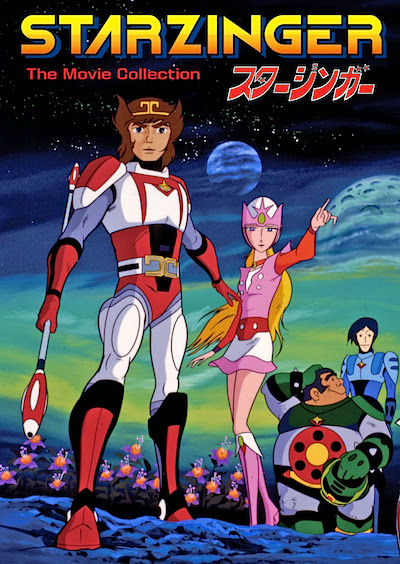
"THE SPACEKEETERS" RETURN IN "STARZINGER"!
Movie Collection from Shout! Factory in August

英語版総集編 『SF西遊記スタージンガー』米国 DVD新発売!


Shout! takes advantage of Toei Animation's classic promotional art.

Following up on their release of the GAKING: The Movie Collection, the champion of the Japanese fantasy film enthusiast, Shout! Factory is preparing to issue another 1970s anime classic, STARZINGER: The Movie Collection, a three-film compilation of the 73-episode series (it's unknown at press time if the last nine episodes, Starzinger II, are included), with English Dubbing commissioned by Toei Animation, written and directed by William Winckler (Tekkaman, The Space Knight).

Created by anime and manga pioneer Leiji Matsumoto, who also penned the classics SPACE PIRATE: CAPTAIN HARLOCK (the subject of an upcoming and highly anticipated CGI feature from Shinji Aramaki) and GALAXY EXPRESS 999, STARZINGER was originally subtitled as "SF Saiyuki," a reference to the Japanese moniker for the 16th Century Chinese long novel, Journey to the West — better known as The Monkey King — which also inspired Akira Toriyama's DRAGON BALL franchise.

In STARZINGER, Matsumoto transposes the narrative of Sun Wukong, along with his companions, protecting the pilgrimage of a buddhist monk, Tripitaka, into the vast cosmic tapestry of infinite space. Broadcast from April 2, 1978 through August 24, 1979, the series was produced to capitalize on the Anime Boom caused by the explosive popularity of SPACE BATTLESHIP YAMATO for which Matsumoto served as a production designer and director, during the very height of his meteoric rise.

The Milky Way is in chaos. Precious Galactic Energy, emanating from the Great Planet, located at the center of our galaxy, grows weak — causing structural anomalies in the very fabric of the cosmos, and mutating lifeforms in its proximity. In order to restore the cosmic balance, Princess Aurora of Earth makes the perilous 30,000 light year journey with her powerful cybernetic bodyguards, Jan Kugo, Sir Djorgo, and Don Hakka. Along the way, they face many trials and encounter evil creatures who jeopardize their mission.

While not widely broadcast during it's original release in North America, some readers may remember the series as THE SPACEKEETERS, one of the titles under the FORCE FIVE banner, a package of five different Toei Animation series syndicated in the '80s by US anime pioneer Jim Terry, later broadcast as feature film compilations on Showtime (which were followed by subsequent VHS releases via Family Home Entertainment).

Because of the failure of similar compilations of the past (namely the aforementioned F.H.E. release), Toei assembled a team of in-house writers, directors, and editors to tackle the problem by allowing all of the story's major story arcs and dilemmas to be spread over three films, instead of one — resulting in a much more satisfying viewing experience. The voice cast includes Paul Oberle (Zombrex: Dead Rising Sun), Kyle Rea (The Mythical Detective Loki), and Chase Masterson (Star Trek: Deep Space Nine) as Queen Lacet.

Shout's DVD-only release contains all three compilation films on two discs, running for a total of 360 minutes (approximately 5½ hours) in 2.0 Stereo. MSRP: $19.93. Street Date: August 20, 2013. Order from Amazon.com or directly from Shout! Factory!


Friday, May 24, 2013

LOST "YAMATO" MUSIC VIDEO SERIES RETURNS! Blu-ray Reissue & New "YAMATO: 2199" Edition

幻の廃盤MV「宇宙戦艦ヤマト」復活!


Blu-ray cover for the reissue of the original 1984 Music Video release.

Music has always been an integral element of the Space Battleship Yamato saga, and while as important as the iconic visual elements, the legendary scores by the renown composer Hiroshi Miyagawa also seem to exist with a complete life of its own. The entire industry of anime soundtracks can be traced back to the phenomenal success of "Symphonic Suite: Yamato," a milestone 1977 album recorded to capitalize on the rising wave of Yamatomania in Japan.

In 1984, with the advent of Home Video, Yamato was not only represented by releases of the popular feature films, but also a handful of specials and music videos. One of these was Nippon Columbia's MV (or Music Video) Series, which set scenes from the feature films to several of their respective "Symphonic Suites," which were issued on the Laserdisc format. These have never since been reissued in any Home Video platform, until now... and on DVD and Blu-ray!


Leiji Matsumoto LP jacket for "Symphonic Suite Yamato" (1977).

MV Series SPACE BATTLESHIP YAMATO is a reproduction of the original release, with the score processed 24bit/96khz from the analog master, similar to the process Columbia employed to remaster the entire Yamato music catalogue for the "Yamato Sound Almanac" series launched in July 2012. According to Columbia's press materials, "While the video steams from the original 1974 broadcast series, this is a BGV (background music video) which will make you feel the rich musical world of Yamato!"

Publisher: Nippon Columbia. CAT: COXC-1063. ASIN: B00CRKLFY6. EAN: 4988001749516. Region Code: A. Single Disc. Running Time: 49 mins. Street Date: 07/24/2013. MSRP: ¥3990.


Blu-ray cover for the all-new Music Video release for YAMATO: 2199.

Dropping on the same day is minute MV Series SPACE BATTLESHIP YAMATO: 2199 featuring Akira Miyagawa's score coupled with scenes from the currently-running remake, as a companion edition to the original. Composer Akira Miyagawa is the son of the late Hiroshi Miyagawa, and for the new series has brought his father's original score back to life in addition to compositions of his own — and is an amazing addition to the Yamato Saga in its own right.

Publisher: Nippon Columbia. CAT: COXC-1062. ASIN: B00CRKLG72. EAN: 4988001749509. Region Code: A. Single Disc. Running Time: 45 mins. Street Date: 07/24/2013. MSRP: ¥3990.

.
CD for SPACE BATTLESHIP YAMATO: 2199 Original Soundtrack Vol. 1.

The epic music tapestry of Yamato is the very epitome of the romanticized space opera — emotional, awe-inspiring, heroic, beautiful, and tocuhing — as vast as the cosmos itself and just as stirring to the soul of any adventurer. Needless to say, I have a deep emotional connection to Yamato and the powerful music of the Miyagawas — dating back to my childhood — so, these are must-buys and highly recommended!

Click the links above to order your copies (DVD versions will also be available, but are not compatible with US players) through Amazon Japan — stay tuned to this blog and the Cosmo DNA website for more news and information on the Yamato Saga as they develop!

Tuesday, May 21, 2013

BEFORE "PACIFIC RIM" THERE WAS "GAIKING"! Movie Collection from Shout! Factory Out Now

英語版『大空魔竜ガイキング』米国 DVD新発売! 


Original 1976 promotional poster for SPACE DRAGON: GAIKING!

Before EVANGELION. Even longer before the announced Gale Anne Hurd production, which I reported on December 18th, there was SPACE DRAGON: GAIKING (Daimakuryu Gaikingu, 1976)! While not widely seen, some readers may remember GAIKING as one of the titles under the banner, FORCE FIVE, a package of five different Toei Animation series syndicated in North America during the '80s, later broadcast as feature film compilations on Showtime (followed by subsequent VHS releases via Family Home Entertainment).

GAIKING was part of an explosion of Super Robot animated series during the '70s (including live-action counterparts such as SUPER ROBOT: RED BARON), which rocket-punched their way into Japanese pop culture with Go Nagai's MAZINGER Z in 1972. While Nagai was the master of the genre, creating such memorable series as UFO ROBO: GRENDIZER (1975), GAIKING became a point of contention between Nagai and Toei Animation, in which Nagai walked. Toei brought in animator Akio Sugino (Cat's Eye) to complete the development of the series.

One of the early, and unique transforming robots — including Tohokushinsha's BRAVE RAIDEEN (1975) — GAIKING begat toys that were able to transform as well, leading to the later advent of THE TRANSFORMERS. The series was also notable for featuring a mobile transport for the robot (also housing three support mecha), its maintenance and relief crews, known as the titular "Space Dragon." This conceit allowed the main cast to travel to different countries across the globe to widen the scope of the action, as well as into interplanetary space.

Threatened with imminent destruction from a black hole, the ruler of the distant planet Zela, plots to invade our world. Emperor Darius assembles the "Black Horror Corps" to defeat any resistance and allow the people of Zela to immigrate to Earth. With his first-string "Combat Force" members assassinated, Professor Daimonji puts together a rag-tag team, led by former Red Suns baseball pitcher, Sanshiro Tsuwabuki to repel the invaders. Tsuwabuki's latent psychic abilities allows him to make a neural connection with the super robot, Gaiking, to protect mankind from the hordes of Black Horror Monsters!

On the eve of PACIFIC RIM, Shout! Factory has released GAIKING: THE MOVIE COLLECTION, a three-film compilation of the 44-episode series, with English Dubbing commissioned by Toei Animation, written and directed by William Winckler (Tekkaman, The Space Knight). Because of the failure of similar compilations of the past, Toei assembled a team of in-house writers, directors, and editors to tackle the problem by allowing all of the story's major story arcs and dilemmas to be spread over three films, instead of one — resulting in a more satisfying, coherent viewing experience.

Shout's DVD-only release contains all three compilation films on two discs, running for a total of 326 minutes (approximately 5½ hours) in 2.0 Stereo (with English Subtitles). MSRP: $19.93. Street Date: May 21, 2013. Order from Amazon.com or directly from Shout! Factory!

Thursday, May 16, 2013

THE REAL ASTROPHYSICS OF "YAMATO: 2199"
University Professor Becomes Scientific Advisor

平成「ヤマト」リアル追求…大学教授が科学考証


"Taking Off 2.0" by Nobuteru Yuuki. ©SBY2199 Production Committee

With SPACE BATTLESHIP YAMATO: 2199 now airing on television in Japan (Sundays at 5:00 pm on TBS), a remake of the 1974 original, some viewers may not be aware that a professor from the Faculty of Science at Kagoshima University is also serving as the Scientific Advisor on the new series.


Professor Toshihiro Handa of Kagoshima University.

Specializing in Radio Astronomy, 54-year old Professor Toshihiro Handa grew up watching YAMATO while he was a Middle School student. “I’m very honored to be involved, since this anime series sparked my interest in astronomy,” he stated.


The Faculty of Science at Kagoshima University, Kyushu.

Since it first aired in 1974, SPACE BATTLESHIP YAMATO has garnered many deeply rooted fans. Like the original, the setting in this remake is the mysterious intergalactic nation of “Gamilas” polluting the Earth in attacks, leading to a fateful crisis in the year 2199.


The planet Gamilas, the center of the Great Gamilas Empire.

With total annihilation looming, Susumu Kodai, an officer in the UN Cosmo Force, boards the Yamato to find the planet “Iscandar” to retrieve a purification system to regenerate the Earth. The new series bowed in theaters and home video in 2012, and on television this past April, 33 years after the original.


The planet Iscandar, located 168,000 Light Years from Earth.

So, how did Professor Handa become involved in this new series? In 2008, the production committee approached National Astronomical Observatory of Japan, looking for “an individual who will enjoy helping us with sorting out facts,” and singled out Professor Handa, who was well known among his peers as an “anime lover.”


The colossal storm on the southern pole of Saturn from Episode 4.

Since then, he has engaged in numerous discussions concerning everything ranging from the visual design and animation with the animation staff, including supervising director Yutaka Izubuchi, in a myriad of topics such as “What would be the position of certain planetary bodies on January 1, 2199?” to “how would the Great Magellanic Galaxy appear when exiting the Milky Way?” Professor Handa would also reflect upon the celestial bodies rendered in CG, and lecture the staff on their relationships, as well as outline other scientific principals.


Looking back at the Milky Way Galaxy from Episode 14.

As an enthusiastic SPACE BATTLESHIP YAMATO fan, Professor Handa also knows that there has to be some artistic license, “If we adhere strictly to scientific principals, it will disrupt the narrative and world within it, so we need to be flexible in adapting this anime to some extent. However, the point of view from an astronomical standpoint is far more accurate and realistic than in the previous (1974) production.”

The Small Magellanic Cloud as seen in Episode 11.

Based on Professor Handa’s involvement, outdated astronomical terminology and designations used in the original series have been updated to reflect currently accepted standards, such as “Large Magellanic Galaxy” opposed to “Great Magellanic Cloud”, as well as terms concerning our own Galaxy, the Milky Way. Also, the original distance from the Earth to Iscandar was adjusted from 148,000 Light Years to 168,000 Light Years on the basis of new theories concerning the distance of the Magellanic Galaxy.


Detail of the Wave Motion Engine Systems Manual from Episode 3.

Another example of Professor Handa’s cooperation include even minor details, for example, the technical language and nomenclature seen in the operations manual for the Wave Motion Engine, even if on screen for mere seconds. Since there’s quite a distance between them, the Production Committee and the Professor, they stay in close communication via e-mail, including sending materials such as storyboards, and the staff’s concerns concerning scientific problems and principals. And every time he sees the finished work, “I can’t help but be impressed at their continued ingenuity.”


A beautiful, but dangerous Neutron Star featured in Episode 15.

As Professor Handa left Middle School for High School, YAMATO was the vehicle that opened up the cosmos to him, and prompted him in his longing to explore this unknown world. In closing, he said with hope, “Like myself, I would be pleased if this new series would inspire young people’s interest in astronomy and space.”

Written by Kei Mine
Originally published by Yomiuri Online
May 11, 2013
Translated by August Ragone

Stay tuned to this blog and the Cosmo DNA website for more news and information on SPACE BATTLESHIP YAMATO: 2199 as they develop!

Sunday, May 12, 2013

UPDATE ON "ULTRA Q: THE COMPLETE SERIES"!
Specs for Shout! Factory's Upcoming Release


Iconic opening title animation will remain in beautiful B&W!

With the release of the news of Shout! Factory's impending release of ULTRA Q (see previous blog entry), there has been wild speculation on internet concerning the contents of this forthcoming set — since the series was remastered for HD 1080p and colorized for the domestic Japanese Blu-ray release by US-based Legend Films (who handled the colorization work on Ray Harryhausen's B&W classics) — since Shout! Factory's page for listed this title as being "color."


Ziggy Namegon and the Mollusks from Mars are slimier in B&W!

Now, the the truth can be told; according to Shout! Factory's VP of Acquisitions and Production, who spearheaded licensing the rights to ULTRA Q and ULTRA SEVEN, "I've seen it on (the check) discs; (our release will be) in B&W." So, there you have it; this release of ULTRA Q will be in it's original chiaroscuro color format, which made it so atmospheric — therefore, we can assume that the aforementioned colorized version will not be included in this release.


Yuriko and Jun, can't believe their ears — it's in Japanese!

Also, since there were no other details on neither the Shout! or Amazon listings, rumors began swirling that perhaps the "lost" English language tracks produced back by Film House Inc. in Toronto, back in 1966, might also be included — since they were unearthed as a result of the research on my book a few years ago. Cliff's reply was short and to the point: "(This release) is in Japanese with English subs."


Garamon is a-gog that he's finally going to be discovered in the US!

Containing all 28 B&W episodes on six discs (with a total running time of 690 minutes), the street date for ULTRA Q: THE COMPLETE SERIES is August 13, 2013 with an MSRP of $59.97. Format: NTSC. Region Encoding: Region 1. Includes extensive on-screen liner notes by Yours Truly on the development and production of the series. You can pre-order from Shout! Factory or Amazon, today!

Friday, May 10, 2013

SHOUT! FACTORY UNLEASHES "ULTRA Q"!
Seminal Sci-Fi Series on US DVD August 13th

伝説の特撮番組『ウルトラQ』は米国DVDで登場!


Shout! Factory's package design for the forthcoming DVD release.

THE TRUTH CAN FINALLY BE TOLD... ULTRA Q is coming to DVD in the US from on August 13th! Eiji Tsuburaya's seminal 1966 science fantasy series, which spurred the creation of ULTRAMAN, is finally receiving its long-overdue release in North America, thanks to Cliff MacMillan of Shout! Factory, who has pushed through releases of the original GAMERA film series, neglected movies such as MESSAGE FROM SPACE, and tokusatsu teleseries, including ULTRA SEVEN and JOHNNY SOKKO. Details as to the contents of this release have yet to be officially announced, but I was contracted to provide content for their momentous home video releases of ULTRA Q and ULTRA SEVEN back in 2011.

So, for those unfamiliar with ULTRA Q, here's what I wrote for the DVD package copy:

“For the next 30 minutes, your eyes will leave your body and arrive in this strange moment in time…” In the world of ULTRA Q, the very fabric of nature is warped into a state of unbalance, and all manner of strange phenomenon and unearthly creatures threaten the very future of mankind! On the scene are a world-renowned scientist and his young friends — a female photojournalist, an aviator, and his co-pilot — who investigate these supernatural menaces. When sheer military might is futile, the intrepid team comes to the rescue, armed solely with their ingenuity and scientific prowess, to quell these malevolent forces and restore the balance of nature.

The precursor to ULTRAMAN, ULTRA Q is a seminal science-fantasy television series in the monstrous mold of THE OUTER LIMITS and THE X FILES. As deeply ingrained in Japan’s pop culture as THE TWILIGHT ZONE is in America’s, ULTRA Q is available for the first time ever in its entirety on DVD! Eiji Tsuburaya, the visual effects wizard behind GODZILLA, RODAN, and MOTHRA, creates a spectacular cavalcade of bizarre beasts and mass mayhem in each and every episode of this wildly popular series. Never before broadcast in North America, ULTRA Q stars Kenji Sahara (RODAN), Hiroko Sakurai (ULTRAMAN) and Yasuhiko Saijo (SON OF GODZILLA).

As with previous Japanese releases from Shout!, I wrote extensive liner notes on the making of the series, which will *not* be in a booklet this time, but rather on one of the actual discs, itself (which you scroll through to read). This essay contains numerous facts about the development, production, and even the lost English Dubbing, never before published in English! But, it's the fans who make these things happen — so please support these releases from Shout! — because, if you don't support them with your dollars, those "Bean Counters" in the front office will be led to believe there's no market in the US for these films and television series! So, order "ULTRA Q: The Complete Series" today!

Stay tuned for more information as it is cleared for release!

• Pre-order ULTRA Q from Shout! Factory 
• Pre-order ULTRA Q from Amazon

Wednesday, May 1, 2013

"MOTHRA" OVER FRISCO BAY ON MOTHER'S DAY!
Ishiro Honda's Classic Screening on May 12th

見よ、『モスラ』サンフランシスコ湾に現わる!


Original Japanese release poster for MOTHRA ('natch)! ©Toho, 1961

IMAGINE A MONSTER SO HUGE IT BLACKENED THE SKY! Join me as I host "Thrillville Theater" on Sunday, May 12th at The New Parkway in Oakland for a special screening of the uncut Japanese version of Ishiro Honda's 1961 spectacle, MOTHRA (w/English Subtitles)! I will blab about the film, share rare, behind-the-scenes images, and more! SEE! Eiji Tsuburaya's momentous miniature work as the featured creature smashes all in it's wake for the sake of the tiniest women in all creation! PLUS: Everyone attending will receive special Mothra door prizes (while supplies last) and Kimono My House will be on hand with a megaton of Mothra and Kaiju merchandize for sale! There will be only one screening, starting at 6:00 pm, so don't miss this night of food, beer, wine, couches, and MOTHRA at The New Parkway, 474 24th Street (near Telegraph), Oakland, California! Admission is only $6.00 (cheap) — order advance tix online from Brown Paper Tickets!

(Mothballs not included.)

Check in over at our Facebook Event Invite page!

Saturday, April 6, 2013

2013 IS 1973: "ULTRAMAN TARO"
April 6, 1973 - April 5, 1974

ウルトラの父、ウルトラの母もみまもる!


Promotional poster for Panasonic's original DVD release from 2005.

ULTRAMAN TARO was not only the fourth sequel to the original ULTRAMAN (1966), but also was the third of three visual effects series produced in celebration of the 10th Anniversary of Tsuburaya Productions in 1973, and features the 6th member of what was to become the "Ultra Brothers." An elite membership of the Galactic Guard, the Ultra Brothers are each assigned different planets to watch over and protect throughout the cosmos — and our planet is no exception.

In this series, the Mother of Ultra creates Ultraman Taro, from the combined power of the Ultra Brothers and the lifeforce of Kotaro Higashi (Saburo Shinoda) — creating a hybrid being to defend the Earth against the strongest monsters ever seen. The most radical departure in the second wave of Ultra Series, starting with RETURN OF ULTRAMAN (1971), ULTRAMAN TARO was not only the most fantastical and outrageous in writing and execution (almost to the level of parody), but was also the most shockingly violent.

Underlining this were the outlandish monster designs and an off-kilter music score by Masanobu Higarashi (Silver Mask). TARO also flipped the Ultra Series on its ear with revealing the up-to-then-mysertious "Land of Light," their homeworld in the M78 Nebula, giving viewers a peek into a rather disappointing civilization (elevated in the manga by Mamoru Uchiyama). For all of it's eccentricities, TARO was the highest-rated series of the '70s, and remains one of the most popular characters in the "Ultra Family."

Thursday, April 4, 2013

2013 IS 1973: WHITE LION MASK『白獅子仮面』
April 4, 1973 - June 7, 1973

スカッと参上 白獅子仮面!


Riding in to save the day, it's not the Lone Ranger, that's for sure!

Set during the Kyoho Period of the Edo Era (1716-1735), the city of Edo (now Tokyo) is under the terror of Okami Kamen (Wolf Mask). Town Magistrate, Echisen Ooka, send his top man in the Kage Yoriki (Shadow Police), Hyoma Tsurugi (Kyotaka Mitsugi), to investigate. He unveils the evil pulling the strings of a Yokai army, Kaen Daimaoh (Infernal Devil), but is mortally wounded by the creature. Suddenly, another apparition appears, Shiro Jishi Kamen (White Lion Mask), who spares his life — and now Tsurugi must fight as the human form of this agent of righteousness to preserve justice!

Following on the hooves of P-Productions' THE VIGILANT LION MARU and Toei's TRANSFORMING NINJA ARASHI, WHITE LION MASK (Shiro Jishi Kamen) failed to find it's audience, running for a scant 13 episodes. For decades afterwards, the series all but disappeared from Japanese television and was never issued on Home Video (due to convoluted rights issues between various parties involved in the production). Then, in 2003, the rights were finally cleared and the short-lived series was finally issued on DVD, which is now, sadly, out of print.

Tuesday, April 2, 2013

2013 IS 1973: ZONE, THE SHOOTING STAR MAN
April 2, 1973 - September 24, 1973

ゾーンファイト・ パワー!


Eye-bleeding cover of a ZONE children's book (Shogakukan, 1973).

During the height of the Henshin Boom of the early 1970s, every network wanted their own superhero television series, and a number of studios were busy offering them proposals. One of the more conservative was Toho Co., Ltd., who had produced the popular RAINBOWMAN, THE WARRIOR OF PIETY the previous year, they also planned to capitalize on the phenomenon with the conception of GODZILLA VS. MEGALON (1973), which opened in cinemas on March 17th — featuring the very superheroic sidekick, Jet Jaguar.

Hot on it's heels, Toho and Mannensha Co. Ltd. unleashed ZONE, THE SHOOTING STAR MAN (shortened to ZONE FIGHTER for overseas sales) for the NTV (Nippon Television) network, with feature film monsters Godzilla, King Ghidorah, and Gigan appearing as guest stars (the Big G appears in five episodes). For 26 colorful and exciting episodes, Zone Fighter and his siblings sally forth against the vile alien forces of Garoga to protect their adopted home from destruction and bring peace to all mankind — with the help of Godzilla, of course!