DRACULA HAS RISEN FROM THE GRAVE (1968)
Friday, October 31, 2008
Monday, October 20, 2008
Thursday, October 2, 2008
Monster of the Month
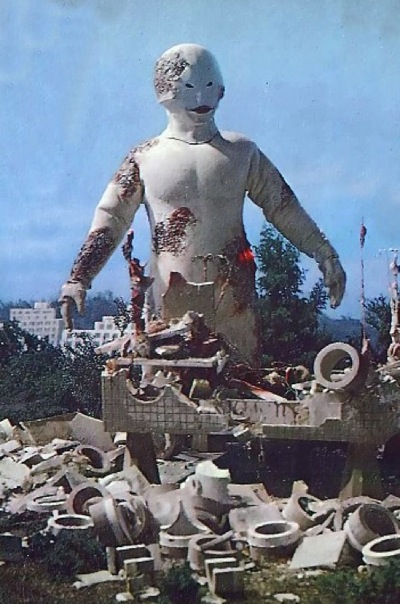
Drill Devil-Beast: DORILLING
ドリル魔獣ドリリング 「サンダーマスク」より

©Toyo Agency/Hiromi Productions
Height: 56 meters • Weight: 4,200 metric tonnes • Origin: Japan Alps • Original Appearance: THUNDER MASK (1972-73) Episode 9 “Bore Through the Earth!" • Design: Makiho Narita • Fabricator: Ekisu Productions
Bemking, the self-proclaimed "Ruler of the Universe," created this cybernetic colossus at his base on the surface of the Moon. Activated in the Japan Alps, Dorilling's mission is to bore massive tunnels to collapse major urban centers and plunge the human order into chaos. The monster's razor-sharp claws can smash solid rock, his drill trail can be weaponized, and his three 100,000 horse-power, head-mounted drills, can bore through five meters of solid steel in five seconds. These powerful drills can also be launched as guided missiles, which return to its housing after striking. Dorilling's deadly Nitroglycerine-spewing flame thrower, located in his mouth, can easily demolish buildings in a single strike.
Imagined by Makiho Narita, a former illustrator who worked for the "God of Manga," Osamu Tezuka, the artificially-engineered Devil-Beasts featured in THUNDER MASK are some of the weirdest and evocative creatures to ever grace Japanese television. Seriously. Produced during the peak of the "Henshin Boom" of the early 1970s, THUNDER MASK was among sixty superhero shows that aired between 1971 and 1979. This series has never been released on home video, and thus is virtually unknown outside of Japan because of the tangled web of ownership issues between the investors. It's a shame, because cool monsters like Dorilling, with his "Rocket Punch"-like drill missiles, must be seen to be believed.
©Toyo Agency/Hiromi Productions
Height: 56 meters • Weight: 4,200 metric tonnes • Origin: Japan Alps • Original Appearance: THUNDER MASK (1972-73) Episode 9 “Bore Through the Earth!" • Design: Makiho Narita • Fabricator: Ekisu Productions
Bemking, the self-proclaimed "Ruler of the Universe," created this cybernetic colossus at his base on the surface of the Moon. Activated in the Japan Alps, Dorilling's mission is to bore massive tunnels to collapse major urban centers and plunge the human order into chaos. The monster's razor-sharp claws can smash solid rock, his drill trail can be weaponized, and his three 100,000 horse-power, head-mounted drills, can bore through five meters of solid steel in five seconds. These powerful drills can also be launched as guided missiles, which return to its housing after striking. Dorilling's deadly Nitroglycerine-spewing flame thrower, located in his mouth, can easily demolish buildings in a single strike.
Imagined by Makiho Narita, a former illustrator who worked for the "God of Manga," Osamu Tezuka, the artificially-engineered Devil-Beasts featured in THUNDER MASK are some of the weirdest and evocative creatures to ever grace Japanese television. Seriously. Produced during the peak of the "Henshin Boom" of the early 1970s, THUNDER MASK was among sixty superhero shows that aired between 1971 and 1979. This series has never been released on home video, and thus is virtually unknown outside of Japan because of the tangled web of ownership issues between the investors. It's a shame, because cool monsters like Dorilling, with his "Rocket Punch"-like drill missiles, must be seen to be believed.
Wednesday, October 1, 2008
HARPY SHOCKTOBER!
It's time for SHOCK IT TO ME!
One of the things that made Monster Kids happy, back in the day.
It's October. My favorite month of the year—the entire 31 days are Halloween, as far as I'm concerned. I guess you know that something is wrong with you when you become visibly excited when your local variety stores have busted out the Halloween decorations... I guess that I've loved Halloween all of my life. Back when I was a wee little monster, there was a much bigger deal made about Halloween But, it seemed to lose something into adulthood. Or was it just me?
When I was growing up, kids went to school in costumes and hundreds of us went Trick-or-Treating; there were horror films and monster movies on all of the local stations and movie theaters (even more than usual in those days), and boy, did I love monster movies. I still do. Monsters were anti-social malcontents that I could live through—because they could express themselves with careless abandon and blatant disregard for societal order—it's no wonder children naturally gravitate towards them—we loved them!
During October, I would put on my own Halloween Parties in our garage, decking it out with dummies adorned with monster masks. I was also very lucky that my mother allowed me to decorate the spare room in our flat with all of the monster stuff I owned—including my collection of Famous Monsters of Filmland and The Monster Times and Aurora model kits—which also doubled as my own private screening room, where I ran those Super 8mm digests of feature films, such as THE VAMPIRE AND THE BALLERINA, all year round.
By the late 1980s, our local horror hosts vanished from the airwaves; and by the 1990s, even local movie theaters stopped booking horror movie marathons at Halloween. I guess that I lost the Halloween Spirit during that decade, and moved on to other interests—becoming a music and events producer (and also concentrated on writing about Japanese Fantasy Films). But, the spectre of "Creature Features" was always creeping in the dark recesses of my mind.
After programming "Godzillafest" in 2004—a big 50th Anniversary celebration of Japanese Monsters—I knocked around the idea of staging an all-day classic horror movie marathon in San Francisco with fellow kook, Michael Monahan (aka "Doktor Goulfinger"). While there were others doing Halloween-themed events across the Bay (most notably, Will "The Thrill" Vaharo's "Thrillville" at the Parkway Theatre in Oakland), San Francisco had nothing.
Armed with our proposal, we approached another lifelong monster kid, Bill Longen, Events Producer at the Castro Theatre. A former film editor at KTVU-2, Bill (who worked on "Creature Features" and ran "Trailers on Tape"), thought that we were nuts—and thus the SHOCK IT TO ME! Classic Horror Film Festival was born. Now, running 8mm reels for the neighborhood kids, has mutated into screening 35mm prints for everyone who loves monster movies! Four years later, Halloween seems much blighter.
So, we hope that you'll join us for SHOCK IT TO ME! on October 17th and 18th... We'll be lurking for you!
Monday, September 1, 2008
MONSTER OF THE MONTH Keloid Alien: S'PELL
被爆星人スペル星人 「ウルトラセブン」より

©Tsuburaya Productions
Height: 1.7-40 meters • Weight: 160 kilograms-1,500 metric tonnes • Origin: Planet S'pell • Original Appearance: ULTRA SEVEN (1967-68) Episode 12 “From Another World With Love" • Suit Actor: Seikichi Nakamura • Voice Actor: Isao Yasu • Design: Tohru Narita • Fabricator: Ryosaku Takayama
Exposed to intense radiation from an experimental "S'pellium Bomb," these mutated keloid beings sent an expedition to Earth to find a cure. The S'pell agents developed a device, disguised as a wrist watch, which absorbs the wearer's blood supply into concentrated crystals—and they soon discovered that the most pure blood was that of human children. When their plans were uncovered by the Ultra Garrison, one of the extraterrestrials transformed into a colossus that could emit a high-intensity heat ray from its eyes (powerful enough to kill 10,000 men), and fly at speeds up to Mach 20.
After it's initial broadcast, this episode was put on a self-imposed ban due to controversy arising from labeling this creature "Hibaku Seijin" (A-Bomb Survivor Alien)—from "Hibakusha", a term referring to the A-Bomb Survivors of Hiroshima and Nagasaki. The term was coined by Shoji Otomo, a writer working feelance for Tsuburaya Productions and Akita Shoten publishing, first appearing in a 1968 pictorial in Bokura magazine. In 1970, a teenager stumbled across the term on a monster card that came in her younger brother's copy of Shogakukan's Grammar School: Second Year, and alerted her father, who was a member of the Tokyo Federation of A-Bomb Sufferers Organizations.
Even though the term "Hibaku Seijin" was changed to "Kyuketsu Seijin" (Vampire Alien), an article featured in the Asahi Shimbun newspaper turned public opinion against Tsuburaya Productions, and the episode and the alien were then banished from all subsequent publications, broadcasts and home video releases. Ironically, an English-dubbed version of the episode was broadcast in Hawaii in the mid-1970s on Honolulu's KHON-2, and was later aired on the Atlanta-based TNT cable network in 1997 (as "Crystallized Corpuscles"). In 2000, the rights to the TNT version reverted back to Tsuburaya Productions, and so it is doubtful that Alien S'pell will ever see the light of day again.

©Tsuburaya Productions
Height: 1.7-40 meters • Weight: 160 kilograms-1,500 metric tonnes • Origin: Planet S'pell • Original Appearance: ULTRA SEVEN (1967-68) Episode 12 “From Another World With Love" • Suit Actor: Seikichi Nakamura • Voice Actor: Isao Yasu • Design: Tohru Narita • Fabricator: Ryosaku Takayama
Exposed to intense radiation from an experimental "S'pellium Bomb," these mutated keloid beings sent an expedition to Earth to find a cure. The S'pell agents developed a device, disguised as a wrist watch, which absorbs the wearer's blood supply into concentrated crystals—and they soon discovered that the most pure blood was that of human children. When their plans were uncovered by the Ultra Garrison, one of the extraterrestrials transformed into a colossus that could emit a high-intensity heat ray from its eyes (powerful enough to kill 10,000 men), and fly at speeds up to Mach 20.
After it's initial broadcast, this episode was put on a self-imposed ban due to controversy arising from labeling this creature "Hibaku Seijin" (A-Bomb Survivor Alien)—from "Hibakusha", a term referring to the A-Bomb Survivors of Hiroshima and Nagasaki. The term was coined by Shoji Otomo, a writer working feelance for Tsuburaya Productions and Akita Shoten publishing, first appearing in a 1968 pictorial in Bokura magazine. In 1970, a teenager stumbled across the term on a monster card that came in her younger brother's copy of Shogakukan's Grammar School: Second Year, and alerted her father, who was a member of the Tokyo Federation of A-Bomb Sufferers Organizations.
Even though the term "Hibaku Seijin" was changed to "Kyuketsu Seijin" (Vampire Alien), an article featured in the Asahi Shimbun newspaper turned public opinion against Tsuburaya Productions, and the episode and the alien were then banished from all subsequent publications, broadcasts and home video releases. Ironically, an English-dubbed version of the episode was broadcast in Hawaii in the mid-1970s on Honolulu's KHON-2, and was later aired on the Atlanta-based TNT cable network in 1997 (as "Crystallized Corpuscles"). In 2000, the rights to the TNT version reverted back to Tsuburaya Productions, and so it is doubtful that Alien S'pell will ever see the light of day again.
Tuesday, August 26, 2008
「三大怪獣・地球最大の決戦」
GHIDRAH: THE THREE-HEADED MONSTER (1964)

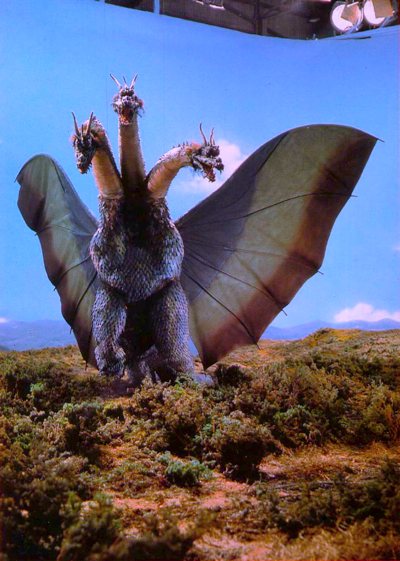
Publicity photoshoot blue color design for King Ghidorah.
GHIDRAH: THE THREE-HEADED MONSTER
San Daikaiju Chikyu Saidai-no Kessen, Toho, 1964, 85 minutes
Director ISHIRO HONDA • Visual Effects Director EIJI TSUBURAYA
"Three Giant Monsters: The Greatest Battle on Earth" (the film's Japanese title) was planned to feature all three of their biggest monster stars, Godzilla, Rodan and Mothra, who would team up to fight a new, and extraterrestrial menace. With the aim to appeal to general audiences, the narrative takes on a fairy tale-style approach, and while it is far more light-hearted than MOTHRA VS. GODZILLA, it rather compliments the Honda-Tsuburaya film that preceded it into theaters, DOGORA: THE SPACE MONSTER (all released the same year), although it features one of the greatest monsters in all cinema.
Shinichi Sekizawa's screenplay is more fantasy-oriented, centering on an Eastern princess (a descendant of aliens) marked for assassination, and written to appeal to a broader audience than the previous films. Honda said to the late Guy Tucker, "When I make a monster film, I never think that it will be for children. I want to imagine and express a story [to a wide audience], but it's always children who are the most interested." While the other monsters are portrayed fairly de rigueur during the most of the film, they suddenly become anthropomorphic, "I don't think that monsters should be comical characters, the audience is more entertained when [the monsters] strike fear in the hearts of the [human] characters." But, despite this, Honda effortlessly sweeps the audience into the story, with assured and swift direction.
Then, there’s the star of the film. Perhaps the most inspired creature the studio ever conceived, King Ghidorah was the idea of scenarist Sekizawa, who only described the monster as having "three heads, two tails, and a metallic roar like a bell." Akira Watanabe, whose sketches combined the mythical Yamata-no-Orochi from Japanese legend and traditional Chinese Dragons, were faithfully brought to life by the prosthetic crew in Toho’s Visual Effects Department, designed the realization of King Ghidorah. According to legend, the triple threat was conceived to be a menacing crimson, while gold was favored by visual effects director, Eiji Tsuburaya. In color publicity photos after the suit was completed, he was painted blue, with red, gold, and blue-striped wings, but it was decided that blue would become problematic with Blue Screen matte process. There've been many conflicting stories concerning this, and no definitive answer, so far. Regardless, the interplanetary invader created such an impact on audiences, that it has since remained one of the most popular monsters ever created by Toho.
Yosuke Natsuki (b.1936), who had just come off of Honda's DOGORA, top-lines the cast as Detective Shindo. A former model, Natsuki, was preened as one of Toho’s new, young leads, and made a number of films in the 1960s. But, he wasn’t a flash-in-the-pan, either, and starred in numerous popular television series, such as G-MEN ’75 (1975-82). Almost twenty years after GHIDRAH, Natsuki returned to the kaiju eiga with Koji Hashimoto’s THE RETURN OF GODZILLA (1984) and more recently in Minoru Kawasaki’s MONSTER X STRIKES BACK: ATTACK THE G-8 SUMMIT (2008) - he also provided the voice of Commander DEUS in ULTRASEVEN X (2007). Still quite active, the veteran actor recently scored important roles in François Rotger’s THE PASSENGER (2005) and Shunichi Nagasaki’s BLACK BELT (2007).
The spunky, and very in-demand, Yuriko Hoshi (WARRING CLANS) stars as Shindo's sister, Naoko, an investigative reporter for a series called "Mysteries of the 20th Century." Ozu regular, Hiroshi Koizumi (DAUGHTERS, WIVES AND A MOTHER), once again plays the scientist, a geologist named "Professor Murai" (both actors seemingly carried over from their similar roles in MOTHRA VS. GODZILLA). The beautiful Akiko Wakabayashi (BANDITS ON THE WIND) plays the unifying character, "Princess Salno," who went on to appear in YOU ONLY LIVE TWICE (1967). Her only starring role was in Luigi Filippo D'Amico’s AKIKO (1961). Originally, the assassin "Malmess" was to be played by actor Yoshio Tsuchiya (FUNERAL PROCESSION OF ROSES), but was held up on the lagging production of Akira Kurosawa's RED BEARD, and was replaced by character actor Hisaya Ito (A WOMAN’S LIFE).
Many of Tsuburaya's visual effects for the picture are thrilling, such as the birth of King Ghidorah, its awesome destruction of Yokohama and Tokyo, and the first battle between Godzilla and Rodan. His work here is as good as seen in MOTHRA VS. GODZILLA - with fantastic long shots of Godzilla and Rodan engaged in mortal combat - until battle reaches the slopes of Mt. Fuji. Here, the scenes between Godzilla and Rodan become static and stagey, oddly juxtaposed with fantastic shots of King Ghidorah’s wonton rampage, until Godzilla, Rodan and Mothra unite to drive off the interloper. The difference is somewhat jarring from the first half of the film, but Tsuburaya believed that this humanizing of the monsters would win over audiences.
Honda said, "I was hesitant to let Mothra act as the mediator... I felt that the monsters... were far too humanized." While the increasing anthropomorphic behavior of the colossi in the last quarter of the film seems to lower the bar that was set with MOTHRA VS. GODZILLA - it still doesn’t lower the entertainment value as a whole. Carried along by Maestro Akira Ifukube's wonderful fairy tale score (including a memorable song from The Peanuts), the visual treats of Tsuburaya, and the magnificence of King Ghidorah, GHIDRAH: THE THREE-HEADED MONSTER (the film's US title), is not only a memorable entry in the series, but also one of the most entertaining films of the kaiju eiga.
Executive Producer TOMOYUKI TANAKA Screenplay SHINICHI SEKIZAWA Production Design TAKEO KITA Cinematography HAJIME KOIZUMI Music AKIRA IFUKUBE Visual Effects Production Design AKIRA WATANABE Visual Effects Photography SADAMASA ARIKAWA [US Version] Additional Music and Sound Effects FILMSCORES INC. English Dialogue JOE BELLUCI Post-production Consultant RAY ANGUS
Starring YOSUKE NATSUKI (Detective Shindo) YURIKO HOSHI (Naoko Shindo) HIROSHI KOIZUMI (Professor Murai) AKIKO WAKABAYASHI (Princess Salno) HISAYA ITO (Malmess) AKIHIKO HIRATA (Chief Detective Okita) THE PEANUTS: EMI and YUMI ITO (The Little Beauties) and TAKASHI SHIMURA (Dr. Tsukamoto)
Monday, August 11, 2008
ETSUKO SHIHOMI: DRAGON PRINCESS
Jump back, Jack, or your skull'll be cracked!
志穂美悦子「若い貴族たち 13階段のマキ」より

Shihomi ready to Nunchaku you! Makoto Naito's THE 13 STEPS (1975)
Thursday, August 7, 2008
「ゴジラ • エビラ • モスラ 南海の大決闘」 GODZILLA VS. THE SEA MONSTER (1966)
Sadamasa Arikawa (center) directing Haruo Nakajima (as Godzilla) and Hiroshi Sekita (as Ebirah).
GODZILLA VS. THE SEA MONSTER
Gojira-Ebira-Mosura Nankai-no Daiketto, 1966, 87 minutes
Director JUN FUKUDA • Visual Effects SADAMASA ARIKAWA • Visual Effects Supervisor EIJI TSUBURAYA
In 1965, there was a big change in the Visual Effects Department at Toho, with contracts ending and Tsuburaya pulling people and resources over to his own effects company, Tsuburaya Productions. Since he was spending so much time at his own studio, Tsuburaya chose his cinematographer, Sadamasa Arikawa, to divide chores as Visual Effects supervisors. Since Honda and Tsuburaya were busy with international co-productions (such as THE WAR OF THE GARGANTUAS), Tanaka handed the next Godzilla project over to popular action film director Jun Fukuda, who previously helmed the sci-fi thriller SECRET OF THE TELEGIAN (1960) and the colorful action-comedy 100 SHOT/100 KILLED (1965).
America's Rankin/Bass Productions, famous for its puppet animated television specials produced in Japan (such as "Rudolph the Red-Nosed Reindeer"), was shopping studios to take on a live-action feature film, based on their KING KONG cartoon series, produced by Toei Animation. The first screenplay, penned by Shinichi Sekizawa ("King Kong vs. Ebirah: Operation Robinson-Crusoe"), was rejected, but as negotiations continued, writers were put to work to submit further treatments which were offered to Rankin/Bass (eventually becoming KING KONG ESCAPES in 1967). While Toho was busy creating new monster films, such as THE WAR OF THE GARGANTUAS, there were no Godzilla projects on the boards for 1966,
The general consensus was that the Godzilla series needed a fresh direction, the relatively new medium of television was also keeping people away from theaters, so Tanaka thought that it was time to go after the teenage market with the same very same formula that made films such as the YOUNG GUY (starring Yuzo Kayama) so popular. There was also a very trendy interest in the exotic tropics, Hawaii and the South Seas, reflected in Japanese pop songs and movies of the early-to-mid-1960s. Tanaka thought that this could be exploited with the rejected screenplay for "King Kong vs. Ebirah," which incorporated these elements perfectly. Tanaka ordered the project into production, substituting Godzilla for King Kong, in a slightly revised screenplay entitled "Godzilla-Ebirah-Mothra: Big Duel in the South Seas."
The cast was top-lined by leading man Akira Takarada, the biggest box-office draw at the studio, playing the is-he-isn't-he master thief, who adds a worldly presence to the mostly youth cast. As the beautiful escapee, 29 year-old Mizuno was a last-minute marquee-value replacement for 19 year-old Starlet Noriko Takahashi (the dancing girl in FRANKENSTEIN CONQUERS THE WORLD), who originally was cast in the part, but fell ill due to acute appendicitis during principal photography. The driving electric guitar and jazz-infused soundtrack was composed by Masaru Sato (YOJIMBO) scoring his second Godzilla film (the first was GODZILLA RAIDS AGAIN in 1955) was quite a departure from Akira Ifukube’s bombastic marches. The lush photography was in the hands of Kazuo Yamada, who shot the majority of Hiroshi Inagaki’s memorable films, including CHUNSHINGURA (1962).
Fukuda approached this as pure escapism, with a fast-paced story that also weaves in Youth Movie elements with James Bondian histrionics — Takarada's hot-headed safecracker, a sinister organization bent on world domination through nuclear proliferation, and a band of teenagers swept up into the action, with whom the target audience could indentify. It is quite apparent that little was revised in the changing of the central monster from Kong to Godzilla, because of the odd Kong-like ticks adopted by Godzilla — his attention directed at a beautiful woman, his battles with a Giant Condor and a Jet Squadron, his boulder-throwing antics, and the rubbing of his nose (ala Kayama's character in the aforementioned YOUNG GUY series). The colorful film is an unusual, but highly enjoyable, adventure — despite its relatively lower budget — and is one of the most underrated of the 1960s entries.
(It's also the only Godzilla film to open with a Go-Go Contest!)
Executive Producer TOMOYUKI TANAKA Screenplay SHINICHI SEKIZAWA Production Design TAKEO KITA Cinematographer KAZUO YAMADA Film Editor RYOHEI FUJII Music MASARU SATO Visual Effects Production Design YOSHIYUKI INOUE Visual Effects Photography SOKEI TOMIOKA and YOICHI MANODA
AKIRA TAKARADA (Yoshimura) KUMI MIZUNO (Dayo) TORU WATANABE (Ryota) TORU IBUKI (Yatta) CHOTARO TOGIN (Ichino) HIDEO TSUNAZUKA (Niita) JUN TAZAKI (Outpost Commander) AKIHIKO HIRATA (Captain Dragonpatch) HISAYA ITO (Nuclear Physicist) HIDEYO AMAMOTO (Ship Captain) CHIEKO NAKAKITA (Kane, Ryota and Yatta's Mother) FUMIKO HONMA (Shinto Medium) IKIO SAWAMURA (Old Infant Islander) and THE BAMBI PAIR (The Little Beauties)
Friday, August 1, 2008
Monster of the Month
Doruge Demon: OKOZERUGE
深海魔人オコゼルゲ 「超人バロム・1」より

©Saito Productions/Toei
Height: 2.2 meters • Weight: 100 kilos • Origin: Japanese Coast • Original Appearance: SUPERHUMAN BAROM-1 (1972) Episode 1 “The Devil’s Envoy: Deepsea Amphibian Okozeruge" • Design: Norio Maezawa • Fabricator: Keizo Murase • Voice Actor: Eiji Maruyama
The first of Doruge’s “Agents of Evil,” created to corrupt and enslave mankind. When infected with the “Dorgue Bacillus,” crossed with the cells of a poisonous Okoze (or Scorpionfish), the hapless Takaichiro Suzaki is transformed into Okozeruge. The monstrous mutant is able to spit a highly toxic liquid from its mouth which kills on contact, as well as infrared eyes allowing it night vision up to 1 km. Physically stronger than any mortal, this Dorugeman's only weakness is — besides Barom-1 — natural sunlight.
SUPERHUMAN BAROM-1 featured some of the most off-the-wall mutant creatures ever, who have recently created waves among Japanese toy collectors around the world, through a line of retro-styled vinyl figures from Rainbow Zoukei Kikaku. While Okozeruge is one of the more bizarre concepts for — ostensibly — a children’s television series, it is typical of the creative latitude prevalent in Japanese productions at the time (although complaints were lodged by the Japan PTA). Outwardly garish, Okozeruge is also suitably nightmarish.
I wouldn’t want to run into him in a dark alley. Would you?
©Saito Productions/Toei
Height: 2.2 meters • Weight: 100 kilos • Origin: Japanese Coast • Original Appearance: SUPERHUMAN BAROM-1 (1972) Episode 1 “The Devil’s Envoy: Deepsea Amphibian Okozeruge" • Design: Norio Maezawa • Fabricator: Keizo Murase • Voice Actor: Eiji Maruyama
The first of Doruge’s “Agents of Evil,” created to corrupt and enslave mankind. When infected with the “Dorgue Bacillus,” crossed with the cells of a poisonous Okoze (or Scorpionfish), the hapless Takaichiro Suzaki is transformed into Okozeruge. The monstrous mutant is able to spit a highly toxic liquid from its mouth which kills on contact, as well as infrared eyes allowing it night vision up to 1 km. Physically stronger than any mortal, this Dorugeman's only weakness is — besides Barom-1 — natural sunlight.
SUPERHUMAN BAROM-1 featured some of the most off-the-wall mutant creatures ever, who have recently created waves among Japanese toy collectors around the world, through a line of retro-styled vinyl figures from Rainbow Zoukei Kikaku. While Okozeruge is one of the more bizarre concepts for — ostensibly — a children’s television series, it is typical of the creative latitude prevalent in Japanese productions at the time (although complaints were lodged by the Japan PTA). Outwardly garish, Okozeruge is also suitably nightmarish.
I wouldn’t want to run into him in a dark alley. Would you?
Wednesday, July 23, 2008
ROCKET TO LA JOLLA!
The San Diego Comic-Con International or Bust!
"Excuse me, Miss... is there booze on this crazy moon flight?"
This weekend, I will be attending the massive and monstrous Comic-Con International aka the San Diego Comic Con, to sign copies of EIJI TSUBURAYA: MASTER OF MONSTERS. This year's event is going to be the biggest in their history with the show sold out in advance for the first time, and record attendance estimated to be in excess of 150,000. So, to paraphrase Charlton Heston in PLANET OF THE APES, "This is a going to be a Madhouse!"
So, where will be you be able to find me in all of the chaos and madness? I will be at the Chronicle Books booth in the Exhibitors Hall (where, if you look from one side of the hall to the other, you can almost see the curvature of the Earth) from 3:30 pm on Saturday July 26th and from 2:00 pm on Sunday July 27th. If you don't already have a copy, we will be selling them throughout the show — if you already have a previously-purchased copy, don't fret, because I'll sign them, too (although that may devalue it). In the Comic-Con Exhibitors Hall, Chronicle Books can be found at Booth #1637.
So, we hope to see you there — stop by and say "hey"!
Friday, July 18, 2008
"EIJI AND THE TALE OF TWO GODZILLAS"
GHIDRAH, THE THREE-HEADED MONSTER (1964)
「三大怪獣・地球最大の決戦」より

Tsuburaya takes a break to pose with a Godzilla costume and prop during the shooting of Seiji Maruyama's RETREAT FROM KISKA (1965).
Wednesday, July 16, 2008
EATING STEAKS WITH GODZILLA!
And Other Great Memories of G-FEST XV
ゴジラは私達が付いているステキを食べた!

Haruo Nakajima entertained us with stories during the private dinner.
Photo: Clawmark Toys
It’s kind of a blur right now. As I get ready to head out to the San Diego Comic Con, memories of G-Fest XV two weeks ago are still swimming in my head. I can’t tell you how much of a great time I had in Chicago — or rather Rosemont — I met some really cool folks, signed a lot of books (we sold out on Saturday morning, and Tom from Clawmark Toys had to buy out another dealer so we could have more to sign!). People were really receptive to my presentations, and it was great to be in on some other sessions, notably having the honor of interviewing Haruo Nakajima on stage — with Brett Homenick and Robert Scott Field — who was really amused by the slides we projected of him on set and in cameo roles. The closing panel celebrating the DESTROY ALL MONSTERS 40th Anniversary on Sunday afternoon was great fun, too — and even special effects wizard Greg Nicotero came to G-Fest as an attendee with his son (a rabid Godzilla fan)!

Danny Tokarz talks with the man they called... Godzilla!
Photo: Armand Vaquer
There were a lot of laughs in hanging out with some folks whom I’ve communicated with for years, but never got the chance to meet in person — above and beyond was Danny Tokarz, who is like my Siamese Twin separated at birth (or as Danny said, “You know, the BASKET CASE Siamese Twin”). Danny and his old buddy, Joey, treated me to some serious Chicago-style pizza (“Not that thick crust shit that the Chicago Tourism Board wants you to believe is Chicago Style!") and some serious baked clams, which were awesome — garlic never tasted so good. Needless to say, those guys killed me, and we were all in hysterics, with everyone constantly being ripped on by former UFC fighter Don Frye (star of GODZILLA FINAL WARS) — and he liked it being dished right back at him, too. Don had me in stitches during the long autograph sessions, and was extremely down-to-earth with no pretense — he ripped on himself, too — and hung out with fans all weekend, holding court in the hotel bar. Over the course of the weekend, all of the guests seemed to be having an awesome time, and so were we.

Danny and Brett share some laughs with Don "Fire Missiles!" Frye.
Photo: Brett Homenick
A fantastic and unexpected capper to the weekend was being invited by the unrivaled Tom and Diane Dougherty of Clawmark Toys to attend a private Sunday night dinner with Haruo Nakajima at a local stake house. In attendance was Mr. Nakajima’s charming daughter, Sonoe, Tom, Diane, Robert Scott Field, G-Fest organizer Brett Homenick, and Silent Charity Auction Winners Chris Eddings and Matt Harris (who were in visible awe at being in Mr. Nakajima’s presence). For three hours we ate, laughed, asked questions and listened to amazing stories, poor Robert was hardly able to eat his steak, as Mr. Nakajima really kept him on his toes (I helped a little, too). I also finally got to ask Mr. Nakajima: Which scene could he be spotted in Kurosawa’s SEVEN SAMURAI? And he related, in great detail, that it was the scene where Kikuchiyo (Toshiro Mifune) and Kyuzo (Seiji Miyaguchi) ambush the three bandit scouts at the tree — Mr. Nakajima was the proverbial monkey in the middle, who is chased and cut down in the panning shot by Kyuzo. Needless to say, it was a great night, and special thanks go out to David Nunes for setting it up.

Signing books in the hotel lobby. Photo: Armand Vaquer
It’s funny; when you travel a long way, you expect to hook up with people and see the sights, or get in contact with local friends of friends, but there just aren't enough hours in the day. I was in the Chicago area for five (the first was mostly crashing out after checking into my room, then stumbling down to the bar and having drinks with Don, Mr. Nakajima and the gang), and it still wasn't enough time. Between my sessions at the event, pressing flesh and signing my books, I hardly left the hotel. I feel bad that I didn't get to meet — or even call — some Chicagoans I had promised to catch up with. I still had a great time in spite of that because of the hospitality of Danny, Joey and Brett (and many others at the show). It was also humbling and touching when kids stopped me to ask me questions, especially when they kept apologizing for taking up my time, to which I replied, “I came here to meet you. So please, ask away!” It all flew by so fast. But, there’s always next year, right? (I didn't even get into Chicago proper until the day after the convention ended, where I had the worst spaghetti, ever. But, that's another story.)

Karlos Borloff meets Godzilla! Photo: Armand Vaquer
A big surprise was getting to meet D.C. area horror host, Karlos Borloff of Monster Madhouse-fame — and he was thrilled to meet Mr. Nakajima (what Monster Kid wouldn't want to meet the man who was Godzilla?) — and I met lots of other great people all weekend. Far too many to mention (you know who you are!). I do have to stop and thank Jay Johnson for breaking the two year hiatus of the annual "Godzilla Blood Party" — that stuff'll kill ya! More thanks and shout outs must also go out to event producer J.D. Lees, his right-hand man Armand Vaquer, the diligent Brett Homenick, the omnipresent Robert Scott Field for the warm welcome, and anyone else I may have left out (including A.V. wizards Andy Steele and Jeff Horne — you, too, Butch! Did you get enough autographs from Mr.Nakajima?) I'm still kind of drained, but I hope that I will be invited back to G-Fest as a guest next year (although I’d still attend as a fan)!
Maybe we'll see you there next year, too?
Haruo Nakajima entertained us with stories during the private dinner.
Photo: Clawmark Toys
It’s kind of a blur right now. As I get ready to head out to the San Diego Comic Con, memories of G-Fest XV two weeks ago are still swimming in my head. I can’t tell you how much of a great time I had in Chicago — or rather Rosemont — I met some really cool folks, signed a lot of books (we sold out on Saturday morning, and Tom from Clawmark Toys had to buy out another dealer so we could have more to sign!). People were really receptive to my presentations, and it was great to be in on some other sessions, notably having the honor of interviewing Haruo Nakajima on stage — with Brett Homenick and Robert Scott Field — who was really amused by the slides we projected of him on set and in cameo roles. The closing panel celebrating the DESTROY ALL MONSTERS 40th Anniversary on Sunday afternoon was great fun, too — and even special effects wizard Greg Nicotero came to G-Fest as an attendee with his son (a rabid Godzilla fan)!
Danny Tokarz talks with the man they called... Godzilla!
Photo: Armand Vaquer
There were a lot of laughs in hanging out with some folks whom I’ve communicated with for years, but never got the chance to meet in person — above and beyond was Danny Tokarz, who is like my Siamese Twin separated at birth (or as Danny said, “You know, the BASKET CASE Siamese Twin”). Danny and his old buddy, Joey, treated me to some serious Chicago-style pizza (“Not that thick crust shit that the Chicago Tourism Board wants you to believe is Chicago Style!") and some serious baked clams, which were awesome — garlic never tasted so good. Needless to say, those guys killed me, and we were all in hysterics, with everyone constantly being ripped on by former UFC fighter Don Frye (star of GODZILLA FINAL WARS) — and he liked it being dished right back at him, too. Don had me in stitches during the long autograph sessions, and was extremely down-to-earth with no pretense — he ripped on himself, too — and hung out with fans all weekend, holding court in the hotel bar. Over the course of the weekend, all of the guests seemed to be having an awesome time, and so were we.
Danny and Brett share some laughs with Don "Fire Missiles!" Frye.
Photo: Brett Homenick
A fantastic and unexpected capper to the weekend was being invited by the unrivaled Tom and Diane Dougherty of Clawmark Toys to attend a private Sunday night dinner with Haruo Nakajima at a local stake house. In attendance was Mr. Nakajima’s charming daughter, Sonoe, Tom, Diane, Robert Scott Field, G-Fest organizer Brett Homenick, and Silent Charity Auction Winners Chris Eddings and Matt Harris (who were in visible awe at being in Mr. Nakajima’s presence). For three hours we ate, laughed, asked questions and listened to amazing stories, poor Robert was hardly able to eat his steak, as Mr. Nakajima really kept him on his toes (I helped a little, too). I also finally got to ask Mr. Nakajima: Which scene could he be spotted in Kurosawa’s SEVEN SAMURAI? And he related, in great detail, that it was the scene where Kikuchiyo (Toshiro Mifune) and Kyuzo (Seiji Miyaguchi) ambush the three bandit scouts at the tree — Mr. Nakajima was the proverbial monkey in the middle, who is chased and cut down in the panning shot by Kyuzo. Needless to say, it was a great night, and special thanks go out to David Nunes for setting it up.
Signing books in the hotel lobby. Photo: Armand Vaquer
It’s funny; when you travel a long way, you expect to hook up with people and see the sights, or get in contact with local friends of friends, but there just aren't enough hours in the day. I was in the Chicago area for five (the first was mostly crashing out after checking into my room, then stumbling down to the bar and having drinks with Don, Mr. Nakajima and the gang), and it still wasn't enough time. Between my sessions at the event, pressing flesh and signing my books, I hardly left the hotel. I feel bad that I didn't get to meet — or even call — some Chicagoans I had promised to catch up with. I still had a great time in spite of that because of the hospitality of Danny, Joey and Brett (and many others at the show). It was also humbling and touching when kids stopped me to ask me questions, especially when they kept apologizing for taking up my time, to which I replied, “I came here to meet you. So please, ask away!” It all flew by so fast. But, there’s always next year, right? (I didn't even get into Chicago proper until the day after the convention ended, where I had the worst spaghetti, ever. But, that's another story.)
Karlos Borloff meets Godzilla! Photo: Armand Vaquer
A big surprise was getting to meet D.C. area horror host, Karlos Borloff of Monster Madhouse-fame — and he was thrilled to meet Mr. Nakajima (what Monster Kid wouldn't want to meet the man who was Godzilla?) — and I met lots of other great people all weekend. Far too many to mention (you know who you are!). I do have to stop and thank Jay Johnson for breaking the two year hiatus of the annual "Godzilla Blood Party" — that stuff'll kill ya! More thanks and shout outs must also go out to event producer J.D. Lees, his right-hand man Armand Vaquer, the diligent Brett Homenick, the omnipresent Robert Scott Field for the warm welcome, and anyone else I may have left out (including A.V. wizards Andy Steele and Jeff Horne — you, too, Butch! Did you get enough autographs from Mr.Nakajima?) I'm still kind of drained, but I hope that I will be invited back to G-Fest as a guest next year (although I’d still attend as a fan)!
Maybe we'll see you there next year, too?
Thursday, July 10, 2008
HAPPY BIRTHDAY, EIJI TSUBURAYA!
July 10, 1901-January 25, 1970
円谷英二への誕生日おめでとう!

Tsuburaya at the official press junket for ULTRAMAN, 1966.
The “Father of Japanese Special Visual Effects” was born on July 10, 1901 as Eiichi Tsuburaya in the town of Sukagawa, Fukushima. As with his life, even his date of birth is steeped in legend — official sources have often listed that Eiji Tsuburaya was born on July 7th — a date of fortune in the celebration of Tanabata (meaning “Seven Evenings”), a Japanese star festival derived from the Obon (a celebration of ancestors). Tanabata is usually celebrated on July 7th or August 7th, to commemorate the meeting of Orihime (Vega) and Hikoboshi (Altair).
Tanabata originated from the Chinese Festival to Plead for Skills (Oi Xi), which came to Japan in the Heian Period (795-1192), and spread to the public during the Edo Period (1603-1867), where it was then combined with Obon traditions. From the Edo Period, girls wished for better sewing and craftsmanship skills, while boys wished for better calligraphy skills, by writing wishes on strips of tanzaku paper, which were hung on bamboo trees. This tradition is still practiced today in Japan.
Even if Eiji Tsuburaya was not born on July 7th, the myth of being born on the Tanabata certainly was apt, because Tsuburaya would become famous for his multiple artistic and practical skills, which he had in spades — and eventually, the name Tsuburaya would become world-renown with the production of GODZILLA (1954).
Tsuburaya at the official press junket for ULTRAMAN, 1966.
The “Father of Japanese Special Visual Effects” was born on July 10, 1901 as Eiichi Tsuburaya in the town of Sukagawa, Fukushima. As with his life, even his date of birth is steeped in legend — official sources have often listed that Eiji Tsuburaya was born on July 7th — a date of fortune in the celebration of Tanabata (meaning “Seven Evenings”), a Japanese star festival derived from the Obon (a celebration of ancestors). Tanabata is usually celebrated on July 7th or August 7th, to commemorate the meeting of Orihime (Vega) and Hikoboshi (Altair).
Tanabata originated from the Chinese Festival to Plead for Skills (Oi Xi), which came to Japan in the Heian Period (795-1192), and spread to the public during the Edo Period (1603-1867), where it was then combined with Obon traditions. From the Edo Period, girls wished for better sewing and craftsmanship skills, while boys wished for better calligraphy skills, by writing wishes on strips of tanzaku paper, which were hung on bamboo trees. This tradition is still practiced today in Japan.
Even if Eiji Tsuburaya was not born on July 7th, the myth of being born on the Tanabata certainly was apt, because Tsuburaya would become famous for his multiple artistic and practical skills, which he had in spades — and eventually, the name Tsuburaya would become world-renown with the production of GODZILLA (1954).
Tuesday, July 8, 2008
"MECHAGODZILLA, DESTROY THEM UTTERLY"
Bandai's Amazing RC-Operated Titan of Terror!
RCメカゴジラがやってきた!

Bandai's amazing RC Mechagodzilla! Photo: CScout Japan
The iconic Mechagodzilla, the bionic double of the King of the Monsters, was created in 1974 for the 20th Anniversary Godzilla film, Jun Fukuda's GODZILLA VS. MECHAGODZILLA, and proved so popular, he was brought back the next year for Ishiro Honda's TERROR OF MECHAGODZILLA. Since then, as a character, Mechagodzilla has endured in popularity for more than three decades, and has been re-envisioned in several more recent Toho films, such as GODZILLA AGAINST MECHAGODZILLA (2002) and GODZILLA: TOKYO SOS (2003). Despite the updates, the first version of the character still captures the imagination of fans everywhere.

"Cross Attack Beam, fire!" Photo: GA Graphics
While the original version of the alien super robot has been rendered in various forms of vinyl, resin, diecast and injection mold plastic, kaiju fans and Japanese toy collectors, alike, thought that they saw the zenith figure of their favorite space titanium-alloy monster issued in spectacular — and ultimate — form as part of Bandai's best-selling "Soul of Chogokin" line a couple of years ago. Released in both 1974 and 1975 versions, this diecast figure was one of the many releases in the popular revival of their "Chogokin" brand (or "Super Alloy," a term coined from Go Nagai and Toei Animation's MAZINGER Z). No one could have imagined that it could get any better. Until now.

"Initiate, Defense Neo-Barrier!" Photo: GA Graphics
At the 2008 Tokyo Toy Show on June 21st and 22nd, produced by the Japan Toy Association, the largest toymaker in Japan, Bandai, previewed a prototype of their latest, and arguably, greatest idea. Ever. Bandai unveiled their upcoming 20" Radio Controlled 1974-type Mechagodzilla! This ultimate in robot toy decadence is radio operated via a remote control box, ala Gigantor, and promises full walking action (forward, reverse, right and left), flashing lights to simulate weapons firing (spinning hands for the Finger Missiles, opening chest plate for Cross Attack Beam, etc.) and defensive capabilities (spinning head to simulate Neo Barrier generation) — replete with corresponding sound effects.

"His power is in your hands!" Photo: GA Graphics
According to the Japanese website, GA Graphics, who were in attendance at the Tokyo Toy Show, the prototype "RC Mechagodzilla 1974" (tentative name) was on display in a glass case at the Bandai booth, and while it demonstrated several of its special features (including lights that flash to simulate missile firing and eyes that change from amber to blue), the walking function was not demoed for either the buyers or the public at the show. With this being a prototype, it is likely that Bandai is still busy working on getting this ultimate toy for big boys ready for its scheduled December release date.
Because of the declining birtrate in Japan, toy manufacturers have been refocusing their marketing squarely at adults with highly detailed items that were previously the realm of the so-called niche "Garage Kit" market, spawned by independent, Cottage Industry manufacturers. One recent example is Bandai's full-scale, and functional, Kamen Rider Henshin Belt, which surpassed all expectations in sales to this new — and growing — demographic.
While manufacturer's suggested retail price was not announced at the Tokyo Toy Show, those interested in picking this badass piece up will have to expect it to be in the triple digits — so start saving your pennies, now. This is truly a toy that is guaranteed to be worth its weight in Space Titanium.
Bandai's amazing RC Mechagodzilla! Photo: CScout Japan
The iconic Mechagodzilla, the bionic double of the King of the Monsters, was created in 1974 for the 20th Anniversary Godzilla film, Jun Fukuda's GODZILLA VS. MECHAGODZILLA, and proved so popular, he was brought back the next year for Ishiro Honda's TERROR OF MECHAGODZILLA. Since then, as a character, Mechagodzilla has endured in popularity for more than three decades, and has been re-envisioned in several more recent Toho films, such as GODZILLA AGAINST MECHAGODZILLA (2002) and GODZILLA: TOKYO SOS (2003). Despite the updates, the first version of the character still captures the imagination of fans everywhere.
"Cross Attack Beam, fire!" Photo: GA Graphics
While the original version of the alien super robot has been rendered in various forms of vinyl, resin, diecast and injection mold plastic, kaiju fans and Japanese toy collectors, alike, thought that they saw the zenith figure of their favorite space titanium-alloy monster issued in spectacular — and ultimate — form as part of Bandai's best-selling "Soul of Chogokin" line a couple of years ago. Released in both 1974 and 1975 versions, this diecast figure was one of the many releases in the popular revival of their "Chogokin" brand (or "Super Alloy," a term coined from Go Nagai and Toei Animation's MAZINGER Z). No one could have imagined that it could get any better. Until now.
"Initiate, Defense Neo-Barrier!" Photo: GA Graphics
At the 2008 Tokyo Toy Show on June 21st and 22nd, produced by the Japan Toy Association, the largest toymaker in Japan, Bandai, previewed a prototype of their latest, and arguably, greatest idea. Ever. Bandai unveiled their upcoming 20" Radio Controlled 1974-type Mechagodzilla! This ultimate in robot toy decadence is radio operated via a remote control box, ala Gigantor, and promises full walking action (forward, reverse, right and left), flashing lights to simulate weapons firing (spinning hands for the Finger Missiles, opening chest plate for Cross Attack Beam, etc.) and defensive capabilities (spinning head to simulate Neo Barrier generation) — replete with corresponding sound effects.
"His power is in your hands!" Photo: GA Graphics
According to the Japanese website, GA Graphics, who were in attendance at the Tokyo Toy Show, the prototype "RC Mechagodzilla 1974" (tentative name) was on display in a glass case at the Bandai booth, and while it demonstrated several of its special features (including lights that flash to simulate missile firing and eyes that change from amber to blue), the walking function was not demoed for either the buyers or the public at the show. With this being a prototype, it is likely that Bandai is still busy working on getting this ultimate toy for big boys ready for its scheduled December release date.
Because of the declining birtrate in Japan, toy manufacturers have been refocusing their marketing squarely at adults with highly detailed items that were previously the realm of the so-called niche "Garage Kit" market, spawned by independent, Cottage Industry manufacturers. One recent example is Bandai's full-scale, and functional, Kamen Rider Henshin Belt, which surpassed all expectations in sales to this new — and growing — demographic.
While manufacturer's suggested retail price was not announced at the Tokyo Toy Show, those interested in picking this badass piece up will have to expect it to be in the triple digits — so start saving your pennies, now. This is truly a toy that is guaranteed to be worth its weight in Space Titanium.
Subscribe to:
Posts (Atom)